Wayground logo

Free Printable Worksheets

Font size

S
M
L
XL
Worksheets

Semester 1 BioChem Revision

Total questions: 40

Worksheet time: 14mins

Name
Class
Date
1.
What does this picture represent? 
a)
solid
b)
liquid 
c)
gas
d)
plasma
2.
When the temperature of matter increases the particles...
a)
speed up and move closer
b)
speed up and move farther apart
c)
slow down and move closer together
d)
slow down and move farther apart
3.
What does this picture represent? 
a)
solid
b)
liquid
c)
gas
d)
plasma
4.
If the tops were removed from the cylinders, the following would happen:
a)
The solid would fly out of the container
b)
The liquid would fly out of the container.
c)
The gas would fly out of the container.
d)
They ALL would fly out of the container.
5.
The molecules in the picture are tightly held together with little movement. They have shape and energy.  Therefore, the picture represents _________.
a)
solid
b)
liquid
c)
gas
d)
plasma
6.
What happens to the particles when I add heat?
a)
The particles get bigger
b)
The particles get smaller
c)
The particles get slower
d)
The particles get faster
7.
My glass of ice water is sitting in the sun and has droplets of water on the outside of the glass. What is happening?
a)
condensation
b)
evaporation
c)
melting
d)
freezing
8.

Solid to gas is called

a)

condensation

b)

evaporation

c)

sublimation

d)

freezing

9.

Liquid to gas is called

a)

condensation

b)

evaporation

c)

freezing

d)

melting

10.

What two changes of state occur when thermal energy is taken away/decreased in a substance?

a)

Freezing

b)

Condensation

c)

Melting

d)

Evaporation

11.
What is the formula for density?
a)
density = mass x volume
b)
density = mass / volume
c)
density = mass + volume
d)
density = mass - volume
12.
Jack has a rock. The rock has a mass of 14g and a volume of 2cm3. What is the density of the rock?
a)
7 mL
b)
7 g/cm3
c)
28 g/cm3
d)
1/7 g/cm3
13.
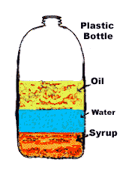
Which liquid is the least dense?
a)
oil
b)
water
c)
syrup 
d)
plastic bottle
14.
Which box has a higher density?  
a)
Box A
b)
Box B
c)
cannot be determined
d)
they are the same
15.
What is the density of water?
a)
0 g/ml
b)
1 g/ml
c)
10 g/ml
d)
100 g/ml
16.
Will an object with a density of 1.01 g/cm3 float or sink?
a)
float
b)
sink
17.
What is the volume of the fish?
a)
18.0 cm3
b)
6.0 cm3 
c)
38.0 cm3
18.
What does every food chain start with? (Even if it's not drawn or written there!)
a)
producers
b)
sun
c)
consumer
d)
decomposers
19.
An organism that needs to eat other organisms to obtain energy is known as a:
a)
Autotroph
b)
Producer
c)
Consumer
d)
Mutualist
20.
What does a food web represent?
a)
All connections of energy flow throughout all organisms in a habitat.
b)
The specific ways that mutualism is carried out.
c)
A single pathway or energy flow between organisms. 
d)
How carnivores get their food. 
21.
The rabbit in this food web would be considered a:
a)
Decomposer
b)
Producer
c)
Secondary Consumer
d)
Primary Consumer
22.
What is the term for each step in the transfer of energy and matter within a biological community?
a)
energy path
b)
food web
c)
trophic level
d)
food pyramid
23.
An illustration that uses arrows to show the MANY possible directions in which matter and energy can pass through the organisms in an ecosystem.
a)
Food chain
b)
Food web
c)
Energy Pyramid
d)
Succession Map
24.
The nonliving aspects of an ecosystem.
a)
Abiotic factors
b)
Biotic factors
25.
The living portions of the ecosystem.
a)
Biotic factors
b)
Abiotic factors
26.
A collection of organisms that make up a community as well as all of the nonliving aspects of the environment.
a)
Population
b)
Community
c)
Habitat
d)
Ecosystem
27.

Decomposers...

a)

Recycle nutrients in the ecosystem.

b)

Provide most of the Earth's energy.

c)

Can be considered producers because they grow in the ground.

d)

Are mostly Abiotic.

28.

Which of these are examples of Commensalism?

a)

Barnacles riding on a whale.

b)

Remora feeding of food scrapes left by a shark.

c)

A tick sucking blood from its host.

29.

A relationship in which both species benefit is called...

a)

Parasitism

b)

Commensalism

c)

Mutualism

30.
The scientific name for an organism is made from the:
a)
class and family name
b)
genus and species name
c)
domain and kingdom name
d)
kingdom and phylum name
31.
Term given to describe the 2 name naming system is:
a)
dichotmous key
b)
binomial nomenclature
c)
2 scientific names
d)
binomial key
32.
What is the most specific level of classification?
a)
Family
b)
Domain
c)
Species
d)
Carolus Linnaeus
33.
A dichotomous key for trees is provided. Hikers found a tree that has large brown cones and single sharp needles. What species of tree have the hikers found?
a)
Juniper
b)
Pine
c)
Spruce
d)
Fir
34.
A student discovers an arachnid with a segmented abdomen, long legs, and a tail with no stinger. The student uses the dichotomous key below to identify it. Which arachnid has the student found?
a)
Whip Scorpion
b)
Wind Scorpion
c)
Daddy long legs
d)
Scorpion
35.
Molds, yeast, and mushroom belong to kingdom:
a)
Eubacteria
b)
Archaebacteria
c)
Protista
d)
Fungi
36.

What are the six kingdoms?

a)

Animalia, Plantae, Protista, Eubacteria, Archaebacteria, Fungi

b)

Protista, Eubacteria, Archaebacteria, Fungi, Mammal, Reptile

c)

Protista, Eubacteria, Archaebacteria, Fungi, Mammal, Amphibian

37.

Which of the following are classes of chordates?

a)

Mammals, mollusk, Reptile, Amphibian, Bony fish

b)

Bony fish, Cnidaria, Amphibian, Mammal, Ave, Sharks

c)

Mammal, Reptile, Amphibian, Bony fish, chondrichthyes and ave

38.

What class of chordate is this animal?

a)

Mammal - marsupial

b)

Mammal - monotream

c)

Mammal - placental

d)

Mammal - fluffy

39.

What class of chordate is the Tiger Quoll?

a)

Mammal - placental

b)

Mammal - marsupial

c)

Mammal - mean

d)

Mammal - monotream

40.

What class of Chordate is this animal?

a)

Mammal - monotream

b)

Mammal - placental

c)

Mammal - spikey

d)

Mammal - marsupial