
 Worksheets
End of Year Challenge (Practice)
Total questions: 70
Worksheet time: 43mins
The Sun revolves around the Earth
The reason that the sun is brighter to us than all of the other stars is that it is......
the biggest star in the universe.
the hottest star in the universe.
the oldest star in the universe.
the closest star to Earth in the universe.
A period of time that is 24 hours long and includes daytime and nighttime
day
explanation
night
seasons
An arrangement of stars as seen from Earth
explanation
sun
stars
constellation
The only star in our solar system
Sun
Polaris
Sirius
Rigel
The length of time it takes for Earth to orbit the sun once
Night
Year
Day
24 Hrs.

The sun is so bright that we can't see other stars during the ________.
daytime
nighttime
winter
summer
Because we are facing different directions at night at different times of the year, we see different ______________.
constellations
moons
planets

The Sun is the biggest star in the sky.
Why do stars appear small in the nighttime sky sky?
because they only give off a little bit of light
because the sun is very big
because objects appear smaller the farther away they are from us
because they are small
Why can't we always see the a lot of stars in the daytime?
because they are too small
because sunlight overwhelms the light given off by stars during the day time
because the sun is too big
because they disappear
Which is the closest star to earth?
Alpheratz
Beta Pegasi
Sun
Algenib

Earth's ________ on its axis causes day and night.
spinning/rotation
revolution
phase
comet

One full orbit of the Earth around the sun is called a
axis
rotation
revolution
satellite
Day and night is caused by the _____________ of earth on its axis.
revolution
orbit
spinning/rotation
A scientist who studies stars, planets, and other objects in the universe
data
astronomer
biologist
geologist
The sun, the planets that orbit the sun, and other objects that orbit the sun
Earth
Galaxy
Stars
Solar System

What causes the yearly pattern of stars that we see?
The Earth orbits around the sun in a counterclockwise path.
The Earth orbits around the sun in a clockwise path.
The Sun orbits around the Earth in a counterclockwise path.
The Earth spins on its axis in a counterclockwise direction.

What do the four parts of the artifact represent?
seasons
years
months
quarters
matter that is made of only one kind of atom or molecule
substance
wastewater
matter
property
what you can observe or measure about something that helps you figure out what it is e.g. size, color, shape, texture, etc.
substance
wastewater
matter
property
water that has been used and now contains harmful substances
substance
wastewater
matter
saltwater
the stuff that things are made of
substance
wastewater
matter
saltwater
wastewater treatment plant
turns saltwater into clean freshwater
turns freshwater into wastewater
treats house plants
turns wastewater into clean freshwater

a process in which substances change into different substances
evaporation
iterate
chemical reaction
condensation

What is the evidence of a chemical reaction when a slice of apple turns brown?
color change
taste change
temperature change
gas is made
light is made

What is evidence of a chemical reaction when fireworks explode (2)?
color change
taste change
temperature change
gas is made
light is made

What is the evidence of a chemical reaction of the statue of liberty turning green?
color change
taste change
temperature change
gas is made
light is made

What is the evidence of a chemical reaction when you mix paint colors?
color change
taste change
temperature change
gas is made
mixing paint is not a chemical reaction

What is the evidence of a chemical reaction when a candle is burning (3).
color change
taste change
temperature change
gas is made
light is made

Why would more rain form over Lake A than Lake B?
The water vapor molecules are moving higher into the atmosphere where it is colder.
The water vapor molecules are moving lower into the atmosphere where it is colder.
The water vapor molecules are moving higher into the atmosphere where it is warmer.
The water vapor molecules are moving lower into the atmosphere where it is colder warmer..
What happens to the atoms that make up the molecules of substances during a chemical reaction?
The atoms get mixed up and combine to make new atoms.
The atoms get mixed up, but the properties of the molecules do not change.
The atoms do not rearrange, the molecules stay the same.
The atoms get mixed up and make new molecules.
What percentage of the Earth is salt water?
28%
59%
97%
100%
Where is most of the surface freshwater located on Earth?
lakes
wetlands
rivers
Where is most of the freshwater on Earth found?
glaciers
rivers
lakes
ground water

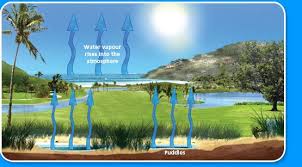
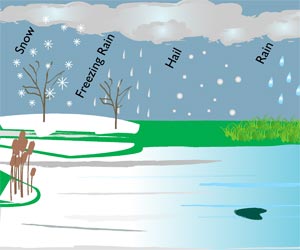

When water changes from a gas to a liquid, it goes through
a. Condensation
b. Evaporation
c. Precipitation

Water droplets forming on the outside of your glass
Evaporation
Condenstation
Precipitation
You notice that the glass of water you left out yesterday is less full, this is due to .....
evaporation
condensation
precipitation

What causes condensation?
When liquid water gets warmer.
When water vapor gets warmer.
When liquid water gets colder..
When water vapor gets colder.
What happens when salt water evaporates?
The liquid water evaporates, but the salt remains.
The salt evaporates, but the liquid water remains.
The water vapor evaporates, but the salt remains.
The salt remains, but the water vapor evaporates
How does the amount of water on Earth change over time?
increases
decreases
remains the same
it depends on how much water people use.
Where does water vapor come from?
any body of water
condensation
precipitation
the three phases of water
Liquid water that falls to Earth as rain
condensation
evaporation
precipitation
atmosphere
What two things are necessary for rain drops to form?
Water vapor in the air and cooling temperatures.
Water vapor in the air and warming temperatures.
Liquid water in the air and cooling temperatures.
Liquid water in the air and warming temperatures.
Where in the atmosphere does water vapor condense into liquid water?
Higher up in the atmosphere because it is colder.
Higher up in the atmosphere because it is warmer.
Lower in the atmosphere because it is colder.
Lower in the atmosphere because it is warmer.
What do water vapor molecules look like at the nanoscale?
Water molecules are spread far apart and are moving more quickly
Water molecules are spread far apart and are moving more slowly.
Water molecules are close together and are moving more quickly.
Water molecules are close together and are moving more slowly.
What do liquid water droplet molecules look like at the nanoscale?
Water molecules are spread far apart and are moving more quickly
Water molecules are spread far apart and are moving more slowly.
Water molecules are closer together and are moving more quickly.
Water molecules are closer together and are moving more slowly.
Almost all the water on Earth is ________.
Saltwater
Freshwater

Water molecules that are spread far apart and moving fast
water vapor (gas)
liquid water
ice
Water molecules that are close together, but can move around each other.
water vapor (gas)
liquid water
ice
Water molecules that are close together, but do not move around each other.
water vapor (gas)
liquid water
ice
all the living and nonliving things in an area
environment
habitat
country
region

a diagram that shows what eats what in an ecosystem
ecosystem
food web
environment
organism
Food molecules in an ecosystem can always be traced back to _________.
plants
matter
predators
organisms
What is matter made out of?
molecules
organisms
plants
animals
Animals grow by ________
changing food molecules into body molecules that can build their bodies
changing body molecules into food molecules that can build their bodies
getting lots of sleep
changing atoms into molecules
What happens to food molecules in an animal's body?
Some are used to make body molecules, AND some are released as energy that helps the animal move and grow.
To make body molecules
To release energy that helps them move and grow
They disappear
True or False
The Sun is the brightest star in the sky.
True
False

