wayground logo

Free Printable Worksheets

Font size

S
M
L
XL
Worksheets

Separation of mixtures / analysing chromatography (year 10)

Total questions: 44

Worksheet time: 31mins

Name
Class
Date
1.
A single part of a mixture or solution is called
a)
Mixture
b)
Substance
c)
Solution
d)
An item
2.
A combination of two or more substances where each keep their own properties
a)
Mixture
b)
Solution
c)
Substance
d)
Solute
3.
To make different without changing what the material is made of such as; cutting, folding,etc.
a)
Filter
b)
Physical State
c)
Physical change
d)
Origami
4.
This tool is used for separating solids from liquids or coarse particles from fine particles
a)
Hands
b)
Sieve
c)
Boiling water
d)
Evaporation
5.
A material that allows liquids to pass through it, while very small solids remain behind
a)
Filter
b)
Sieve
c)
Funnel
d)
Spoon
6.
liquid to a gas; may be used to separate substances in a solution
a)
Precipitation
b)
Condensation
c)
Evaporation
d)
Freezing
7.
What are the two main categories of matter?
a)
Elements & Compounds
b)
Pure Substances & Mixtures
c)
Homogeneous & Heterogeneous
d)
Suspensions & Colloids
8.
The atom is the smallest part of...
a)
An element
b)
A compound
c)
A mixture
9.
An example of a homogeneous mixture is...
a)
Pizza
b)
Granite
c)
Salad Dressing
d)
Salt Water
10.
An example of a heterogeneous mixture is...
a)
Coffee
b)
Kool-Aid
c)
Salad Dressing
d)
Salt Water
11.
The six most abundant elements of of life are...
a)
Carbon, Helium, Nitrogen, Oxygen, Phosphorous, Sulfur
b)
Carbon, Hydrogen, Nitrogen, Oxygen, Polonium, Sulfur
c)
Carbon, Hydrogen, Nitrogen, Oxygen, Phosphorous, Sulfur
d)
Carbon, Hydrogen, Nitrogen, Oxygen, Phosphorous, Silicon
12.
This is considered "least mixed."
a)
Solution
b)
Suspension
c)
Colloid
13.
This is considered "well mixed."
a)
Solution
b)
Suspension
c)
Colloid
14.
Which of the following is a compound?
a)
Sugar
b)
Salt Water
c)
Salad Dressing
d)
Oxygen
15.
Which of the following is an element?
a)
Sugar
b)
Salt
c)
Water
d)
Oxygen
16.
_________ is a type of physical change that one can separate mixture.
a)
Combustion
b)
Decomposition
c)
Evaporation
17.

Which of these elements are found in a hydrocarbon

a)

carbon

b)

oxygen

c)

helium

d)

hydrogen

18.

Which fraction is the most VOLATILE?

a)

Petrol

b)

LPG

c)

Bitumen

d)

Kerosene

19.

Where is the HOTTEST part of the fractionation column

a)

top

b)

right

c)

bottom

d)

left

20.

What does viscous mean?

a)

how easy it is to burn

b)

how easy it is to light

c)

how easy it is to evaporate

d)

how thick/ sticky the substance is

21.

Gasoline and many other chemicals are produced from____ using fractional distillation.

a)

Oil

b)

Crude Oil

c)

Crude Water

d)

Dirty Water

22.

What is the most important feature in fractional distillation?

a)

The two component part must have different boiling point

b)

The two component part must have similar boiling point

c)

The two component part must have same boiling point

23.
Which letter in the diagram of Industrial Crude Oil Fractions identifies 'Petroleum Gas'?
a)
A
b)
B
c)
C
d)
D
24.
Which letter in the diagram of Industrial Crude Oil Fractions identifies 'Bitumen'?
a)
B
b)
D
c)
G
d)
H
25.
How does the temperature change from top to bottom?
a)
Increases
b)
Decreases
c)
It does not change
d)
Cannot be determined
26.
Two or more substances that are chemically combined is a ___
a)
compound
b)
mixture
c)
solvent
d)
solute
27.

Ink can be separated by a method of -----------------------------------------------

a)

distillation

b)

filtration

c)

chromatography

d)

sedimentation

28.
chromatography separates the mixture of dyes on the basis of their ----------------------------
a)
density
b)
solubility
c)
gravity
d)
boiling point
29.
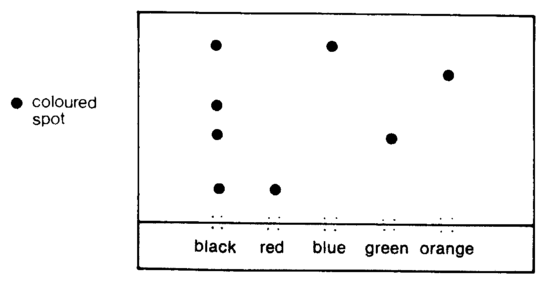
On the chromatogram given -------------- is mixture.
a)
red
b)
orange
c)
green
d)
black
30.
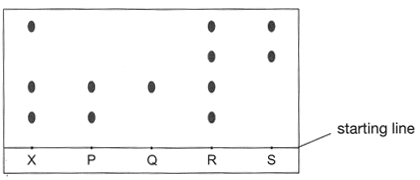
The diagram below shows a chromatogram obtained when a sample X was analysed together with four other known dyes P, Q, R and S. Dye Q was known to cause cancer. Which of the following dye(s) is/are safe for use?
a)
P only
b)
S only
c)
P and S
d)
P and X
31.
In Chromatography the retardation factor Rf are used for identification of components. A high  Rand a low Rt (retention time) mean the component has a 
a)
greater affinity to the stationary phase in both TLC and HPLC.
b)
greater affinity to the stationary phase in TLC but a greater affinity for the mobile phase in HPLC
c)
greater affinity to the mobile phase in TLC but a greater affininty for the stationary phase in HPLC
d)
greater affinity to the mobile phase in  both TLC  and HPLC
32.
A high Rvalue indicates strong
a)
strong affinity to the stationary phase
b)
strong affinity to the mobile phase
c)
no affinity to the stationary phase
d)
 no affinity to the stationary phase
33.
A chromatography experiment uses water as a mobile phase. Which of the following would have the highest Rvalue
a)
ethanol
b)
propanol
c)
butanol
d)
pentanol
34.
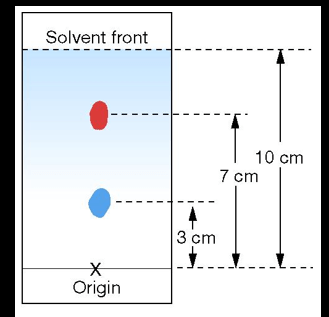
The Rvalue  for the blue component is 
a)
0.3
b)
0.7
c)
10
d)
3
35.
The Rvalue  for the red component is 
a)
0.3
b)
0.7
c)
10
d)
7
36.
The mobile phase in paper chromatography is typically a
a)
plasma
b)
solid
c)
gas
d)
liquid
37.
The substance in the mixture that has the greatest affinity for the mobile phase will travel
a)
fastest
b)
slowest
38.
The retention factor is used
a)
to zero the chromatography scale
b)
to identify unknown compounds in a sample
c)
to retain solvent
d)
as a starting tool for chromatography
39.

What is the correct image of paper chromatography???

a)
b)
c)
40.

Which of the following would be considered a physical change?

a)

Cutting paper

b)

pH test

c)

Burning marshmellow

d)

Roasting a Turkey

41.

Which of the following would be considered a physical property?

a)

Colour

b)

Flammability

c)

pH

d)

Reactivity

42.
Which of the following is represented by point 3 on the graph above. 
a)
Gas heating
b)
Sublimation
c)
Liquid Heating
d)
Evaporation
43.
How would you separate a mixture of two liquids that mix (miscible)  together perfectly. 
a)
Filtration
b)
Magnetism
c)
Chromatography
d)
Distillation
44.
A gas
a)
has a definite shape but no definite volume
b)
has a definite volume but no definite shape
c)
has fast-moving particles