wayground logo

Free Printable Worksheets

NEW

Font size

S
M
L
XL
Worksheets

Semester 1 Science Knowledge

Total questions: 60

Worksheet time: 33mins

Name
Class
Date
1.
A living thing, such as a plant, that can make its own food
a)
Producer
b)
Consumer
c)
Herbivore
d)
Carnivore
2.
This type of cell needs a cell wall and chloroplasts
a)
Plant cell
b)
Animal Cell
c)
Bacteria
3.
The powerhouse of the cell is the...It converts energy from food into energy the cell can use
a)
Mitochondrion
b)
Golgi body
c)
Nucleus
d)
Ribosomes
4.
What do atoms contain?
a)
elements, neutrons, and bonds
b)
protons, neutrons, and electrons
c)
protons, molecules, and elements
d)
electrons, protons, and bonds
5.

A lightyear is:

a)

How much light the Sun gives off in one year.

b)

A year in which very little happens.

c)

The time it take light to travel the distance from the Sun to the Earth.

d)

The distance light travels in one year.

6.

Which electromagnetic wave has the highest ENERGY?

a)

Sound

b)

Microwaves

c)

X Rays

d)

Gamma radiation

7.
This is used to separate white light into colors. 
a)
prism
b)
reflection
c)
sunlight
d)
spectrum
8.
Light is a form of _________.
a)
sound
b)
heat
c)
energy
d)
color
9.
Light travels ___________.
a)
backwards
b)
in a straight line
c)
in curves
d)
at a right angle
10.
By passing light through a prism, you can tell ____________.
a)
that white light is made of different colors
b)
the weight of the prism
c)
the original source of light
d)
that blue light is brighter than white light
11.
What color appears when all colors are absorbed?
a)
black
b)
red
c)
white
d)
violet
12.
What happens to light when it strikes an opaque surface?
a)
the light passes through with no change
b)
the light is refracted back and separated into colors
c)
the light curves around the opaque surface entirely
d)
the light does not pass through the opaque surface
13.
Which of the following allows you to see objects that do not produce their own light?
a)
absorption
b)
refraction
c)
reflection
d)
deflection
14.

When you shine sunlight through a magnifying glass onto a piece of paper, you can sometimes set the paper on fire. Why does this happen?

a)

The glass of the magnifier heats up.

b)

The energy of the Sun is focused in one small place.

c)

The energy of the Sun is spread out over the whole piece of paper.

d)

Sunlight sets everything on fire if it sits still long enough.

15.

2. WHICH OF THE FOLLOWING IS A SOURCE OF LIGHT?

a)

the moon

b)

our eyes

c)

fire

d)

a mirror

16.

Why is light able to travel through space when sound cannot?

a)

Light is able to be reflected by objects.

b)

Light is able to travel through gas.

c)

Light is able to travel through a vacuum.

d)

Light is able to travel through translucent objects.

17.

Why do you feel warm when you stand in the sunlight?

a)

You are warmed by the sunlight that reflects off your clothes.

b)

The sunlight refracts through your body, warming it up.

c)

The sunlight is transmitted through your body, warming it up.

d)

Your clothes absorb some of the sunlight and convert it to heat.

18.

7. When light bounces off a mirror, it is __________.

a)

Absorbed

b)

Reflected

c)

Corrected

d)

Refracted

19.

Which is a source of light?

a)

Chair

b)

Mirror

c)

Flashlight

d)

ball

20.

The moon generates light.

a)

True

b)

False

21.

Plants depend on the sun’s light energy to ____________.

a)

Make carbon dioxide

b)

Perform photosynthesis (make their own food)

c)

Produce a spectrum

d)

Make water

22.

What does the pupil do in bright light?

a)

The pupil bends the light.

b)

The pupil becomes smaller.

c)

The pupil reflects the light.

d)

The pupil changes color.

23.

How many colors is white light from the sun made of?

a)

Three

b)

Twelve

c)

Seven

d)

Five

24.

How is light energy transmitted? Light energy is transmitted as _________.

a)

Cells

b)

Waves

c)

Circles

d)

wires

25.

What does a prism do to a white light ?

a)

It makes it colorful.

b)

It breaks it into seven colors.

c)

It makes it burn.

d)

It makes it beautiful.

26.
How does light behave as it enters these mediums?
a)
continue its path as straight line.
b)
bends toward the normal
c)
bends away from the normal
d)
reflects
27.
Swimming pools and the ocean look shallower than they really are due to:
a)
reflection 
b)
dispersion
c)
refraction
d)
total internal reflection
28.
According to the Law of reflection, a light ray striking a mirror
a)
continues moving through the mirror in the same direction
b)
moves into the mirror at a slightly different angle
c)
bounces off the mirror toward the direction it came from
d)
bounces off the mirror at the same angle it hits.
29.
Glass has a _____________ index of refraction than air.
a)
Equal
b)
Greater
c)
Less
d)
Impossible to say
30.
The point where the rays meet is known as....
a)
Fire
b)
the focal point
c)
refraction
d)
Plane of the lens
31.
The image formed in a flat mirror is
a)
larger than the object and farther away.
b)
reduced and closer to the mirror.
c)
a real image of the object.
d)
equal to the height and distance of the object.
32.
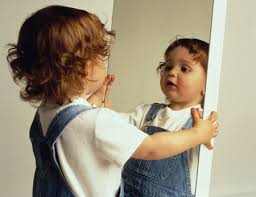
Why does the lower part of the child appear so much different in size from the upper part?
a)
The light rays that travel through water and then into air are refracted.
b)
The light rays that travel through water and then into air are enlarged.
c)
The light rays that travel through air and then into water are reflected.
d)
The light rays that travel through air and then into water are reduced.
33.

What type of lens is wider in the middle than on the edges?

a)

Concave

b)

Convex

c)

Objective

d)

Ocular

34.

What type of lens is thinner in the middle than at the edges?

a)

Convex

b)

Concave

c)

Objective

d)

Magnifying

35.

When light passes through a convex lens, it does this.....

a)

Diverge, or spread apart

b)

Converge, or come together

c)

Reflect, or bounce off

d)

Create a rainbow

36.

Light bends as it passes through a lens. This is called what?

a)

Reflection

b)

Diffraction

c)

Refraction

d)

Dilation

37.

What type of lens do you have in your eye?

a)

Concave

b)

Prismatic

c)

Objective

d)

Convex

38.

The angle of the incoming rays of light are also called the.....

a)

Angle of reflection

b)

Angle of refraction

c)

Angle of incidence

d)

Wave angle

39.

The distance between a convex lens and its focal point is called what?

a)

The focus

b)

The focal length

c)

The wave length

d)

The amplitude

40.

How is white light able to separate through a prism?

a)

the light is being absorbed

b)

the light is being refracted

c)

the light is being reflected

41.
Which particle has a positive charge?
a)
electron
b)
orbital
c)
proton
d)
neutron
42.
Choose the particle that has no charge.
a)
nucleus
b)
neutron
c)
proton
d)
electron
43.
An electron has a _____ charge.
a)
negative
b)
positive
c)
neutral
44.
What are valence electrons?
a)
electrons on the first orbital always
b)
nucleus
c)
the outermost shell
d)
the number of electrons on the outermost orbital
45.
Which particles make up the nucleus of an atom?
a)
protons and neutrons
b)
electrons and protons
c)
electrons, protons, and neutrons
d)
electrons and neutrons
46.
What is the mass number and name of an element with 8 protons and 8 neutrons?
a)
16 - Carbon
b)
16 - Oxygen
c)
24 - Oxygen
d)
8 - Neon
47.
An element with a mass number of 10 and an atomic number of 6 has how many protons?
a)
5
b)
8
c)
6
d)
10
48.
How many electrons are in the atom pictured? 
a)
1
b)
2
c)
3
d)
0
49.
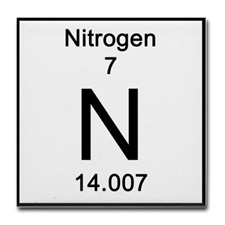
What is the number of protons that the element in this image contain?
a)
14
b)
7
c)
15
d)
18
50.
How many protons, electrons and neutrons does an neutral atom of Calcium have?  Its atomic number is 20 and the mass number is 40.
a)
20 protons, 18 electrons and 40 neutrons
b)
20 protons, 20 electrons and 20 neutrons
c)
40 protons, 40 electrons and 20 neutrons
d)
20 protons, 18 electrons and 20 neutrons
51.
What is the study of the interactions among organisms and  between organisms and their environments called?
a)
Biology
b)
Ecology
c)
Astronomy
d)
Biosphere
52.
The direction of the flow of energy in a food web is represented by ___.
a)
Light bulbs
b)
Dotted Lines
c)
Arrows
d)
Bubbles
53.
Consumer that eats plants
a)
heterotroph
b)
herbivore
c)
producer
d)
community
54.
A frog eats a fly. The frog and fly are demonstrating ________.
a)
mutualism
b)
competition
c)
predator/prey
d)
parasitism
55.
Which of the following is NOT a consumer
a)
grass
b)
dog
c)
shark
d)
fish
56.
Which animal is the apex predator?
a)
hawk
b)
lizard
c)
snake
d)
grass
57.
Which animal is not the apex predator but, a predator to a mouse?
a)
hawk
b)
rabbit
c)
snake
d)
grass
58.
In the energy pyramid here, how much of the energy in each level gets lost as heat or used by the organism for survival?
a)
80%
b)
90%
c)
10%
d)
20%
59.
Which of the following is a herbivore?
a)
cricket
b)
frog
c)
hawk
d)
shrew
60.
A place where an organism gets everything it needs to survive.
a)
habitat
b)
community
c)
ecosystem
d)
population