
Font size
 Worksheets
SBVC Chem 101 Ch 10 Quiz
Total questions: 39
Worksheet time: 2hrs 13mins
Draw the Lewis Dot structure for SF4 and determine how many lone pair electrons it has around the sulfur?
0
1
2
3
Which Lewis Dot Model drawing correctly shows an O2 molecule?


Look at this compound. Is this an ionic compound or a covalent compound?
ionic
covalent
none of these

In HCN (Carbon is usually the central atom) what kind of bond is between the C and N
Single
Double
Triple
CCl4 has how many double bonds?
0
1
2
3


How many total valence electrons are participating in bonding in the molecule above?
8
4
2
3
Which is the correct molecular structure for carbon dioxide?


What is the correct Lewis Dot Structure for ammonia NH3


What is the goal of the Lewis Dot Structure?
To determine the electron position.
To show the element's valence electrons & bonding capabilities.
To find the atomic mass of an element.
To search for the number of electrons in an individual atom.

Which is the correct Lewis Dot Structure for H2S?


State the number of BP, LP, ECC and shape for CO2 molecule. (BP-Bonded Pair, LP-Lone Pair, ECC- Electron Charge Center)
BP-4, LP-0, ECC-2, linear
BP-4, LP-0, ECC-4, linear
BP-2, LP-0, ECC-2, linear
BP-2, LP-0, ECC-4, linear

State the number of BP, LP, ECC and shape for SO3 molecule.(BP-Bonded Pair, LP-Lone Pair, ECC- Electron Charge Center)
BP-6, LP-0, ECC-3, trigonal planar
BP-6, LP-0, ECC-3, trigonal pyrimidal
BP-3, LP-0, ECC-3, trigonal planar
BP-3, LP-0, ECC-3, trigonal pyrimidal

State the number of BP, LP, ECC and shape for SO2 molecule.(BP-Bonded Pair, LP-Lone Pair, ECC- Electron Charge Center)
BP-3, LP-1, ECC-3, trigonal planar
BP-3, LP-1, ECC-3, bent
BP-2, LP-1, ECC-3, trigonal planar
BP-2, LP-1, ECC-3, bent

State the number of BP, LP, ECC and shape for F2O molecule.(BP-Bonded Pair, LP-Lone Pair, ECC- Electron Charge Center)
BP-2, LP-2, ECC-2, trigonal planar
BP-2, LP-2, ECC-2, bent
BP-2, LP-2, ECC-4, trigonal planar
BP-2, LP-2, ECC-4, bent

State the number of BP, LP, ECC and shape for PH3 molecule.(BP-Bonded Pair, LP-Lone Pair, ECC- Electron Charge Center)
BP-3, LP-1, ECC-4, trigonal planar
BP-3, LP-1, ECC-4, bent
BP-3, LP-1, ECC-4, trigonal pyrimidal
BP-4, LP-0, ECC-4, trigonal pyrimidal

State the number of BP, LP, ECC and shape for BH4- molecule.(BP-Bonded Pair, LP-Lone Pair, ECC- Electron Charge Center)
BP-4, LP-0, ECC-4, square planar
BP-4, LP-0, ECC-4, trigonal pyrimidal
BP-4, LP-0, ECC-4, tetrahedral
BP-4, LP-0, ECC-4, octahedral
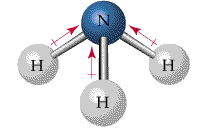
Use your knowledge and electronegativity sheet to predict what the following compound is classified as.
polar covalent
nonpolar covalent
ionic
metallic

Use your knowledge and electronegativity sheet to predict what the following compound is classified as.
nonpolar covalent
polar covalent
ionic
metallic

Use your knowledge and electronegativity sheet to predict what the following compound is classified as.
non-polar covalent
polar covalent
ionic
metallic
Use your knowledge and electronegativity sheet to predict what type of bond would form between calcium and bromine.
non-polar covalent
polar covalent
ionic
metallic
Use your knowledge and electronegativity sheet to predict what type of bond would form between phosphorus and fluorine.
non-polar covalent
polar covalent
ionic
metallic
In a polar covalent bond, electrons are shared:
equally
unequally
between two metals
between a metal and a non-metal
Electronegativity is a measurement of the ability of a nucleus to:
attract bonding electrons
attract other nuclei
attract electrons in the non-valence energy levels


Will PH3 be polar or nonpolar based on the electronegativity difference and the shape?
polar
nonpolar
Using your electronegativity handout and the types of atoms involved, predict what type of bond would form between F and Cl.
nonpolar covalent
polar covalent
ionic
metallic
Which of the following formulas represents a polar molecule?
H2
H2O
CO2
CCl4
A covalent bond usually forms between:
a metal and a nonmetal
either metals or nonmetals
two metals
two nonmetals
A diatomic molecule like O2 is always_______ because electrons are shared ________.
nonpolar; equally
polar; equally
nonpolar; unequally
nonpolar; unequally
What causes a partial charge on a molecule?
unequal sharing of electrons
an electronegativity difference between 0.4 and 1.8.
the shape of the molecule
all of the above
Water which is polar likes to dissolve:
ionic compounds
polar molecules
nonpolar molecules
metallic compounds
What is the VSEPR (Valence Shell Electron Pair Repulsion) theory used to predict?
the number of bonds between atoms
polarity
molecular shape
electronegativity

