
 Worksheets
Year 9 Science Quiz
Total questions: 35
Worksheet time: 41mins
Name
Class
Date
1.
What characteristic defines all chemical changes?
a)
There is a change of state.
b)
Electricity is produced.
c)
A new material is formed.
d)
Bubbles are produced.
2.
Is corroding metal a chemical or physical change?
a)
physical
b)
chemical
3.
This type of cell needs a cell wall and chloroplasts
a)
Plant cell
b)
Animal Cell
c)
Bacteria
4.
Plants perform photosynthesis through this organelle. It captures energy from the sun and uses it to produce food for the cell.
a)
Chlorophyll
b)
Chloroplasts
c)
Mitochondria
d)
Golgi Apparatus
5.
A living thing, such as a plant, that can make its own food
a)
Producer
b)
Consumer
c)
Herbivore
d)
Carnivore
6.
A living thing that feeds on the wastes and remains of plants and animals
a)
Decomposers
b)
Fungus
c)
Scavenger
d)
Microorganism
7.
A force is a push or a pull.
a)
True
b)
False
8.
When something is unbalanced it causes an object to move.
a)
True
b)
False
9.
Which moon phase comes after waxing crescent?
a)
First Quarter
b)
Waning Crescent
c)
Full moon
d)
Waxing Gibbous
10.
The orbit of the Earth around the sun is:
a)
circular
b)
elliptical
c)
irregular
11.
What causes the temperatures at the north and south pole to remain cold throughout the year?
a)
The speed at which the Earth moves around the sun
b)
The tilt of the Earth on its axis
12.
Fill in the blanks.In a 24 hour period, the earth completes one ________ on its ________
a)
rotation, orbit
b)
revolution, axis
c)
rotation, axis
d)
revolution, orbit
13.
Which moon phase is Earth between the moon and the sun?
a)
New moon
b)
full moon
c)
first quarter
14.
True or false? DNA is the shortened form of the term ‘Deoxyribonucleic acid’?
a)
True
b)
False
15.
Pure water has a pH level of around?
a)
6
b)
7
c)
8
d)
9
16.
Survival of the Fittest and Evolution were proposed by what scientist?
a)
Charles Darwin
b)
Albert Einstein
c)
Steven Hawking
d)
Isaac Newton
17.
Why are advantageous traits more likely to be passed onto offspring?
a)
Because they are more likely to survive and reproduce.
b)
Because they come from dominant alleles.
c)
Because they come from recessive alleles.
d)
Because the trait is an acquired phenotype.
18.
Genetic differences between organisms of the same species
a)
Variation
b)
Adaptation
c)
Behavior
d)
Environment
19.
What is the difference between particles in a gas and a solid?
a)
gas particles are closer together
b)
solid particles move faster than gas particles
c)
solid particles expand on heating
d)
gas particles have more kinetic energy than solid particles
20.
Always starts with a Hydrocarbon that reacts with oxygen and produces carbon dioxide and water.
a)
Decomposition
b)
Synthesis
c)
Combustion
d)
Single Replacement
21.
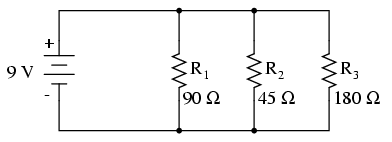
This is an example of a ______ circuit
a)
Series
b)
Parallel
c)
Open
d)
Dihexihedral
22.
wood is a _____?
a)
conductor
b)
insulator
23.
A material in which electrons are able to move easily
a)
Circuit
b)
Insulator
c)
Resistance
d)
Conductor
24.

What may happen if the snowshoe hare was removed from the food web pictured?
a)
The insects in the habitat would increase.
b)
The shrew population would decrease due to being only hawk food source.
c)
The willow tree population would decrease.
d)
Foxes would dies due to no food source.
25.

In the food web shown, the snail would be considered...
a)
primary consumer
b)
secondary consumer
c)
tertiary consumer
d)
producer
26.
The X axis is labeled with
a)
the control variable
b)
the independent variable
c)
the sample variable
d)
dependent variable
27.
The Y axis is labeled with the
a)
control variable
b)
independent variable
c)
sample variable
d)
dependent variable
28.

Which is correct?
a)
the independent variable is distance
b)
the dependent variable is distance
29.
What tool is used to measure the mass of an object?
a)
meter stick
b)
graduated cylinder
c)
spring scale
d)
balance
30.

What does this tool measure?
a)
mass
b)
weight
c)
gravity
31.

What does this science tool do?
a)
used for heating a liquid
b)
used for measuring volume of a liquid
c)
used for measuring mass
d)
used for measuring volume of a sound
32.
Which of the following represents an element?
a)
H2O
b)
H2
c)
NaCl
d)
CaCO3
33.
What products are produced when we react an acid with an alkali?
a)
salt + carbon dioxide + water
b)
salt + hydrogen
c)
salt + water
d)
salt + water + hydrogen
34.
What salt is produced if you react sodium hydroxide with hydrochloric acid?
a)
sodium hydroxide
b)
sodium sulfate
c)
sodium nitrate
d)
sodium chloride
35.
A salt is formed when nitric acid combines with sodium hydroxide. What is the name of the salt?
a)
Sodium chloride
b)
Sodium nitrate
c)
Hydrogen Nitrate
d)
Nirate
100 %

