Wayground logo

Free Printable Worksheets

Font size

S
M
L
XL
Worksheets

Spring Final

Total questions: 80

Worksheet time: 2hrs 49mins

Name
Class
Date
1.
The process by which rocks are broken down chemically or physically is known as:
a)
Weathering
b)
Erosion
c)
Deposition
d)
Transportation
2.
When wind, water, or ice leave materials in a location, this is known as:
a)
Weathering
b)
Erosion
c)
Deposition
d)
Transportation
3.
Deltas are built up by -
a)
deposition
b)
leaching
c)
abrasion
d)
erosion
4.
A hot wet climate causes weathering to take place -
a)
slowly
b)
rapidly
c)
unevenly
d)
at the same rate as when the climate is dry and cool
5.
wind erosion forms what type of landform?
a)
meander
b)
drumlin
c)
sand dune
d)
sand bar
6.
The process by which water, ice, wind or gravity moves weathered rock and soil from one place to another.
a)
weathering
b)
erosion
c)
deposition
d)
dumptruck
7.
These rocks were broken apart from the continuous freeze/thaw of water in the cracks of the rocks. This is an example of:
a)
ice wedging
b)
acid rain
c)
permeability
d)
abrasion
8.
How wells dry out?
a)
ground water is removed slowly than it replaced
b)
ground water get trapped in an aquifer
c)
ground water is removed more quickly than it is replaced
d)
ground water becomes contaminated with pollutants
9.
Which statement is true about ground water?
a)
IT creates pores between rock and sediment
b)
It eventually return to the surface
c)
It flows quickly uphill in porous soil
d)
It remains underground very briefly
10.
Groundwater contamination…
a)
is easily cleaned up
b)
is difficult to clean or remove
c)
is not a problem for modern people
d)
does not affect the United States
11.
How do people extract groundwater?
a)
groundwater cannot be extracted
b)
by drilling wells and pumping water out of the ground
c)
mining water from the Earth
d)
answer not shown
12.

What landform can you see in the picture?

a)

Meanders

b)

Rapids

c)

Estuary

d)

V shaped valleys

13.
Where weather occurs.
a)
stratosphere
b)
thermosphere
c)
troposphere
d)
mesosphere
14.
Where we live.
a)
stratosphere
b)
thermosphere
c)
troposphere
d)
mesosphere
15.
The two most common gases in the atmosphere.
a)
Nitrogen and Oxygen
b)
Oxygen and trace gases
c)
Carbon Dioxide and Nitrogen
d)
Nitrogen and trace gases
16.
What is the function of the ozone layer?
a)
to allow UV rays to get to Earth
b)
to block UV rays from getting to Earth
c)
To keep oxygen in
d)
to allow meteors to get to Earth
17.
This is the layer where most commercial jet airliners fly.
a)
Troposphere
b)
Stratosphere
c)
Mesosphere
d)
Thermosphere
18.
name this symbol
a)
warm front
b)
cold front
c)
stationary front
d)
occluded front
19.
What does this symbol on a weather map indicate? 
a)
High pressure system
b)
Low pressure system
c)
Cold front
d)
Warm front
20.
What does this symbol indicate on a weather map? 
a)
High pressure system
b)
Low pressure system
c)
Cold front
d)
Warm front
21.
What kind of pressure predicts good weather?
a)
high
b)
low
c)
cold
d)
stationary
22.
When a cold front overtakes a warm front, the temperature drops as the warm air mass is cut off from the ground and pushed upward.  It can bring strong winds and heavy precipitation. 
a)
Warm Front
b)
Cold Front
c)
Occluded Front
d)
Stationary Front 
23.
This type of cloud is thin, wispy, and made of ice crystals
a)
cumulus cloud
b)
stratus cloud
c)
cirrus cloud
d)
cumulonimbus cloud
24.
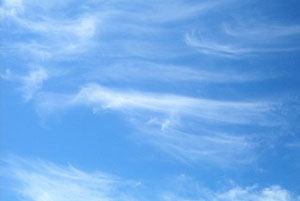
what type of cloud is shown?
a)
cumulus
b)
cirrus
c)
stratus
25.
Which cloud is this?
a)
cumulus
b)
cumulonimbus
c)
cirrus
d)
stratus
26.

What increases how much water vapour air can hold

a)

Temperature. The hotter air is, the more water vapour it can hold

b)

Temperature. The cooler air is, the more water vapour it can hold

c)

Height. The further the air is from the ground, the more water vapour it can hold

d)

Pollution. The more pollutants in the air, the more water vapour it can hold

27.

What is humidity?

a)

This is a measure of how hot or cold something is

b)

This is a measure of how much water vapour is in the air

c)

This is a measure of the volume of water in a cloud

d)

This is the amount of sweat produced in a day

28.
what is the most common precipitation 
a)
sleet 
b)
freezing rain
c)
snow 
d)
rain 
29.
Lvl 2: Precipitation that falls to the planet as balls of ice. They can be small and large.
a)
Rain
b)
Sleet
c)
Hail
d)
Snow
30.
Lvl 2: Precipitation that falls to the planet as ice crystals.
a)
Rain
b)
Sleet
c)
Hail
d)
Snow
31.
Lvl 3: This diagram shows how a certain type of precipitation is formed. Water drops are caught in up-drafts and down-drafts, over and over, before they fall to Earth as
a)
dew.
b)
hail.
c)
rain.
d)
snow.
32.
They are highest clouds in the sky. They are wispy with fuzzy edges. Usually mean good weather.
a)
Cumulus
b)
Cumulonimbus
c)
Cirrus
d)
Stratus
33.
What form of precipitation is the only one that changes from water vapor directly to a solid?
a)
Rain
b)
Sleet
c)
Snow
d)
Hail
34.
What causes wind?
a)
differences in pressure
b)
differences in oxygen
c)
differences in thermosphere
d)
differences in gravity
35.
Where does the initial source of energy come from that creates winds?
a)
the moon
b)
the sun
c)
the Earth's surface
d)
the rotation of the Earth
36.
More direct light would mean the temperature in that area would be...
a)
cooler and letter B
b)
cooler and letter A
c)
hotter at letter A
d)
hotter at letter B
37.
Increased carbon dioxide may cause global warming by trapping more ____________ in the atmosphere.
a)
water
b)
gases
c)
heat
d)
water vapor
38.
Which of the following is an example of a greenhouse gas?
a)
Carbon Dioxide
b)
Nitrogen
c)
Oxygen
d)
Neon
39.
___________is the result of the weight of a column of air pushing on an area.
a)
air pressure
b)
density
c)
volume
d)
none of the above
40.
As you climb up a mountain what happens to the air pressure?
a)
decreases
b)
increases
c)
stays the same
41.
A _____________ is the scientific  instrument used to measure air pressure.
a)
barometer
b)
thermometer
c)
mercury
d)
watch
42.
What happens to the amount of oxygen molecules as altitude increases?
a)
fewer molecules
b)
more molecules
c)
same amount of molecules
d)
nothing happens to the molecules
43.
A heavy storm that is accompanied by rain, thunder, lightning, and strong winds.
a)
Hurricane
b)
Tornado
c)
Thunderstorm
44.
Damage caused by storm surge, which results in coastal flooding.
a)
Hurricane
b)
Tornado
c)
Thunderstorm
45.
A severe storm that develops over tropical oceans
a)
hurricane
b)
tornado
c)
thunderstorm
46.
a)
hurricane
b)
tornado
c)
thunderstorm
47.
a)
hurricane
b)
tornado
c)
thunderstorm
48.
What is this storm?
a)
rain storm
b)
tornado 
c)
hurricane
d)
none of the above
49.
What type of weather front causes thunderstorms and tornadoes?
a)
cold
b)
occluded
c)
stationary
d)
warm
50.
In which layer of the atmosphere do all storms occur?
a)
Stratosphere
b)
Exosphere
c)
Troposphere
d)
Mesosphere
51.

______ causes surface currents.

a)

The Coriolis Effect

b)

gravity

c)

density differences

d)

wind

52.

______ causes deep ocean currents

a)

The Coriolis Effect

b)

gravity

c)

wind

d)

density differences

53.

Nutrients are brought to the surface for phytoplankton to use at _______.

a)

gyres

b)

eddies

c)

upwellings

d)

the equator

54.
What is the major cause of surface currents?
a)
dolphins
b)
wind
c)
hurricanes
d)
tides
55.
Which air mass brings cold, dry air to the United States?
a)
Air Mass #1
b)
Air Mass #2
56.
Which air mass is found over land?
a)
Continental
b)
Marine/Ocean
c)
Tropical
d)
Polar
57.
Is the picture representing a land breeze or sea breeze?
a)
Land breeze
b)
Sea breeze
58.
Does the land or the sea heat up faster in the diagram?
a)
Land
b)
Sea
59.
Is the California current a warm or cold current?
a)
warm current
b)
cold current
60.
What is the primary source of energy that generates most ocean waves?
a)
earthquakes
b)
wind
c)
asteriods falling in the ocean
d)
volcanic eruptions
61.
What is a trough?
a)
highest point on a wave
b)
lowest point on a wave
c)
longest point on a wave
d)
shortest point on a wave
62.
What is a crest?
a)
lowest point of a wave
b)
longest part of a wave
c)
shortest part of a wave
d)
highest point of a wave
63.
What is the distance between two waves?
a)
wave period
b)
wave frequency
c)
wave length
d)
wave height
64.
What is distance from a wave's crest to the trough called?
a)
wave height
b)
wave length
c)
wave frequency
d)
wave period
65.
Which biome, because of its climate, has the largest number of species of plants and animals?
a)
tundra
b)
desert
c)
tropical rainforest
d)
pine forest
66.
Which type of trees is found in a temperate forest?
a)
deciduous
b)
evergreen
c)
ginko
d)
palm
67.
Which major biome is home to cacti, mesquite, white thorn, pack rats, small reptiles, and coyotes?
a)
desert
b)
taiga
c)
tundra
d)
grassland
68.
Which biome contains large populations of grazing herbivores, few species of birds, and deep, rich soil?
a)
taiga
b)
tundra
c)
deciduous forest
d)
grassland
69.
This biome contains mostly spruce trees and Douglas firs, which are both evergreen.  The winters are long and cold and the summers are short and rainy.  The soil is very rich.  Moose and elk live here.  This biome is classified as a
a)
taiga
b)
tundra
c)
deciduous forest
d)
temperate forest
70.
What are the key features of the Tundra?
a)
cold winter, thin acidic soil, evergreen trees
b)
treeless, permafrost, cold dark winters
c)
ong cool summers, short dark winters, migrating animals
d)
many evergreen trees, short moist summers, long snowy winters
71.
Which type of dating method can be used on rock layers by applying the Law of Superposition?
a)
relative dating
b)
absolute dating
c)
radioactive dating
d)
radiometric dating
72.
Several different fossils were found in rock layers in a geologic column.  Above these rock layers, the fossils were almost nonexistent.  Which most likely explains these observations?
a)
A nonconformity occurred
b)
All the organisms migrated.
c)
A period of mass extinction occurred.
73.

What is radio active decay?

a)

The preserved remains of an organism.

b)

Atoms in an unstable element break down to form another element.

c)

When things die and their remains are buried.

d)

The time it takes for 1/2 of the radioactive atoms to decay in an element.

74.

If the same species of reptile was found in Africa and south america, what could this evidence support?

a)

the used to be a land bridge between Africa and South America

b)

That reptiles swam accross the ocean

c)

Africa and South America used to be joined together

d)

humans moved the reptiles from one continent to the other.

75.
According to the law of superposition, which layer is the youngest?
a)
A
b)
B
c)
C
76.

What is the current biological era?

a)

Paleozoic

b)

Mesozoic

c)

Cenozoic

d)

Jurassic

77.
The ocean makes up about ________ % of the Earth's surface. 
a)
100%
b)
53%
c)
70 %
d)
90%
78.
Which projection is this?
a)
Robinson
b)
Mercator
c)
Eckert IV
d)
Goode's Homolosine
79.

Match the topographic map to its profile.

a)
b)
c)
d)
80.

Match the topographic map to its profile picture.

a)
b)
c)
d)