
Font size
S
M
L
XL
 Worksheets
Pre-Test Physical Science
Total questions: 50
Worksheet time: 2hrs 15mins
Name
Class
Date
1.
The study of composition, structure, and properties of matter and the changes it undergoes
a)
chemical
b)
chemistry
c)
mass
d)
matter
2.
A substance with definite composition
a)
chemical
b)
homogeneous mixture
c)
matter
d)
mixture
3.
Measure of the amount of matter
a)
solid
b)
liquid
c)
mass
d)
gas
4.
Anything that has mass and takes up space
a)
chemical
b)
matter
c)
pure substance
d)
homogenous mixture
5.
Characteristic that can be observed or measured without changing the identity of the substance
a)
physical property
b)
chemical property
6.
A change in a substance that does not involve a change in the identity of the substance
a)
physical change
b)
chemical change
7.
State that had definite volume, but not definite shape
a)
solid
b)
liquid
c)
gas
8.
state that has a definite volume and shape
a)
solid
b)
liquid
c)
gas
9.
state with no definite volume or shape
a)
solid
b)
liquid
c)
gas
10.
A blend of two or more kinds of matter each which retains its own identity
a)
mixture
b)
homogenous mixture
c)
heterogenous mixture
11.
Mixtures that are uniform in composition
a)
mixture
b)
homogeneous mixture
c)
heterogeneous mixture
12.
mixtures that are not uniform in composition
a)
Mixtures
b)
Homogeneous Mixture
c)
Heterogeneous Mixture
13.
characteristics that affect a substance's ability to change into another substance
a)
chemical properties
b)
physical properties
14.
Has a fixed composition which means every sample has the same properties and the same composition
a)
Pure Substance
b)
chemical
c)
mixture
15.
Particles in an atom that are neutral and have no charge are
a)
negatrons
b)
electrons
c)
neutrons
d)
protons
16.
an atom with atomic number 6 would have how many protons
a)
6
b)
12
c)
3
d)
cannot be determined
17.

What is the number of protons that the element in this image contain?
a)
14
b)
7
c)
15
d)
18
18.

a)
Number of protons
b)
Number of neutrons
c)
Number of electrons
d)
Mass Number
19.

a)
The number of protons
b)
The number of neutrons
c)
The Mass Number
d)
The number of valence electrons
20.

What is the atomic mass of "F"
a)
9
b)
18
c)
17
d)
19
21.

What does the 1.00794 stand for?
a)
Hydrogen
b)
atomic number
c)
atomic mass
d)
atomic explosion
22.
The particles that are found in the nucleus of an atom are
a)
neutrons and electrons
b)
electrons only
c)
protons and neutrons
d)
protons and electrons
23.
Where are electrons of an atom found?
a)
Nucleus
b)
Electron Cloud
c)
Some are in the nucleus and some in the electron cloud.
d)
They are moving everywhere.
24.
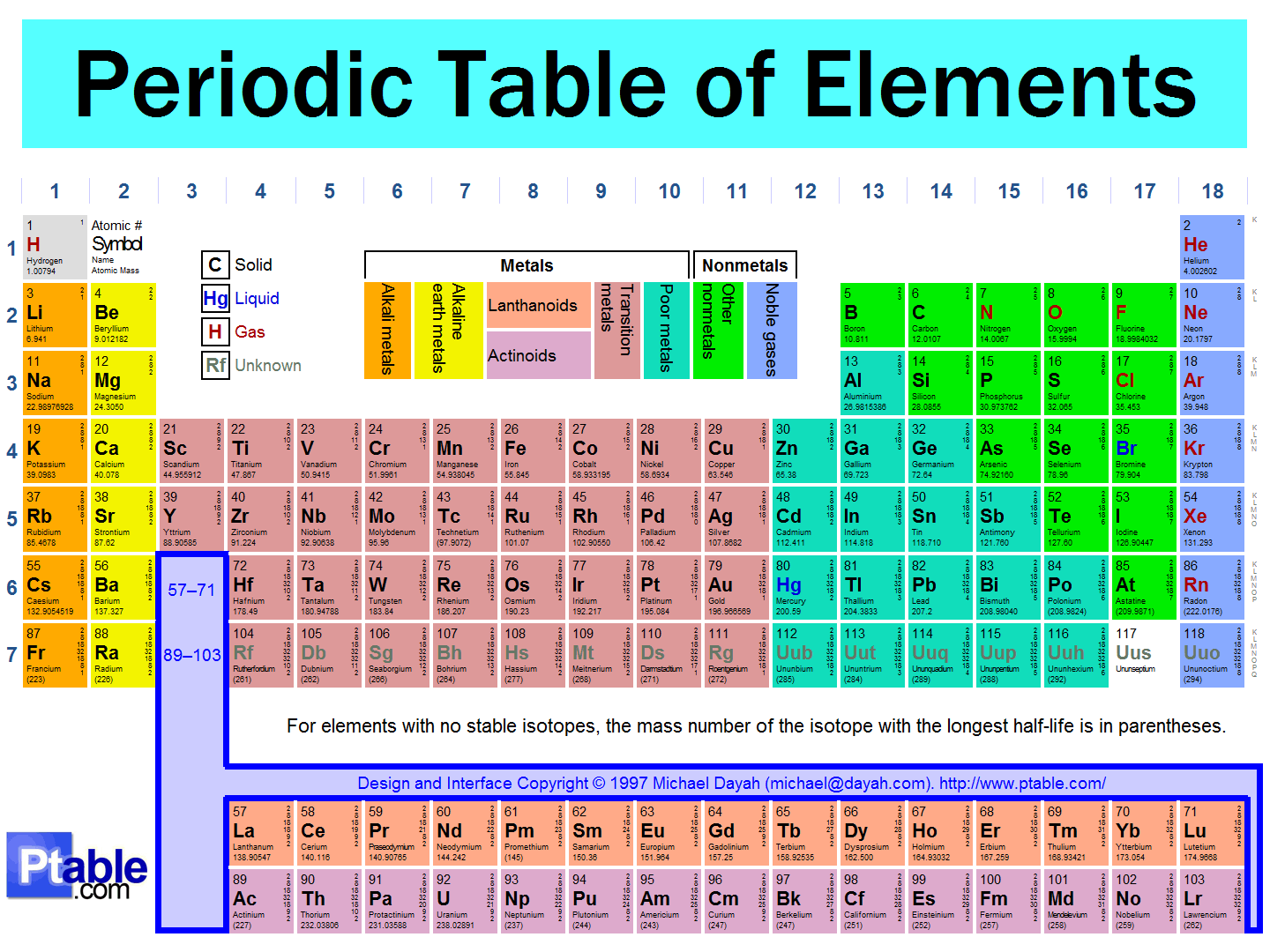
The vertical (up and down) columns in the Periodic Table are called
a)
groups
b)
towers
c)
periods
d)
atomic numbers
25.
The Modern Periodic Table of Elements is arranged by
a)
atomic mass
b)
atomic number
c)
valence electrons
d)
number of isotopes
26.
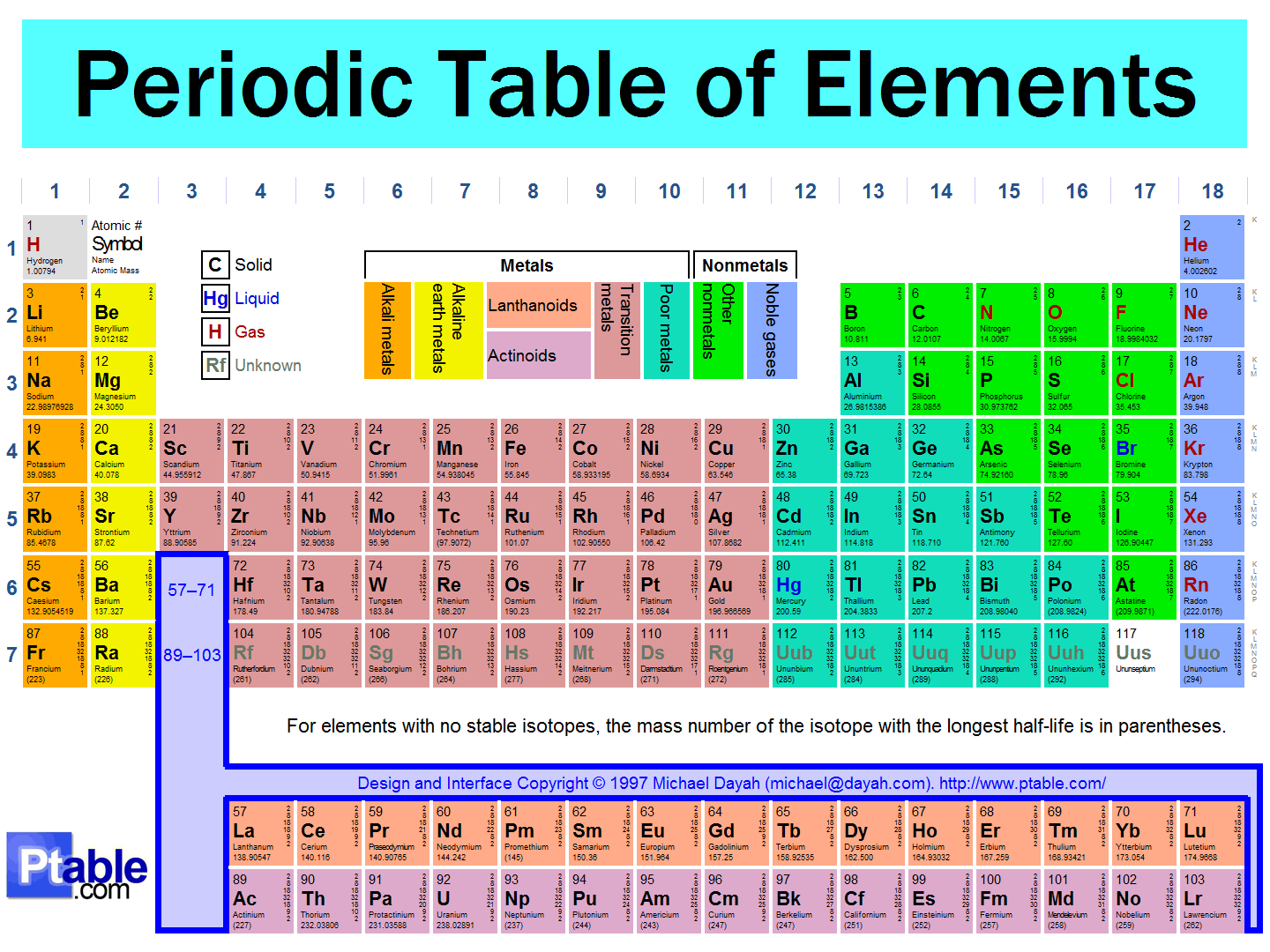
The horizontal (side to side) rows in the Periodic Table are called
a)
groups
b)
families
c)
periods
d)
atomic numbers
27.
What are the three main groups of the periodic table?
a)
groups
b)
metal
c)
nonmetals
d)
metalloids
e)
periods
28.

Which of the following elements is a non-metal in group 14?
a)
Carbon (C)
b)
Silicon (Si)
c)
Tin (Sn)
d)
Lead (Pb)
29.

Which two elements are in the same period?
a)
boron (B) and lithium (Li)
b)
beryllium (Be) and calcium (Ca)
c)
phosphorus (P) and oxygen(O)
d)
boron (B) and phosphorus (P)
30.

Metals are located on the
________ side of the
Periodic Table.
a)
ZIG-ZAG
b)
LEFT
c)
RIGHT
d)
BOTTOM
31.

Find the element on Period 3 and Group 17. What is
this element’s chemical symbol?
a)
F
b)
Br
c)
Cl
d)
I
32.

A golf ball accelerates off a tee at 15m/s2, changing its velocity from 0m/s to 50 m/s down the fairway. How long did it take the golf ball to accelerate?
a)
750 seconds
b)
35 seconds
c)
0.3 seconds
d)
3.3 seconds
33.

A ball of clay is thrown at a wall at a velocity of 28.0 m/s. After it hits the wall, it takes 0.020 s to stop. What is the acceleration of the clay when it hits the wall?
a)
1400 m/s2
b)
-1400 m/s2
c)
0.56 m/s2
d)
-0.56 m/s2
34.

The picture of the position vs. time graph shows an object that is...
a)
accelerating/speeding up
b)
moving at a constant speed
c)
not moving
d)
accelerating/slowing down.
35.
Acceleration is defined as the CHANGE in
a)
time it takes for one place to move to another place.
b)
velocity of an object.
c)
distance divided by the time interval
d)
velocity divided by the time interval
36.
Why does a car accelerate as it round a corner at a constant speed?
a)
Its direction changes
b)
It doesn't
c)
It slows down
d)
Its speeds up
37.
The speedometer on your car tells you
a)
average velocity
b)
instantaneous velocity
c)
average speed
d)
instantaneous speed
38.

What is this graph representing?
a)
Constant Speed
b)
Acceleration (speeding up)
c)
Deceleration (slowing down)
d)
No motion
39.
What two measurements are necessary for calculating speed?
a)
Mass and time
b)
Temperature and mass
c)
Mass and distance
d)
Distance and time
40.

At 60 seconds, how far had this object traveled?
a)
0 m
b)
10 m
c)
20 m
d)
40 m
41.

What is happening in this graph from point B to C?
a)
The object is going down a hill.
b)
The object is returning to its starting location.
c)
The object is slowing down.
d)
The object is staying still.
42.

What is happening in this graph from point A to B?
a)
The object is accelerating.
b)
The object is not moving.
c)
The object is decelerating.
d)
The object is moving at a constant speed.
43.
If you run around the football field (which is 2 miles) 3 times, what is your distance?
a)
0 miles
b)
3 miles
c)
6 miles
d)
9 miles
44.
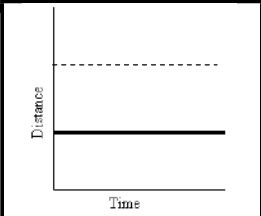
What does this graph represent?
a)
Constant speed
b)
Acceleration
c)
Not moving
45.
What is the speed of an object that travels 60 meters in 4 seconds?
a)
240 m/s
b)
15 m/s
c)
0.067 m/s
d)
15 mph
46.
A measurement of how fast an object is moving
a)
Velocity
b)
Speed
c)
Vector
d)
Acceleration
47.
A description of the speed and direction of an object's motion
a)
Velocity
b)
Speed
c)
Acceleration
d)
Vector
48.
Can be measured in seconds (s)
a)
Distance
b)
Time
c)
Speed
d)
Acceleration
49.
What is the speed of an object that travels 20 meters in 4 seconds?
a)
80 m/s
b)
0.2 m/s
c)
5 m/s
d)
24 m/s
50.
What is velocity?
a)
the quickness of an object
b)
the location of an object
c)
acceleration
d)
speed in a specific direction
Reset

