wayground logo

Free Printable Worksheets

NEW

Font size

S
M
L
XL
Worksheets

Atomic structure and chemical bonding

Total questions: 45

Worksheet time: 35mins

Name
Class
Date
1.

An atom with 3 protons and 4 neutrons will have a valency of

a)

3

b)

4

c)

7

d)

1

2.

The only inert gas which have a complete duplet is

a)

Krypton

b)

neon

c)

Argon

d)

Helium

3.

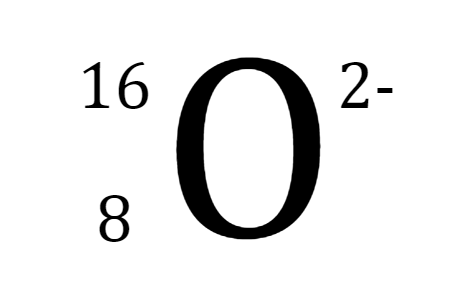
Number of valence electron in O2- are:

a)

6

b)

8

c)

4

d)

10

4.

isotopes have different mass number,because their nuclei contain different number of

a)

proton

b)

electron

c)

neutron

d)

positron

5.

The chemical bond formed between mutual sharing of electrons between the two combining atom

a)

Ionic bond

b)

dative bond

c)

electrovalent bond

d)

covalent bond

6.

The number of electrons lost or gained by an atom refers to

a)

Donation

b)

acceptance

c)

covalency

d)

electrovalency

7.

The molecule containing triple covalent bond is

a)

oxygen

b)

ammonia

c)

nitrogen

d)

methane

8.

sodium and sodium ion :

a)

are chemically same

b)

have same no of electrons

c)

have same no of protons

d)

none of the above

9.

A chemical bond where electrons are shared between two atoms. In this type of bond no ions are. You will find these bonds when carbon bonds to other elements.

a)

Covalent bond

b)

Element

c)

Hydrogen bond

10.

A chemical bond that has hydrogen covalently bonded to an electronegative atom. It happens when oxygen bonds to hydrogen.

a)

Ionic bond

b)

Hydrogen bond

c)

Molecule

11.

A diagram that shows the bonding between atoms of a molecule and the lone pair of electrons that may exists in the molecule

a)

Hydrogen bond

b)

Bohr Model

c)

Electron dot diagram

d)

Element

12.

A chemical bond between two atoms where one or more electrons are passed from one atom to another. When they give up electrons, each of the atoms should have a filled shell. An example is the sodium chloride bond.

a)

Ionic bond

b)

Hydrogen bond

c)

Element

d)

Covalent bond

13.

What is one way Neutrons are different from electrons?

a)

they both are negative

b)

neutrons have no charge, while electrons have a negative charge

c)

Both are in the nucleus( center of atom)

d)

Electrons are inside nucleus and neutrons are outside the nucleus.

14.

How many neutrons does calcium have?

a)

20

b)

40

c)

60

d)

0

15.
Covalent bonds are between...
a)
Metal and Non-metal
b)
Non-metal and Non-metal
c)
Metal and Metal
16.
Ionic bonds are between...
a)
Metal and Non-metal
b)
Non-metal and Non-metal
c)
Metal and Metal
17.
Do covalent bonds share or transport electrons?
a)
Share
b)
Transport
18.
Do ionic bonds share or transport electrons?
a)
Share
b)
Transport
19.
Atoms are most stable when their outer shell is complete.
a)
true
b)
false
20.
When an atom loses an electron, it is called a..
a)
crystal
b)
formula
c)
ion
21.
What usually forms a negative ion?
a)
Non-metals
b)
metals
22.
What usually forms a positive ion?
a)
Non-metals
b)
metals
23.
The name of Cu₃N₂ is
a)
copper (III) nitride
b)
copper (II) nitride
c)
copper nitride
d)
tricopper dinitride
24.
The name of FeCl₂ is
a)
iron chloride
b)
iron (II) chloride
c)
iron (I) chloride
d)
iron dichloride
25.
The chemical formula of potassium iodide is
a)
KI
b)
PI
c)
KI₂
d)
K₂I
26.
The chemical formula of iron (III)bromide is
a)
FeBr
b)
Fe(III)Br
c)
FeBr₃
d)
Fe₂Br₃
27.
An ionic compound made of copper (Cu2+) and oxygen would be named
a)
copper oxygen.
b)
copper oxide.
c)
dicopper oxide.
d)
copper(II) oxide.
28.
The chemical bond formed when two atoms share electrons is called a(n)
a)
ionic bond.
b)
orbital bond.
c)
Lewis structure.
d)
covalent bond.
29.
Is the following compound ionic or covalent:
AlCl3
a)
ionic 
b)
covalent
30.

What is a valence electron?

a)

an electron that is found in the outermost shell of an atom.

b)

an electron found in the innermost shell of an atom.

c)

an electron found in the middle shell.

31.

What is the number of valence electrons for Neon and the other Noble Gases?

a)

5

b)

6

c)

7

d)

8

32.

If an atom transfers an electron to another atom, those atoms form which bond?

a)

Ionic Bond, which is stronger than a covalent bonds

b)

Covalent Bond, which is stronger than ionic bonds

33.

Bonds that form between two metals are called ______________ bonds.

a)

ionic

b)

covalent

c)

metallic

d)

pervasive

34.
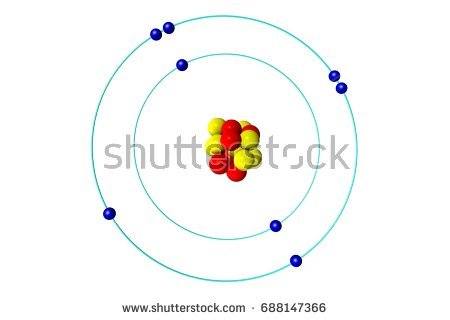
How many valence electrons in this structure?
a)
6
b)
5
c)
4
d)
7
35.
In chemical compounds, covalent bonds form when
a)
the electronegativity difference between two atoms is very large.
b)
electrons are completely transferred between two metals.
c)
pairs of electrons are shared between two nonmetal atoms.
d)
two nonmetal atoms are attracted to each other by opposite charges.
36.
How many electrons does Si contain? (click to see image)
a)
14
b)
28
c)
2
d)
4
37.

Typically, atoms are more stable when they are

a)

bonded together

b)

apart from each other

38.

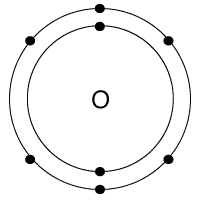
Which is the correct Lewis Structure for oxygen?

a)
b)
c)
d)
39.

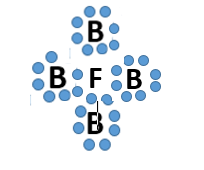
What is the correct Lewis structure for BF3?

a)
b)
c)
d)

BF3 (The formula is the Lewis Structure)

40.
What ending is used for the names of negative ions formed when atoms gain (steal) electrons?
a)
ade
b)
ate
c)
ion
d)
ide
41.
What are the electrons in the outer most level called?
a)
Outer level electrons
b)
Protons
c)
Neutrons
d)
Valence Electrons
42.
How many more electrons are needed to fill an outermost energy level of a Carbon atom?
a)
its already full, 0 needed
b)
2
c)
4
d)
carbon is a nonmetal, it has no electrons
43.
The atomic number of an element tells you what about that element? 
a)
number of ions
b)
number of valence electrons
c)
number of electrons 
d)
what is an element? 
44.
Which of the following compounds is formed by ionic bonding?
a)
HF
b)
PCl5
c)
MgCl2
d)
CH4
45.
Which of the following atoms can able to make electrovalent bonding with Calcium atom?
a)
Fluorine
b)
Sodium
c)
Iron
d)
Aluminum