
 Worksheets
FAA- Grade 7
Total questions: 51
Worksheet time: 26mins
Machine language is combination of ‘0’ and ‘1’
True
False
Super computers are the fastest computers.
True
False
-------------- and-------------are types of computers classified on the basis of data processing.
analog computers and digital computers
super computer and personal computers
Mainframe computer is a powerful multi-user computer capable of supporting many hundreds or thousands of users simultaneously.


Laptops are compact, so overheating can be a problem.


Which computer is the most powerful?
Supercomputers
Minicomputers
Worstation
Mainframe
Personal Computer
Microwaves, washing machine, medical equipment, cameras, toys and airplanes are some of the appliances/ machines which uses the list above.
Personal Digital Assistants
Embedded Computers
Micro Computers
Wearable Computers
What's the main difference between a supercomputer and a mainframe?
There is no real difference between both computer systems.
Mainframes are good for large and complex calculations, whereas supercomputers are good in doing a large quantity of small tasks at the same time.
Supercomputers are good for large and complex calculations, whereas mainframes are good in doing a large quantity of small tasks at the same time.
Mainframes are designed to look aesthetically pleasing, whereas this is not the case with supercomputers.
Which level of a programming language is Assembly Code?
Low
High
Which generation?
Machine Code - Low
Assembly Code - Low
High Level

Which generation?
Machine Code - Low
Assembly Code - Low
High Level
Before a computer can understand a program it must be...
Translated into its machine code.
Translated into a high level language.
Translated into a low level language.
None of these
Translates all of the source code into machine code in one go
Assembler
Compiler
Interpreter
Which of these is high level code?


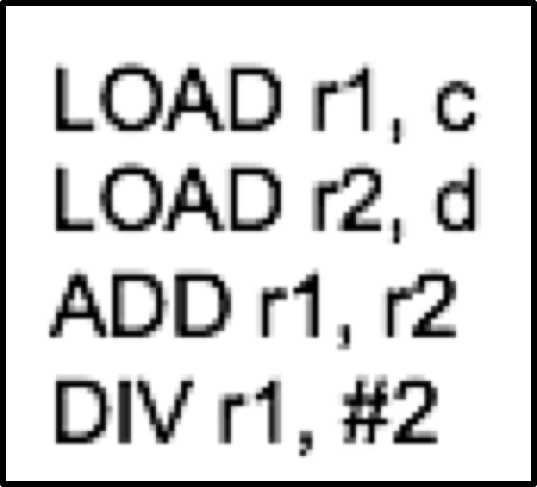
This is an example of what type of language?
High level
Low level
Both
Neither
Uses Mnemonics as command words (for example LDA, STA and ADD)
High level code
Low level code
Assembly language
What is the problem writing machine code?
Quick to learn
Easy to debug
Easy to read
Hard to remember the binary codes Hard to remember the binary codes
What's the difference between high level and low level languages?
High level is written in capitals and low level is written in lower case
High level is hard and low level is easy.
High level language is used by software and low level languages is used by hardware.
Low level languages is made of 1's and 0's and high level language is BASIC, COBOL, FORTRAN, C++, etc.
What does binary code mean?
a coding system using the binary digits 0 and 1.
a coding system using the binary digits 1-10
1000100100
code.org
What is a MNEMONIC?
A single action that can be performed by a computer.
A symbol that represents an instruction in assembly code.
A high level language keyword.
A register used inside a CPU A register used inside a CPU.
Which of the following is NOT a translator?
Assembler
Compiler
Interpreter
Executable
Why do we need translators?
Computers only understand program's in assembly code.
Computers only understand program's in high-level language.
Computers only understand Norwegian.
Computers only understand program's in machine language.
It translates assembly code into machine code.
Assembler
Compiler
Interpreter
Linker

A program that coverts source code into machine code
Object code
Interpreter
Compiler
A translator
Python is an example of . . . . .
A Visual programming language
A Low level programming language
A High level programming language
Machine language

A translator converts high-level language source code into object code, often machine code. The source code is translated all at once and saved to be executed later.
Compiler
Interpreter
high level language
Low level language

The text of a program that a programmer write
Source code
Assembly language
Machine code

Which of these descriptions is of object code?
the translated source code, which could be machine code or a type of intermediary code such as bytecode
the code written by the programmer in the chosen programming language
binary codes representing the native instructions in the processor's instruction set
low-level code written using mnemonics that represent the machine instructions in a more meaningful form
What is the smallest unit of measurement used to quantify computer data.
a bridle
a bit
marble
a tablespoon
Suggests an another name of Machine Language
Low level Language
High Level Language
Assembly Language

Advantages of search engines like Google Chrome/Mozilla Firefox
Dont save time
Easier to find information
Health issues
Harder to find information
These are the fastest and most expensive computers in the world. They are………………………,
Personal computer
Supercomputer
Which computer is the least powerful among the following?
Supercomputers
Mainframe
Minicomputers
Personal Computers
Workstation
Identify the 2 types of Micro computers from the list below:
laptop and smartphones
smartphones and tablets
desktop and embedded
desktop and laptop
Which type of computer is built to support an organization's information?
Mini
Mainframe
Embedded
Super
The largest and fastest type of computer used by large corporations and government agencies for processing a tremendous volume of data.
Computer
MP3 players
Smartphones
Supercomputers
A handheld computer used to make and receive phone calls, and perform some of the same functions as a PC, such as word processing.
Smartphones
MP3 players
Search engines
Supercomputers
A __________ is used by a single user at a time.
Supercomputer
Minicomputer
Microcomputer
Mainframe computer
Which programming language was used in second generation computers?
Machine
Assembly
High level
None of these

What am I?
Desktop PC
Smart phone
Laptop
Mainframe computer/server

Write down your complete Name, Class-Section and G.r number in given sequence.

