wayground logo

Free Printable Worksheets

NEW

Font size

S
M
L
XL
Worksheets

EARTH AND LIFE SCIENCE DIAGNOSTIC TEST

Total questions: 60

Worksheet time: 1hrs 3mins

Name
Class
Date
1.
The convergence of two CONTINENTAL plates will produce ___.
a)
island arcs
b)
rift valleys
c)
folded mountains
d)
trenches
2.
Which statement best describes why S-Waves are NOT recorded by seismographs in certain areas?
a)
Seismographs do not record s-waves.
b)
S-waves travel in a different direction than p-waves.
c)
The earthquake was not strong enough to produce s-waves.
d)
The s-waves are stopped by the liquid outer core.
3.
The BEST evidence that continents were once connected is that they have matching ___.
a)
weather, fossils, and rock types
b)
rock types, fossils, and coastlines
c)
coastlines, weather, and rock types
d)
fossils, coastlines, and weather
4.
As the velocity of a stream DECREASES, which factor will likely INCREASE?
a)
erosion of the stream bank
b)
deposition of the material in the stream
c)
the amount of material carried downstream
d)
the size of the particles carried downstream
5.
Which is the MOST responsible for the formation of new crust at plate boundaries?
a)
continent to continent convergence
b)
rising magma at divergent boundaries
c)
tectonic plates sliding past one another
d)
subduction of one tectonic plate under another
6.
If the African Plate continues to move toward the Eurasian plate, what will eventually happen?
a)
Volcanoes will form and erupt at the plate boundary.
b)
The African plate will break the Eurasian plate into pieces.
c)
The Mediterranean Sea will shrink and mountains will form.
d)
The Mediterranean Sea will become larger and earthquakes will happen.
7.
Coal forms from decayed plants that grew in hot, moist climates, so why is coal now found in cool climates such as Europe and North America?
a)
Europe and North America were once located near the equator.
b)
Europe and North America were once covered by deserts.
c)
The plants that form coal grow in the summer months.
d)
The plants that form coal adapted to cool climates over time.
8.

What force was Wegener looking for to explain how the continents moved?

a)

subduction zones at plate boundaries

b)

hot spots under continents

c)

magnetic reversals of the north and south poles

d)

convection currents in the mantle

9.
What happens when more dense, oceanic crust collides with less dense, continental crust?
a)
oceanic crust sinks below continental crust
b)
oceanic crust rides above the continental crust
c)
continental crust sinks below the oceanic crust
d)
continental crust becomes thinner than oceanic crust
10.
What conclusion can a scientist make as a result of finding different fossils in a rock layer?
a)
the fossils are made up of cooled lava
b)
the fossils formed after heat and pressure changed the type of rock
c)
the fossils are made of the same material as the organisms that formed them
d)
the fossils formed at about the same time as the rock layer they were found in
11.

According to the diagram, what will form when sedimentary rock is exposed to heat and/or pressure?

a)

magma

b)

igneous rock

c)

sediments

d)

metamorphic rock

12.
In order for life as we know it to exist, a planet must have ______________________
a)
heat
b)
animals
c)
liquid water
d)
solar energy
13.
Earth’s atmosphere contains water vapor and carbon dioxide. These greenhouse gases are important because they -
a)
are substances animals need to breathe.
b)
trap thermal energy in the atmosphere.
c)

protect against magnetic particles.
d)
create Earth’s gravitational field.
14.
What is the habitable zone?
a)
A zone with the correct distance away from a star
b)
A zone in space where water turns into vapor
c)
A zone where life can not be sustained
d)
A zone in space where water is frozen
15.

If a planet was positioned half in & half out of the habitable zone it would be able to...

a)

Sustain life because it half of the amount of water will be in liquid form.

b)

Possibly sustain life based on having some water being in liquid form & geothermal activity.

c)

Not support life because half of the water is frozen.

d)

Partially support life, but half of the organisms will freeze when the planet rotates halfway out of the habitable zone.

16.
Which is NOT considered one of the four main earth systems?
a)
atmosphere
b)
hydrosphere
c)
exosphere
d)
biosphere
17.
A system is...
a)
a moving object
b)
a collection of interacting parts
c)
a way of doing things
d)
something made by humans
18.
The four subsystems of Earth are...
a)
the troposphere, stratosphere, mesosphere, and thermosphere
b)
the inner core, outer core, mantle, and crust
c)
Jimmy Johns, Subway, Potbelly, and Firehouse
d)
the geosphere, hydrosphere, atmosphere, and biosphere
19.
The natural chemical or physical processes that breaks down rock on Earth's surface.
a)
weathering
b)
erosion
c)
deposition
d)
jackhammering
20.
The process by which water, ice, wind or gravity moves weathered rock and soil from one place to another.
a)
weathering
b)
erosion
c)
deposition
d)
dumptruck
21.
What are the 3 major types of rocks?
a)
Igneous, Metamorphic, Sedimentary
b)
Metamorphic, Igneous, Cementation
c)
Brown, Red, Gray
d)
Streak, Hardness, Breakage
22.

We are part of which subsystem?

a)

Atmosphere

b)

Biosphere

c)

Geosphere

d)

Hydrosphere

23.
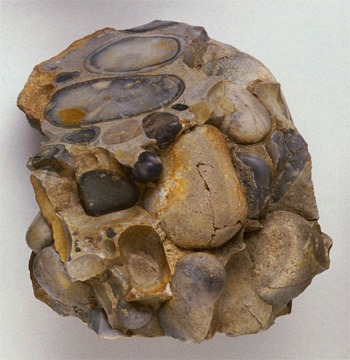
This rock was formed by smaller pieces of rock that settled at the bottom of a lake millions of years ago. What type of rock is this?
a)
Sedimentary
b)
Igneous
c)
Metamorphic
24.
The process when rocks break into smaller pieces due to exposure to natural elements is called
a)
erosion
b)
weathering
c)
sediments
25.
The three groups of rocks are classified by
a)
How they form
b)
Color
c)
Grain size
d)
Chemical Composition
26.
Rocks are formed by
a)
minerals
b)
other metals
c)
small particles
d)
sediments
27.

Earth’s internal heat is produced by ...

a)

Radioactive Decay and Absolute Dating

b)

Residual Heat and Radiogenic Heat

c)

Residual Heat and Radioactive Decay

d)

Radiogenic Heat and Absolute Dating

28.

Earth’s internal heat is produced by ...

a)

Radioactive Decay and Absolute Dating

b)

Residual Heat and Radiogenic Heat

c)

Residual Heat and Radioactive Decay

d)

Radiogenic Heat and Absolute Dating

29.

The remaining 60% of the solar energy is absorbed by the

atmosphere, land, and oceans.

a)

TRUE

b)

FALSE

c)

MAYBE

30.

Encounter theory proposes that planets were formed as a result of the “encounter” between which

two bodies in the solar system?

a)

Stars

b)

Moons

c)

Asteroids

d)

Planets

31.

In the planetesimal theory, which is believed to have had an encounter with an intruding star?

a)

Another Star

b)

Asteriods

c)

Comets

d)

Protosun

32.

Which of the following describes geothermal gradient?

a)

increase in viscosity with depth

b)

increase in volume with depth

c)

increase in temperature with depth

d)

increase in pressure with depth

33.

Which of the following describes the Earth’s thermal budget?

a)

the amount of heat produced in the interior and released on the surface

b)

The amount of heat emitted by the Earth’s core

c)

the balance of heat produced within the Earth’s interior

d)

the amount of heat absorbed by the Earth’s crust

34.

Which of the following are the main sources of Earth’s internal heat?

a)

radioactive decay of isotopes

b)

extraterrestrial impacts

c)

Ultraviolet Radiation

d)

Collision of different materials inside the earth's surface

35.

Which of the following refers to the lowest layer of the atmosphere?

a)

thermosphere

b)

exosphere

c)

troposphere

d)

stratosphere

36.

Which of the following refers to the layer where ozone is located?

a)

thermosphere

b)

stratosphere

c)

exosphere

d)

troposphere

37.

Which of the following statements is true?

a)

Nitrogen has the lowest concentration in the atmosphere.

b)

Argon is a natural greenhouse gas.

c)

Oxygen has the highest concentration in the atmosphere.

d)

Water vapor is a natural greenhouse gas.

38.

Which of the following describes magmatism?

a)

movement of magma

b)

production of lava

c)

movement of lava

d)

production of magma

39.

What is the most abundant element in magma?

a)

aluminum

b)

oxygen

c)

calcium

d)

silicon

40.

What is the most abundant component of the atmosphere?

a)

oxygen

b)

carbon dioxide

c)

nitrogen

d)

argon

41.
Which of the following is considered nonrenewable?
a)
hydroelectric
b)
solar
c)
petroleum
d)
biofuels
42.
Why do we have night and day?
a)
Earth's rotation
b)
Earth's revolution around the Sun
c)
The Sun rotating
d)
The moon block the sun
43.
Earth's rotation causes all of the following EXCEPT
a)
day and night
b)
apparent movement of the sun across the sky
c)
changing shadows
d)
weather
44.
What powers the water cycle?
a)
Sun
b)
Earth's rotation
c)
waves
d)
wind
45.
Which of the following is NOT a characteristic of both the moon and Earth?
a)
gravity
b)
rocks
c)
craters
d)
oceans
46.
Coal, oil, and natural gas are all nonrenewable resources because
a)
the are made quickly
b)
it takes a long time for them to form
c)
they are abundant
d)
they are used everywhere
47.
Which of the following is not necessary in the formation of sedimentary rocks?
a)
deposition
b)
compaction
c)
cementation
d)
earthquakes
48.
Which of the following is an alternative source of energy?
a)
fossil fuels
b)
solar
c)
oil
d)
natural gas
49.
What planet is 5th from the Sun?
a)
Jupiter
b)
Saturn
c)
Earth
d)
Mars
50.
What planet is closest to the Sun?
a)
Mars
b)
Mercury
c)
Earth
d)
Jupiter
51.
A substance that pollutes something, especially water or the atmosphere is called
a)
dirt
b)
pollutant
c)
oxygen
d)
precipitant
52.
Shifting pieces of the Earth's crust are called
a)
tectonic plates
b)
volcano
c)
magma
d)
island
53.
What is the amount of water vapor in the air called?
a)
Condensation
b)
Precipitation
c)
Evaporation
d)
Humidity
54.
Which is the most abundant gas in the atmosphere?
a)
Oxygen
b)
Nitrogen
c)
Ozone
d)
Carbon Dioxide
55.
The type of plate boundary where two plates come together is a .....
a)
Convergent Boundary
b)
Divergent Boundary
c)
Transform Boundary
d)
Plate Boundary
56.
Which of the following causes Earth's tectonic plates to move?
a)
Energy from the Sun
b)
Magnetic Pole Reversal
c)
Convection currents in the mantle
d)
Faults in Mountain Ranges
57.
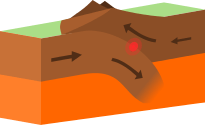
What type of event will occur at this boundary?
a)
Earthquake
b)
Volcano Eruption
c)
Tornado
d)
Mountain Building
58.
What type of plate boundary is this?
a)
Plate
b)
Divergent
c)
Convergent
d)
Transform
59.
A divergent boundary occurs when plates ....
a)
Pull apart
b)
Come together
c)
Slide past each other
d)
subducting
60.
Which of the following is the name of the ancient supercontinent formed 28 Million Years ago.
a)
Pangea
b)
Gondwanda
c)
Laurasia
d)
Neverland