
 Worksheets
NAT Review (Science)
Total questions: 60
Worksheet time: 30mins
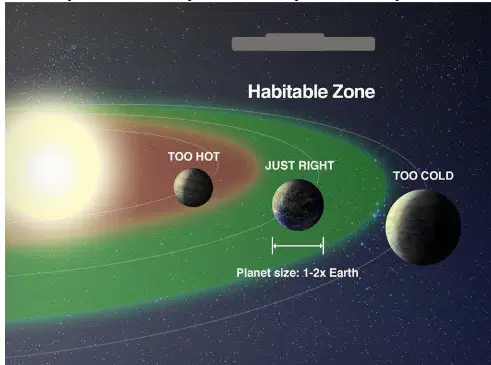
Read each statement carefully and choose the BEST answer. Refer to the illustration of the Goldilocks Zone below. Which statement describes the relation of the distance of the planets to the heat from the sun?
The closer the planet is to the sun, the lower the heat received.
The closer the planet is to the sun, the higher heat is received.
The farther the planet is away from the sun, the lower the heat received.
The farther the planet is away from the sun, the higher the heat received.
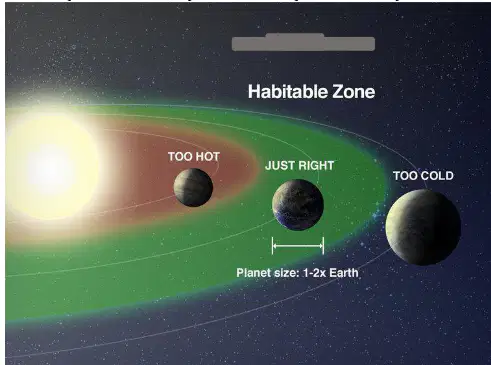
Read each statement carefully and choose the BEST answer. Refer to the illustration of the Goldilocks Zone below. Why is Earth's temperature suitable to sustain water for organisms, compared to Venus and Mars, due to their distances from the sun?
Because Earth's low temperature freezes all water into ice constantly.
Because Earth's high temperature prevents rapid evaporation of surface water.
Because Earth's temperature is optimal for maintaining and transforming liquid water.
Because Earth's temperature is adequate to create and preserve solid water on its surface.
Read each statement carefully and choose the BEST answer. Refer to the illustration of the Goldilocks Zone below. Which of the following shows the effect of the amount of light from the sun on the Earth?
having day and night
widening of orbits of the planet
production of some natural satellites
strengthening of the magnetic field of the Earth.
Scientists have discovered a new planet orbiting a star in another solar system. This planet has a similar size and rocky composition to Earth. It also possesses a liquid water surface covering a significant portion of its surface. Based on the information above and our current understanding of life on Earth, which of the following statements is the LEAST relevant to the question of whether life could potentially exist on this newly discovered planet?
The presence of an atmosphere and its composition.
The temperature range on the planet's surface.
The existence of a magnetic field.
The planet's distance from its star.
Scientists are searching for potential signs of life on other planets in the solar system. They discover a planet with a similar temperature range to Earth and an atmosphere containing oxygen. Based on the information above, which of the following statements is the MOST relevant to the possibility of life existing on this planet?
The planet is located in the habitable zone of its solar system.
The planet has a similar size and mass to Earth.
The planet has a similar rotation period to Earth.
The planet has a magnetic field similar to Earth's.
Scientists discover a new exoplanet orbiting a distant star. This planet is roughly the same size as Earth and lies within the habitable zone of its star, meaning it receives the right amount of energy to potentially harbor liquid water on its surface. However, the exoplanet's atmosphere is found to be composed primarily of ammonia gas. Based solely on the information provided, which of the following statements is MOST RELEVANT to the possibility of life existing on the exoplanet?
The exoplanet is similar in size to Earth, suggesting it may have a rocky composition.
The exoplanet is located within the habitable zone of its star, suggesting suitable temperatures for liquid water.
The exoplanet's atmosphere is composed primarily of ammonia gas, which is toxic to most life forms on Earth.
Earth is the only planet in the solar system known to support life, suggesting life may be rare in the universe.
You are researching the history of life on Earth and come across two sources: Source A: A well-established scientific journal article published by a team of paleontologists, detailing the fossil record and its implications for the evolution of dinosaurs. Source B: A blog post written by an individual with no scientific background, claiming that dinosaurs were wiped out by a giant asteroid based solely on a single, controversial movie. Based on your knowledge of evaluating sources, which source is MOST RELIABLE for understanding the Earth's history and the extinction of dinosaurs?
Source A only
Source B only
Source A and B only
Cannot be determined
You find additional information on Source A (the Paleontological Society website) concerning the Permian-Triassic extinction event, one of the most significant events in Earth's history. However, the specific details about the cause of the extinction are still under scientific debate. Which of the following actions would BEST demonstrate a critical evaluation of the information's credibility?
Assume the explanation on the website is incorrect because different scientific theories exist.
Cross-reference the information with other reliable sources, such as scientific journals or reports from reputable research institutions.
Search online forums with discussions about extinction and accept the most popular explanation.
Only consider peer-reviewed scientific journals published within the last five years; disregard older sources as potentially outdated
When researching scientific topics, why is it important to consider the following criteria when evaluating a source? Authorship: Who created the source? Purpose: Why was the information created? Date of Publication: How recent is the information?
These criteria ensure the source is accurate, unbiased, and up-to-date.
These criteria allow you to only use sources from well-known universities.
These criteria focus on the appearance and readability of the source.
These criteria are unimportant for scientific research because everyone has an opinion.
For questions 10-12 refer to the illustration on the right. What is one of the primary hazards associated with earthquakes, according to the poster?
volcanic eruptions
soil erosion
landslides
floods
For questions 10-12 refer to the illustration on the right. What is the MOST LIKELY reason why ground shaking causes so much damage during an earthquake?
The shaking ground creates loud noises that can startle people.
The shaking ground disrupts the foundation of buildings, causing them to crack or crumble.
The poster identifies liquefaction as a primary earthquake hazard. What is the MOST LIKELY consequence of liquefaction in a city with many high-rise buildings?
The city's water supply will be contaminated.
High-rise buildings are more likely to collapse.
Traffic congestion will increase due to road closures.
There will be widespread power outages throughout the city.
Refer to the diagram of the rock cycle showing sediments, sedimentary rocks, metamorphic rocks, magma, igneous rocks (intrusive and extrusive), and processes such as weathering, erosion, transportation and deposition; lithification (compacting and cementing); metamorphism (heat and pressure); melting; cooling and crystallization; solidification; uplift and exposure. Which of the following information can be gathered using the diagram above?
the types of rocks and their formation
the process how metamorphic rocks are classified
where weathering, erosion, transportation and deposition happens
the process of bringing magma from the mantle to the crust via volcanoes
Based on the diagram above, which of the following is a correct flow of the formation of rocks? I. magma solidification extrusive igneous rocks II. magma melting Intrusive igneous rocks III. igneous rocks uplift and exposure metamorphic rocks IV. sedimentary rocks heat and pressure metamorphic rocks
I and II
II and III
I, II and III
I, II, and IV
Listed below are processes on the formation of a sedimentary rock. Based on the diagram, which is the correct sequence of the formation of a sedimentary rock? I. Igneous rocks undergo uplift and exposure II. Magma cools and crystallizes beneath the surface of the earth III. Weathering, erosion, and other processes turn igneous rocks into sediments. IV. Sediments are buried and are turned into magma. V. Sediments undergo compacting and cementing.
I II III V
I II V
I III V
II IV V
For questions 16–18 refer to the diagrams showing coastal wave erosion: Panel 1 depicts high tide with deep water allowing larger waves with greater energy to reach the cliffs; Panel 2 shows hydraulic action of waves against the cliff; Panel 3 shows rocks thrown against cliffs (corrosion/abrasion); Panel 4 shows rocks hitting each other becoming smoothed and eroded (attrition). You are a coastal geologist studying an area where the coastline is experiencing increased erosion. You observe exposed rock layers and evidence of powerful wave action. Based on the diagram above and the situation, what is the MOST LIKELY initial step you should take to understand the problem and generate a valid hypothesis about the cause of the erosion?
Analyze historical data on sea level rise in the region.
Recommend building a seawall to prevent further erosion.
Collect sand samples from the beach for grain size analysis.
Interview local residents about their observations of the coastline.
For questions 16–18 refer to the diagrams showing coastal wave erosion: Panel 1 depicts high tide with deep water allowing larger waves with greater energy to reach the cliffs; Panel 2 shows hydraulic action of waves against the cliff; Panel 3 shows rocks thrown against cliffs (corrosion/abrasion); Panel 4 shows rocks hitting each other becoming smoothed and eroded (attrition). The diagram illustrates how waves contribute to coastal erosion. Imagine a similar scenario on a coastline with a different rock type, such as softer sandstone instead of the cliffs pictured. How would your hypothesis about wave erosion likely need to be modified?
The rate of erosion would be slower because sandstone is a harder rock.
The waves would have a more significant impact, causing more rapid erosion.
The diagram is inaccurate and does not represent the actual process of coastal erosion.
The process of erosion would remain fundamentally the same, regardless of the rock type.
For questions 16–18 refer to the diagrams showing coastal wave erosion: Panel 1 depicts high tide with deep water allowing larger waves with greater energy to reach the cliffs; Panel 2 shows hydraulic action of waves against the cliff; Panel 3 shows rocks thrown against cliffs (corrosion/abrasion); Panel 4 shows rocks hitting each other becoming smoothed and eroded (attrition). The diagram shows how waves with greater energy can cause more erosion at high tide. This process can also be influenced by the presence of human-made structures like seawalls. Based on this understanding, how might building a seawall along a low-lying coast MOST LIKELY affect the surrounding area beyond the immediate location of the seawall?
It will have no significant impact on nearby areas.
It will cause increased erosion on the beach in front of the seawall.
It will lead to deeper water and the formation of new beaches downdrift of the seawall.
It will cause increased erosion on the beaches and downdrift (down the current) of the seawall.
Astronomers observe a distant galaxy exhibiting a significant redshift in its spectral lines. This observation suggests that the galaxy is moving away from Earth. Which of the following is the MOST LIKELY hypothesis astronomers could generate to explain this observation?
The galaxy is positioned near the edge of the observable universe.
The galaxy is experiencing an unusually high rate of star formation.
The galaxy is located within a cluster of galaxies with high individual velocities.
The galaxy is a very bright object emitting light in the red part of the spectrum.
Let's say another galaxy is observed with an even GREATER redshift. Based on our understanding of the universe's expansion, which of the following hypotheses is the MOST LIKELY explanation for this observation?
The second galaxy is simply rotating faster than the first galaxy.
The second galaxy is moving away from Earth at a faster speed than the first galaxy.
If scientists discovered another galaxy demonstrating an even larger redshift than the first, which of the following would be the MOST likely inference?
The second galaxy is older than the first galaxy.
The second galaxy is smaller than the first galaxy.
The second galaxy is hotter in temperature than the first galaxy.
The second galaxy is moving away from Earth at a faster speed than the first galaxy.
Geologists are investigating the age of a rock formation consisting of distinct layers of sedimentary rocks. They want to determine the age of a specific fossil layer sandwiched between two other rock layers. Which of the following methods would be MOST appropriate for the geologists to use to determine the age of the fossil layer?
radiometric dating of the specific fossil layer itself
carbon dating of organic materials present within the fossil layer
law of superposition applied to the relative positions of the rock layers
comparing the fossil layer to known rock formations in other locations
Geologists are studying a rock formation containing several distinct layers. They want to determine the age of a specific rock layer within the formation. Which of the following methods would be MOST appropriate for determining the age of the specific rock layer?
measuring the speed of sound waves traveling through the rock layer
identifying and analyzing the relative position of fossils within the rock formation
using radiometric dating techniques on minerals from the specific rock layer
comparing the overall mineral composition of the rock layer to known rock formations of similar appearance
Geologists are tasked with determining the age of a series of rock layers in a newly discovered canyon. The rock layers appear stratified, with distinct boundaries between them. However, the presence of fossils in these layers is limited. Which of the following approaches would be the MOST effective strategy for determining the age of these rock layers, given the limited fossil availability?
Use relative dating only, analyzing the order of the layers to determine their age sequence.
Since fossils are limited, it is impossible to determine the age of these rock layers with any reliable method.
Use absolute dating only, focusing on techniques like radiometric dating on volcanic ash layers within the strata.
Combine relative dating with radiometric dating of any available fossils to achieve a more comprehensive understanding.
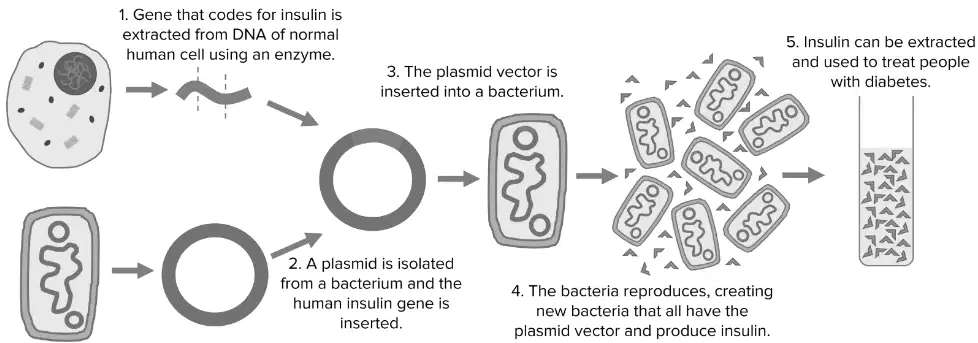
Refer to the diagram showing the steps in genetic engineering through recombinant DNA: 1) gene that codes for insulin is extracted from DNA of normal human cell using an enzyme; 2) a plasmid is isolated from a bacterium and the human insulin gene is inserted; 3) the plasmid vector is inserted into a bacterium; 4) the bacteria reproduce, creating new bacteria that all have the plasmid vector and produce insulin; 5) insulin can be extracted and used to treat people with diabetes. What is the result of step 3 in the process above?
Bacterial cells may form a multicellular embryo.
Bacterial cells will destroy defective human genetic material.
The inserted human DNA may direct the synthesis of human proteins.
The inserted human DNA will change harmful bacteria to harmless ones.
What is the common use of the laboratory technique depicted above?
introduction of toxic substances to kill bacterial cells
change of single-celled organisms to multicellular organisms
production of a human embryo to aid women who are unable to have children
production of hormones or enzymes to replace missing human body chemicals
Why is the plasmid vector inserted into a bacterium and not in other types of cells like plant or animal cells?
because bacteria multiply rapidly
because bacterial cells are resistant to changes in DNA
because the plasmid DNA is harmful to other types of cells
because bacterial cells will become less harmful if the plasmid DNA is inserted
For questions on bees, refer to the diagram showing reproduction among bees. According to the diagram, which is true about drones (male bees) and queen (female) bees?
Both drones and queen bees are haploid.
Both drones and queen bees are diploid.
Drones are diploid while queen bees are haploid.
Drones are haploid while queen bees are diploid.
For questions on bees, refer to the diagram showing reproduction among bees. How are haploid male bees produced?
By fertilization of eggs of a diploid female bee and haploid male bee
Egg cells of diploid female bees undergo meiosis and no fertilization occurs.
Egg cells of a haploid male bee undergo meiosis and no fertilization occurs.
By fertilization of the haploid sperm cell of a male bee and the haploid egg cell of a female bee.
For questions on bees, refer to the diagram showing reproduction among bees. How do bees reproduce asexually?
by regeneration
by binary fission
by fragmentation
by parthenogenesis
A sudden decrease in the population of rabbits in a forest has been observed. Based on the following information about the factors affecting population growth: Biotic potential: the ability of a population to reproduce under ideal conditions. Environmental resistance: factors in the environment that limit population growth (e.g., diseases, food availability, predators). Which combination of factors is MOST LIKELY causing the decrease in the rabbit population?
increase in food availability and decrease in predator population
decrease in food availability and increase in predator population
increase in food availability and no change in the predator population
decrease in food availability and no change in the predator population
The deer population in a national park has been steadily increasing for the past few years. Park rangers are concerned about the potential for a population explosion if left unchecked. Based on the concept of biotic potential and environmental resistance, which of the following factors is MOST LIKELY to eventually slow down the population growth of the deer?
an abundance of food sources within the park
increase in the average lifespan of individual deer
introduction of a new predator species to the park
development of new water sources throughout the park
Based on the concept of biotic potential and environmental resistance, what is the MOST LIKELY long-term outcome for the deer population if the park rangers do not intervene to manage their numbers?
The deer population will continue to grow exponentially without limit.
The deer population will be limited by environmental resistance and stabilize near carrying capacity.
The deer population will immediately crash to extinction regardless of resources.
The deer population will stop reproducing entirely even under ideal conditions.
For questions 34–36, refer to the concept map of biotechnology. Based on the information in the graphic organizer, which of the following statements is most likely NOT true?
Classical biotechnology involves manipulating entire organisms.
Genetic engineering allows for the modification of specific genes.
Biotechnology has been used to create plants resistant to pests.
All forms of biotechnology rely on modifying the genetic makeup of living things.
For questions 34–36, refer to the concept map of biotechnology. While the graphic organizer provides an overview of biotechnology, some details are not included. Which of the following statements cannot be determined based solely on the information presented?
Classical and modern biotechnology utilize different tools and techniques.
Biotechnology has only recently emerged as a field of science and technology.
Genetically modified organisms (GMOs) are always harmful to the environment.
Ethical concerns surround the use of genetic engineering in certain applications.
For questions 34–36, refer to the concept map of biotechnology. The graphic organizer lists various applications of biotechnology. From these applications, which information is NOT relevant to its impact on food production?
Transgenic crops with increased resistance to pests.
Production of enzymes used in cheesemaking.
Development of faster-growing and more nutritious crops.
Creation of microorganisms that can break down pollutants.
Refer to the diagram below illustrating the CRISPR-Cas9 process. Which of the following steps in the CRISPR-Cas9 process most closely aligns with the function of identifying and targeting a specific gene? A. Step 1: Cas9 is an enzyme that acts like "molecular scissors" to cut DNA. B. Step 2: Scientists create a genetic sequence called a "guide RNA" that pairs with the piece of DNA they want to delete, insert or change. C. Step 3: The guide RNA sticks to Cas9 in the cell and together they seek out the target DNA sequence. D. Steps 4 and 5: Cas9 unzips the target DNA and cuts it, allowing for the desired change.
Step 1: Cas9 is an enzyme that acts like "molecular scissors" to cut DNA.
Step 2: Scientists create a genetic sequence called a "guide RNA" that pairs with the piece of DNA they want to delete, insert or change.
Step 3: The guide RNA sticks to Cas9 in the cell and together they seek out the target DNA sequence.
Steps 4 and 5: Cas9 unzips the target DNA and cuts it, allowing for the desired change.
Refer to the diagram below outlining CRISPR-Cas9 gene editing. The diagram outlines the steps involved in CRISPR-Cas9 gene editing. In which order are the steps typically performed? A. Scientists create a guide RNA, Cas9 cuts the target DNA, and the cell repairs the DNA. B. Cas9 cuts the target DNA, scientists create a guide RNA, and the cell repairs the DNA. C. Scientists create a guide RNA, the cell repairs the DNA, and Cas9 cuts the target DNA. D. The cell repairs the DNA, Cas9 cuts the target DNA, and scientists create a guide RNA.
Scientists create a guide RNA, Cas9 cuts the target DNA, and the cell repairs the DNA.
Cas9 cuts the target DNA, scientists create a guide RNA, and the cell repairs the DNA.
Scientists create a guide RNA, the cell repairs the DNA, and Cas9 cuts the target DNA.
The cell repairs the DNA, Cas9 cuts the target DNA, and scientists create a guide RNA
Refer to the diagram below. What is the CORRECT sequence of steps for altering a gene using CRISPR-Cas9, according to the diagram? A. Isolate the target DNA, create a guide RNA, use Cas9 to cut the DNA, and insert the new DNA sequence. B. Create a guide RNA, use Cas9 to cut the DNA, isolate the target DNA, and insert the new DNA sequence. C. Use Cas9 to cut the DNA, create a guide RNA, isolate the target DNA, and insert the new DNA sequence. D. Isolate the target DNA, use Cas9 to cut the DNA, create a guide RNA, and insert the new DNA sequence.
Isolate the target DNA, create a guide RNA, use Cas9 to cut the DNA, and insert the new DNA sequence.
Create a guide RNA, use Cas9 to cut the DNA, isolate the target DNA, and insert the new DNA sequence.
Use Cas9 to cut the DNA, create a guide RNA, isolate the target DNA, and insert the new DNA sequence.
Isolate the target DNA, use Cas9 to cut the DNA, create a guide RNA, and insert the new DNA sequence.
For questions 40-42 refer to the diagram on the right. Heat can make a turbine rotate and turn, allowing the generator to convert energy into electricity. Which set of elements in a geothermal power plant play vital roles in the mechanical energy of the turbine? A. water and steam B. water and condenser C. water and generator D. water and geothermal energy
water and steam
water and condenser
water and generator
water and geothermal energy
For questions 40-42 refer to the diagram on the right. How is electricity generated in a geothermal power plant? A. The chemical energy in the steam is converted into mechanical energy and converted into electricity in the generator. B. The mechanical energy from the earth’s interior is converted to steam that drives the
The chemical energy in the steam is converted into mechanical energy and converted into electricity in the generator.
The mechanical energy from the earth’s interior is converted to steam that drives the
Which energy transformation, represented by arrows, is taking place in the figure of a hydropower plant below. Note: KE = kinetic energy; PE = potential energy.
PE of water → KE of water → KE of turbine → electrical energy of generator
KE of water → PE of water → electrical energy of generator → KE of turbine
PE of water → electrical energy of generator → KE of turbine → KE of water
KE of turbine → PE of water → KE of water → electrical energy of generator
Which correctly describes the two molecules shown in the structures of fatty acids below.
Both are saturated fatty acids.
The first one is polyunsaturated because of the absence of double bonds.
The one above is polyunsaturated while the one below is a saturated fatty acid.
The one above is saturated while the one below is a polyunsaturated fatty acid.
How will you compare the properties of these two fatty acids?
The first one is solid at room temperature and has a higher melting point.
The first one is liquid at room temperature and has a lower melting point.
Both of them are solid at room temperature and have low melting points.
Both of them are liquid at room temperature and have high melting points.
The above molecules are primary components of which biomolecule?
lipids
proteins
nucleic acids
carbohydrates
Which of the following correctly describes the polarity of the molecules in the table above?
water and benzene are polar
benzene and hexane are polar
water and hexane are polar
water is polar while benzene is non-polar.
Which substances will most likely dissolve with each other and form a solution?
benzene and water
hexane and water
benzene and hexane
benzene, hexane and water
What can you conclude about the boiling point of polar and non-polar substances and why?
Polar substances have generally LOWER boiling points than nonpolar ones because of weak dipole interactions.
Polar substances have generally HIGHER boiling points than nonpolar ones because of strong dipole interactions.
The boiling points of polar and nonpolar substances do not differ so much because they have similar molecular structures.
Nonpolar molecules have generally HIGHER boiling points than non-polar substances because they have equally distributed charges
A student conducts an experiment investigating the effect of particle size on reaction rate. They use two equal-sized chunks of calcium carbonate (CaCO3) and react them separately with hydrochloric acid (HCl). In the first trial, the student uses one whole chunk. In the second trial, they grind the other chunk into a fine powder. Which of the following is the MOST LIKELY outcome of the experiment and the associated reason, based on collision theory?
The powdered calcium carbonate will react faster because it has a smaller particle size, leading to less frequent collisions.
The powdered calcium carbonate will react faster because it has a larger surface area, leading to more frequent collisions.
The whole calcium carbonate chunk will react faster because it has a greater concentration of reactants.
Both reactions will occur at the same rate because the overall amount of calcium carbonate is the same.
In the experiment, why is the powdered calcium carbonate expected to react faster than the whole chunk, based on collision theory?
The powdered calcium carbonate has a higher concentration of reactants, leading to more frequent collisions.
The powdered calcium carbonate has a larger surface area, allowing for more efficient mixing with the acid.
The powdered calcium carbonate has a smaller particle size, increasing the kinetic energy of the particles.
The powdered calcium carbonate has a weaker chemical bond, making it easier to break during the reaction.
A chemistry student is investigating the effect of temperature on reaction rate. They plan to react magnesium metal with hydrochloric acid (HCl) at two different temperatures: room temperature (25°C) and a higher temperature (50°C). Based on collision theory, what is the MOST LIKELY outcome of the experiment regarding the reaction rate at different temperatures?
The reaction rate will be slower at 50°C because the particles have less energy to overcome the activation energy.
The reaction rate will be faster at 50°C because the particles have more frequent collisions due to higher kinetic energy.
The reaction rate will not be affected by the temperature change as the amount of reactants remains constant.
The reaction rate will depend on the concentration of the acid, not the temperature.

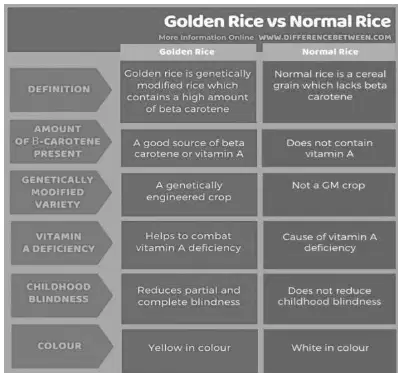
One approved GMO crop in the Philippines is Golden Rice. Referring to the table below, which of the following statements describes the benefit can get from golden rice?
use in the poultry industry.
new feature in color, from white to yellow.
Beta carotene content that reduces blindness.
It is a genetically modified/engineered crop and is easy to reproduce.
Genetically Modified Organisms are an innovative way to give solutions to the food supply in the country. Which benefits can consumers get from GMO crops?
Higher quality crops that are harvested over a long period of time.
Lower resistance to insects that easily be available to the market.
Improved nutritional value of food gives solutions to health.
Crops that adapt to the abrupt change of the environment.
GMO crops introduced new genes that showed up new traits. How could these become risks to the ecosystem?
Diminish the production of biodiversity and the evolution of organisms.
Retain the common texture and tastes of the food.
Higher tolerance to pesticides.
Longer shelf life of the crops.
Refer to the diagram of reflection from concave and convex mirrors showing focal points, centers of curvature, ray paths, and the resulting images. Which observation best demonstrates an association between the type of mirror and the characteristics of the reflected image?
The convex mirror produces an inverted image, while the concave mirror produces an upright image.
The concave mirror produces an upright and magnified image, while the convex mirror produces an inverted and diminished image.
Both the concave and convex mirrors produce upright images, but the convex mirror produces larger images than the concave mirror.
Both the concave and convex mirrors produce inverted images, but the concave mirror produces larger images than the convex mirror.
Refer to the diagram of reflection from concave and convex mirrors showing focal points, centers of curvature, ray paths, and the resulting images. What is the likely cause-and-effect relationship between the curvature of the mirror surface and the characteristics of the reflected image?
The curvature of the mirror surface determines the orientation of the reflected image, resulting in either an upright or inverted image.
The curvature of the mirror surface influences the size of the reflected image, resulting in either a magnified or diminished image.
The orientation of the reflected image affects the curvature of the mirror surface, resulting in concave or convex mirror shapes.
The size of the light source determines the curvature of the mirror surface, resulting in concave or convex mirror shapes.
Based on the observed characteristics of the reflected images in the diagram of concave and convex mirrors, what is the likely outcome when using concave and convex mirrors in real-world applications?
Concave mirrors are commonly used in makeup mirrors to provide a magnified view, while convex mirrors are used as side-view mirrors in vehicles to provide a wider field of view.
Concave mirrors are used as side-view mirrors in vehicles to provide a wider field of view, while convex mirrors are used in makeup mirrors to provide a magnified view.
Both concave and convex mirrors are primarily used in photography studios to manipulate the size and orientation of reflected images.
Concave mirrors are used in telescopes to magnify distant objects, while convex mirrors are used in microscopes to magnify small objects.
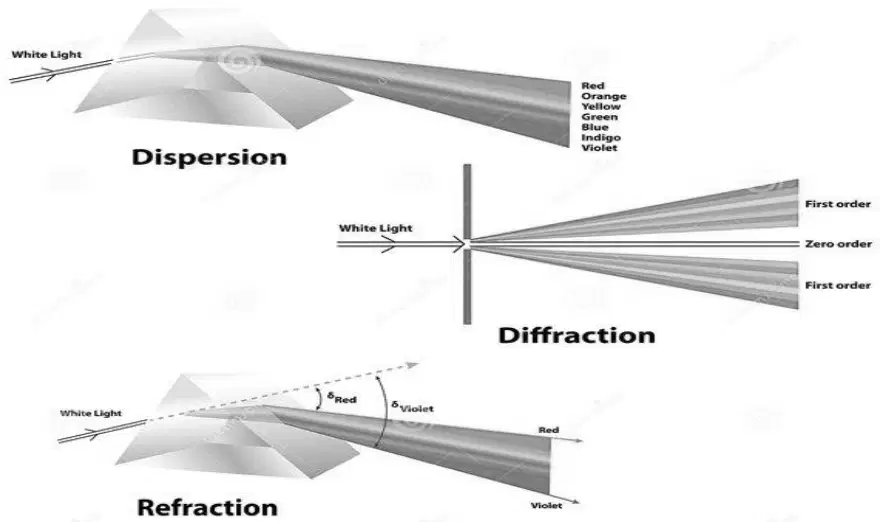
The diagram illustrates three phenomena: dispersion, diffraction, and refraction. When light passes through a prism, which of the following observations is NOT evidence of dispersion?
The white light separates into a spectrum of colors.
The red light bends the least as it passes through the prism.
The violet light bends the most as it passes through the prism.
The prism reflects some of the light back into the medium it came from.
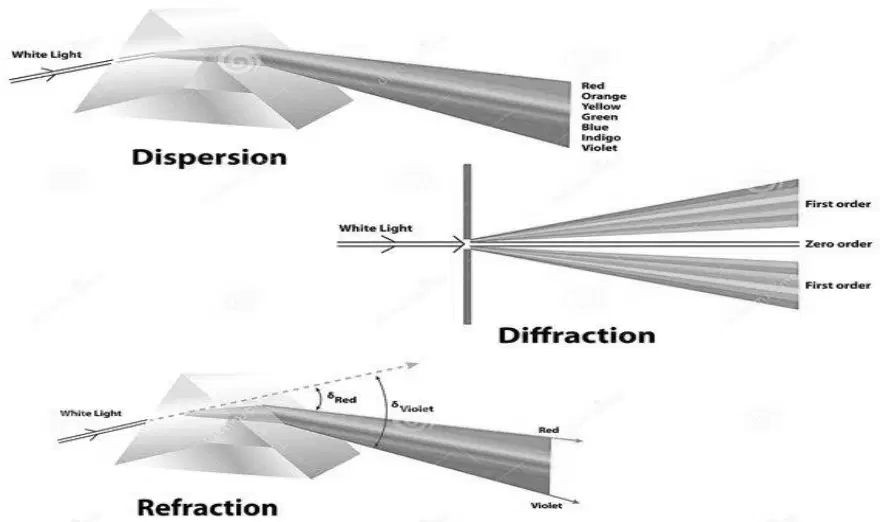
Argument: Light always travels in a straight line. Which of the following observations from the image BEST challenges this argument?
The white light splitting into a spectrum of colors after passing through the prism.
The light bending slightly when it enters and again when it exits the water.
The light spreading out as it passes through the single slit on the right.
The different colors in the spectrum refracting at slightly different angles.
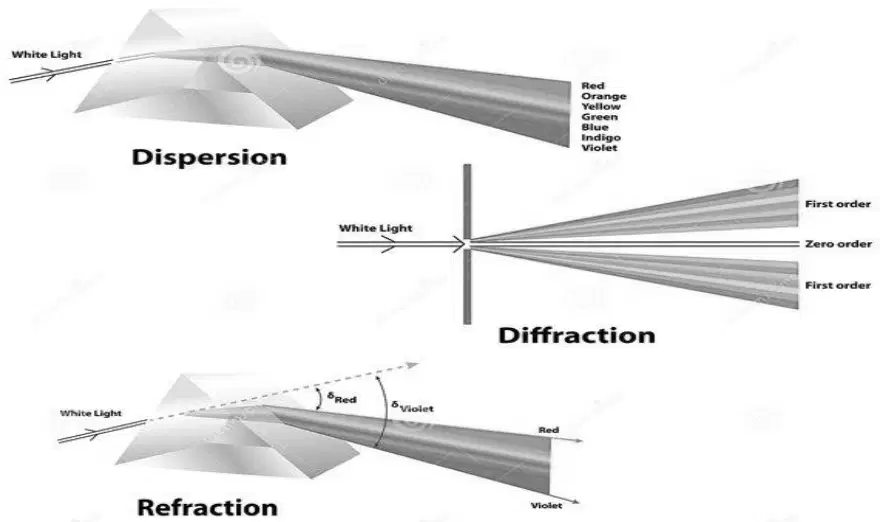
What scientific evidence, based on the diagram, supports the conclusion that the different colors of light travel at different speeds in the prism?
All the colors of light exit the prism at the same angle.
The red light bends the most as it passes through the prism.
The violet light bends the least as it passes through the prism.
The white light separates into distinct bands of color as it passes through the prism

