
 Worksheets
Earth Science: Space
Total questions: 59
Worksheet time: 30mins
Which of the following is true?
The sun is not a star
The sun is not on the main sequence.
The sun is made of helium and hydrogen
The sun has a solid surface
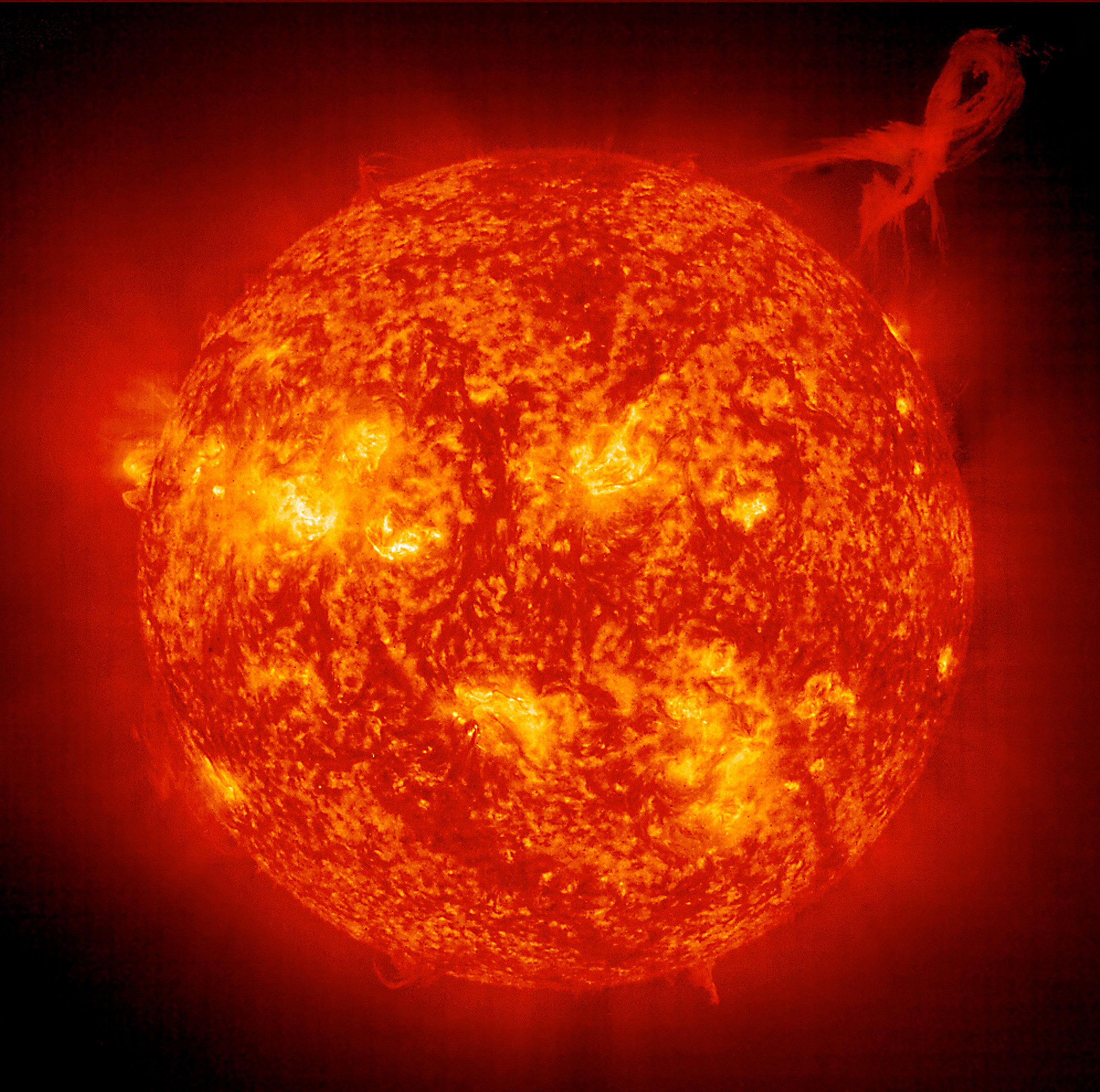
Main sequence stars are mainly made up of which gases?
Carbon and Oxygen
Helium and Hydrogen
Helium and Oxygen
Carbon and Hydrogen
A star starts as a huge cloud of gas and dust called a nebula
true
false

In the diagram given, what happens as we move to the left?
Stars get brighter
Stars get cooler
Stars get hotter
Stars get dimmer
Which of these colors of stars are hottest?
Red
Yellow
Orange
Blue
Which color of star has the lowest temperature?
Yellow Star
Red Star
Orange Star
Blue Star
In which category is our Sun classified?
White Dwarfs
Supergiants
Main Sequence
Giants
To which category do 90% of all stars belong?
Main Sequence
Supergiants
Giants

As a whole, red giants are considered hotter than white dwarfs.
True
False

Look at the H-R diagram. Which star is
cool, dim, and red?
Betelguse
Sirius B
Procyon B
Barnard's star

Which of these is a small, dense, dim, hot star?
Red Dwarf
Red Giant
White Dwarf
Blue Giant
What does the existence of the cosmic background radiation tell us?
the big bang model is wrong
the universe began in a hot, dense state that produced energy to expand.
the universe did not have a beginning
the universe began in a cold, low-density state.
If an galaxy is moving toward us, its spectrum will experience
Hubble observed that galaxies are
Because of the Doppler Effect, the wavelengths of light from a galaxy moving away from us become
longer
shorter

What best describes the doppler effect?
An apparent change in frequency of a wave due to the relative motion between a wave source and an observer
When sound changes pitch
When light changes color
An apparent change in the amplitude of a wave due to the relative motion between a wave source and an observer.

A wave with a large wavelength will have a ______ frequency and _____ energy
high, low
high, high
low, high
low, low

What color has the longest wavelength, or the lowest frequency?
violet
red
green
orange

What color has the shortest wavelength, or the highest frequency?
yellow
blue
red
green

Which of the stars is furthest along in its life cycle?
Betelgeuse
Alpha Centauri B
Sirius B
Vega

Which of these stars are fusing hydrogen into helium in their cores?
Betelgeuse
Alpha Centauri B and Sirius B
Vega and Belelgeuse
Our Sun, Alpha Centauri B, and Vega


Main sequence stars will become red giants when they run out of ______ in their cores?
Helium
Hydrogen
Carbon
Which type of star is furthest along in its life span?
main sequence
white dwarf
red giant


What will happen to Sirius B?
It will become a red giant.
It will explode.
It will become a black dwarf.
It will become a main sequence star.
A planet in an elliptical orbit travels fastest when it is
nearest its star
farthest from its star
everywhere along its orbit.
Acceleration is greater for a planet when it is at the
aphelion
perihelion
Pluto is farther away from the Sun than the Earth. Which one has a longer orbital period?
Earth
Pluto
One of the two foci of a planet's ellipse is a
Star
Planet
Moon
What is the eccentricity of a perfect circle?
zero
one
between one and zero
What is the eccentricity of an ellipse that is not a circle?
zero
one
between one and zero
What is the eccentricity of a straight line?
zero
one
between one and zero
The more eccentric an ellipse
the closer the number is to one
the closer the number is to zero
The more circular an ellipse
the closer the number is to one
the closer the number is to zero
The universe stops expanding and begins to contract.
open universe
closed universe
flat universe
The universe stops expanding but doesn't contract.
open universe
closed universe
flat universe
The universe never stops expanding.
open universe
closed universe
flat universe
What is Kepler's 1st law?
The planets orbit in an ellipse
The plants move faster when they are closer to the sun and slower when they are further from the sun
The farther a planet is from the sun the slower the orbit
(P2 = a3)
What is Kepler's 2nd law?
The planets orbit in an ellipse
The plants move faster when they are closer to the sun and slower when they are further from the sun
The farther a planet is from the sun the slower the orbit
(P2 = a3)
What is Kepler's 3rd law?
The planets orbit in an ellipse
The plants move faster when they are closer to the sun and slower when they are further from the sun
The farther a planet is from the sun the slower the orbit
(P2 = a3)
The point in the earth's orbit where it is closest to the sun and moves the fastest.
aphelion
perihelion
The point in the earth's orbit where it is farthest to the sun and moves the slowest.
aphelion
perihelion

