wayground logo

Free Printable Worksheets

NEW

Font size

S
M
L
XL
Worksheets

7 Forces

Total questions: 65

Worksheet time: 2hrs 11mins

Name
Class
Date
1.

A force is:

a)

a push

b)

a pull

c)

a twist

d)

all the examples above

2.

A force:

a)

cannot be measured, causes something to move, stop moving or change direction.

b)

can be measured, causes something to move, stop moving or change direction.

c)

can be measured, can only act in contact with an object

d)

cannot be measured, can act in contact or at a distance.

3.

What does this measure?

a)

Force

b)

Weight

c)

Mass

d)

Newtons

4.

What is the name of the units in which we measure force?

a)

Einsteins

b)

Newtons

c)

Kilograms

d)

Metres

5.

This is an example of what force?

a)

Pull

b)

Push

c)

Twist

d)

Gravity

6.

This is an example of what force?

a)

Pull

b)

Push

c)

Twist

d)

Magnetism

7.
Balanced forces do not change the objects speed or 
a)
direction
b)
distance 
c)
time
d)
mass
8.
If an object is stationary (not moving) the forces acting upon it are _____________
a)
unbalanced
b)
weak
c)
balanced
d)
Hulk Smash!
9.
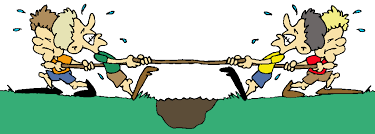
If these teams are pulling with the same amount of force what will happen?
a)
The boy in blue will win.
b)
They will not move at all.
c)
The boy in red will win.
d)
Both will fall down.
10.
Which one is balanced?
a)
top
b)
bottom
c)
both
11.
(T or F?) A balanced force is only an object that is not moving. 
a)
True 
b)
False
12.
An _______ force must act on an object for it to CHANGE it's motion
a)
balanced
b)
unbalanced
c)
gravitational
d)
electrical
13.
Which could be an example of an unbalanced force?
a)
A plate sitting on a dining table
b)
A ball at the top of a hill that is not moving
c)
Earth orbiting the Sun 
d)
A baseball that has been thrown to home plate.
14.
With unbalanced forces, the object will move in the direction of the _______ force.
a)
larger 
b)
smaller 
c)
equal 
d)
cannot be determined
15.
The sum of all forces acting on an object.
a)
Contact Force
b)
Balanced Force
c)
Unbalanced Force
d)
Net Force
16.

If the net force is equal to zero, the forces acting on the object are

a)

balanced

b)

unbalanced

17.
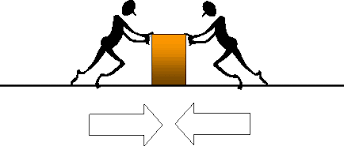
Jonny and Patty are pushing against a basketball. Both of them push against theball on opposite sides with a force of 20 N to keep the ball still. What is the net force?
a)
400 N
b)
24 N
c)
0 N
d)
40 N
18.
What is the net force in this picture?
a)
50 Newtons to the right
b)
950 Newtons to the right
c)
950 Newtons to the left
d)
50 Newtons to the left
19.

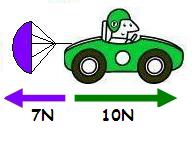
What is the net force?

a)

3 N

b)

3 N, right

c)

17 N, right

d)

3 N, left

20.
What is the net force?
a)
5000 N right
b)
4000 N right
c)
40 N left
d)
4000 N left
21.
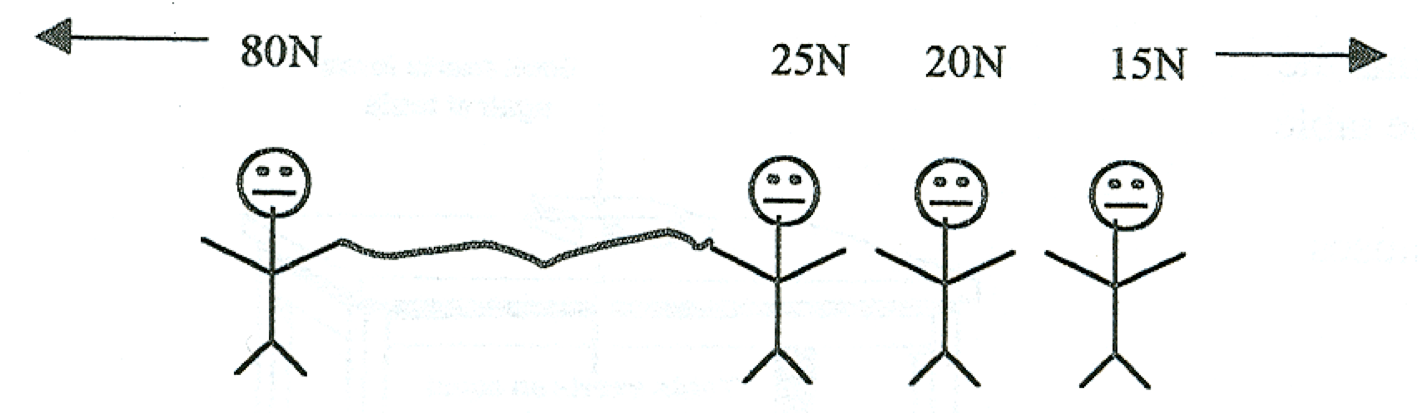
Who wins the tug of war with what net force?
a)
The person on the left with 20 N
b)
The person on the left with 80 N
c)
The people on the right with 20 N
d)
The people on the right with 100 N
22.

Two forces are acting on an object to the right at the same time. What force is required to stop the object moving?

a)

9 N to the right

b)

9 N to the left

c)

3 N to the left

d)

18 N to the left

23.

According to this force diagram, is this object balanced or unbalanced?

a)

Balanced

b)

Unbalanced

c)

I don't know

24.

How do you know if this object is balanced?

a)

It's not balanced; it's Net Force is 14 N

b)

It is balanced because its Net Force is 0 N.

c)

It's not balanced; it's Net Force is 10 N left and 4 N up.

d)

I don't know how to tell.

25.

Which force is having the greatest impact on this object currently?

a)

Applied force

b)

Normal force

c)

Frictional force

d)

Gravitational force

26.

In this force diagram, which arrow is representing Friction?

a)

A

b)

B

c)

C

d)

D

27.

In this force diagram, which arrow is representing the Normal Force?

a)

A

b)

B

c)

C

d)

D

28.

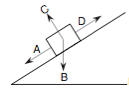
The diagram shows a box being pulled up the ramp. Which letter represents the weight?

a)

A

b)

B

c)

c

d)

d

29.

The diagram shows a box being pulled up the ramp. Which letter represents the Normal Force?

a)

A

b)

B

c)

C

d)

D

30.
When two objects rub together, what force do they produce
a)
Gravity
b)
Air resistance
c)
Friction
d)
Water resistance
31.
The force that opposes the motion of two surfaces sliding past each other is called ___________.
a)
acceleration
b)
inertia
c)
friction
d)
unbalanced
32.
Which of the following forces is a force that acts on an object by touching the object?
a)
electricity
b)
friction
c)
gravity
d)
magnetism
33.
On which surface would friction be the greatest?
a)
carpet
b)
ice
c)
snow
d)
satin
34.

You are pushing a wheelbarrow. What happens to the wheelbarrow's motion if more mass is added and you push with the same force?

a)

The motion will remain the same

b)

The motion will increase.

c)

The motion will decrease.

d)

The motion will change directions.

35.
What force does a parachute use to slow things down before hitting the ground?
a)
Friction
b)
Air resistance
c)
Water resistance
d)
Wind
36.

Without air resistance, a bowling ball and feathers will fall:

a)

at the same time

b)

faster for the bowling ball

c)

slower for the bowling ball

d)

they will both fall much slower

37.

Magnetism is:

a)

a non-contact force force that pulls some metals towards a magnet

b)

a non-contact force force that pulls all metals towards a magnet

c)

a contact force force that pulls some metals towards a magnet

d)

a contact force that pulls all metals towards a magent

38.

This is an example of:

a)

magnetism

b)

gravity

c)

friction

d)

electrostatic attraction

39.

Which of these metals would be attracted to a magnet?

a)

iron

b)

copper

c)

aluminium

d)

gold

40.

Which of these metals would be attracted to a magnet?

a)

iron, cobalt, nickel

b)

iron, copper, aluminium

c)

iron, cobalt, aluminium

d)

copper, nickel, aluminium

41.
What type of force?
a)
Magnetic
b)
Gravitational
c)
Applied
d)
Normal
42.
What happens when two north poles of a magnet are placed together?
a)
they repel
b)
they attract
c)
they cancel each other out
d)
the strength of the magnet is doubled
43.
The north pole of one magnet will be attracted to the __________ pole of another magnet.
a)
east
b)
north
c)
south
d)
west
44.

If a student has two magnets, how might it be determined which magnet is stronger?

a)

Count how many paper clips each magnet can lift.

b)

Submerge each magnet in a bowl of water.

c)

Examine each magnet to determine the north pole.

d)

Measure the length and the mass of both magnets.

45.
What is the force that causes objects to fall to Earth?
a)
Air resistance
b)
Gravity
c)
Water resistance
d)
Pressure
46.
What is the force that causes everything to be pulled down to the Earth?
a)
friction
b)
gravity
c)
balanced
d)
unbalanced
47.

In the free-body diagram, which of the following is the gravitational force acting on the balloon?

a)

5120 N

b)

950 N

c)

1520 N

d)

4050 N

48.

___________ is the amount of matter in an object.

a)

Mass

b)

Weight

c)

Volume

d)

Force

49.
Jupiter has about 317 times more mass than Earth. What can you infer from this fact? 
a)
That Jupiter’s gravitational force is much weaker than on Earth’s gravitational force.
b)
That Jupiter’s gravitational force is much stronger than Earth’s gravitational force.
c)
That Jupiter’s and Earth’s gravitational forces are equal.
d)
Mass has no effect on the gravitational force between two objects
50.

Students conducted an investigation in which they let the same car roll down the same ramp in three different locations in their school with three different floor types, as shown in the picture. Which of the following questions was this investigation most likely designed to answer?

a)

How does the mass of the toy car affect its speed?

b)

How does friction affect the distance a toy car rolls?

c)

How does the mass of the toy car affect the distance it travels?

d)

Why does gravity make a toy car roll down a ramp?

51.

The entire area around a magnet in which magnetic objects experience magnetic force is called the:

a)

magnetic field

b)

North pole

c)

magnetic region

d)

South Pole

52.
Static electricity is:
a)
electricity flowing in a wire
b)
the buildup of electric charges on an object
c)
when protons move between objects
53.
Static means...
a)
not moving
b)
moving slowly
c)
moving quicky
54.
One example of static electricity is...
a)
rain
b)
thunder
c)
lightning
55.
Rubbing a balloon on hair is an example of static charge build up created by....
a)
conduction
b)
friction
c)
induction
d)
hairduction
56.
If an object has the same number of positive and negative charges, its electrical charge is...
a)
positive
b)
negative
c)
neutral or no charge
d)
opposite
57.
If an object has more positive than negative charges, its electrical charge is...
a)
positive
b)
negative
c)
neutral or no charge
d)
opposite
58.
An object becomes charged when the atoms in the object gain or lose
a)
electrons
b)
protons
c)
neutrons
d)
all of the above
59.
An object becomes postiively charged when which of the following occurs?
a)
loses electrons
b)
gains electrons
c)
loses protons
d)
gains neutrons
60.
If you rub a glass rod with a piece of silk, the rod becomes positively charged. This means that
a)
friction destroyed electrons in the rod.
b)
the silk has become negatively charged.
c)
protons have moved to the rod.
d)
glass attracts more protons.
61.
What types of charges attract?
a)
Positive and Positive
b)
Positive and Neutral
c)
Negative and Neutral
d)
Positive and Negative
62.
The girl's hair and the comb are attracting  one another.  The hair and the comb have
a)
opposite charges
b)
like charges
63.
Two objects that have opposite charges will...
a)
attract
b)
repel
c)
not move
64.

Jo rubbed two balloons with a piece of wool. What will happen when the balloons are brought near each other?

a)

The balloons will repel each other.

b)

The balloons will attract each other.

c)

The balloons will become positively (+) charged.

d)

The balloons will pop.

65.
If two objects with static charge are attracted, what do you know about them?
a)
They are both positively charged.
b)
They are both negatively charged.
c)
One is positively charged and one is negatively charged, but you won't be able to tell which is which.
d)
One is positively charged and one is negatively charged, and you can tell which is which by looking at them.