Worksheets
AQA Physics Paper 1- Particle Model of Matter
Total questions: 50
Worksheet time: 41mins

Which of the following is not a state of matter
Ice
Gas
Liquid
Solid

Increasing the temperature of a gas increases the store of which energy type of the particles?
Potential Energy
Chemical Energy
Kinetic Energy
Pressure

Latent Heat of Fusion: The amount of energy required to change the state of 1kg a substance from solid to liquid at fixed _____________
Quantity
Heat Energy
Temperature
Pressure

You need a whiteboard and calculator here. You have 1 minute.
Find how much Ice will melt if you provide 14 000 000 J to a block of ice at 0º C. Latent heat of fusion of ice is 334 kJ / kg
about 42 000 kg
about 4.7 x 10 ^ 9 grams
about 42 kg
0.0238 kg

Find the energy required to boil 0.250 kg of water away at 100ºC. The Latent Heat of Vapourisation of water is 2260 KJ/kg.
Lv of water = 2260 kJ per kg
565 000 J
565 J
9040 J
9.040 J

Which is not a change of state
Melting
Boiling
Sublimation
Frosting

What is the graph called?
Melting and Boiling graph
Temperature Graph
Heating Curve of a substance
Graph of Temperature and heating up

At which point does the substance finish boiling
B
C
E
F
D
In gases, pressure is
directly proportional to volume
inversely proportional to volume
directly proportional to friction
inversely proportional to heat
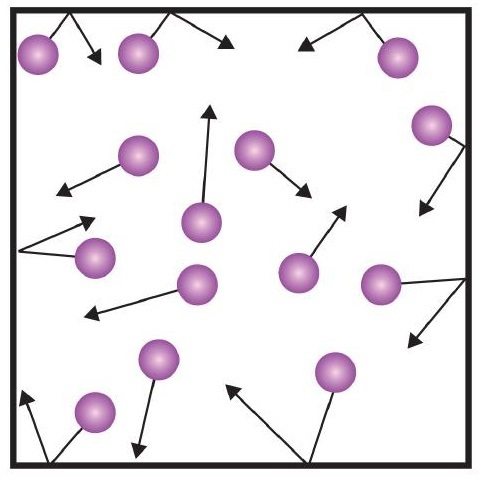
Gas pressure is caused by
Gas molecules heating up
Gas molecules reacting with other gas molecules
Gas molecules hitting the walls of a container
Gas molecules hitting other gas molecules
The temperature of gas is held constant, while its volume is decreased. The pressure exerted by the gas on the wall of the container increases, because its molecules
Strike the walls with higher velocities
Strike the walls with large farce
Strike the walls more frequently
Are in contact with the walls for a shorter time

The pressure of the gas in the balloon in the ice water will be:
Greater than that of the balloon in the boiling water.
Less than that of the balloon in the boiling water.
The same as that of the balloon in the boiling water.
Not enough information to answer the statement.

The pressure inside the syringe will decrease if we move the plunger in:
Direction A
Direction B
We don't have to move the plunger as the pressure will change on its own.
None of the above answers.

The reason gases can be compressed is because:
The particles are very close together.
The particles are merely vibrating.
The particles are unable to move.
The particles are very far apart.
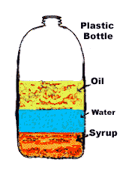

In order to find the density of a regular object you must (check all that apply)
Find the volume
Calculate the weight
Measure the mass
Place it in a measuring cylinder
Divide the mass by volume
To find the density of an irregular object you must (check all that apply)
Find the weight
Measure the length
Place in a measuring cylinder that contains a volume of liquid
Calculate the difference in volume before and after placing the object inside
Find the mass and divide it by the volume

Which is true of liquids?
Particles arranged in an ordered manner
Particles are not touching one another.
Particles are quite closely packed
Particles can vibrate but not move around
A cube of metal has side 2 cm. It weighs 10g. Find its density.
5 g / cm3
20 g / cm3
0.2 g / cm3
1.25 g / cm3
The internal energy of a substance is made up of these two parts:
elastic energy and potential energy
internal energy and vibration energy
potential energy and kinetic energy
kinetic energy and elastic energy
When we increase the kinetic energy of particles we also increase their .............?
mass
temperature
size
area
When a substance is getting hotter, which internal energy store is increasing?
gravitational
potential
kinetic
elastic
The temperature at which a substance changes state from a solid to a liquid is called the ...............?
melting point
boiling point
evaporation point
turning point

What is happening at point D?
The iron has disappeared
The iron has stopped melting
The iron is getting colder
The iron is starting to boil

What is the melting point of iron?
0 oC
1500 oC
2800 oC
3300 oC
What happens to particles during changes of state between solid and liquid.
Particles move so fast they break from their fixed position.
Particles melt and become a liquid.
Particles find a circular orbit around an atom's nucleus.
Particles stop vibrating and change into their liquid form.

Which properties do solids have?
definite shape and volume
no definite shape and a definite volume
no definite shape and no definite volume

What properties do gases have?
definite shape and volume
no definite shape and a definite volume
no definite shape and no definite volume