
 Worksheets
History of Earth | Common Ancestry
Total questions: 35
Worksheet time: 1hrs 10mins


Which statement is correct?
Humans evolved into chimpanzees.
Chimpanzees evolved into humans.
Humans and chimpanzees share a common ancestor.
Humans and chimpanzees are not closely related.

According to the cladogram, which organism is most distantly related to the human?
Crayfish
Grasshopper
Perch
Frog
A branching diagram that shows how a group of organisms might be related to each other.
Phylogenetics
Cladistics
Cladogram
Taxonomy
Common ancestry can be determined by comparing similarities and differences between organisms.
True
False
How many years passed between the extinction of dinosaurs and the appearance of the first humans?
65 billion years
65 million years
65 thousand years
65 hundred years
The Earth formed ____.
45 million years ago
45 billion years ago
4.5 million years ago
4.5 billion years ago

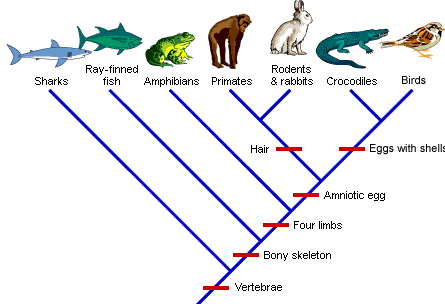
According to this cladogram, primates share a common ancestor with ...
Amphibians
Rodents and rabbits
Crocodiles
Birds
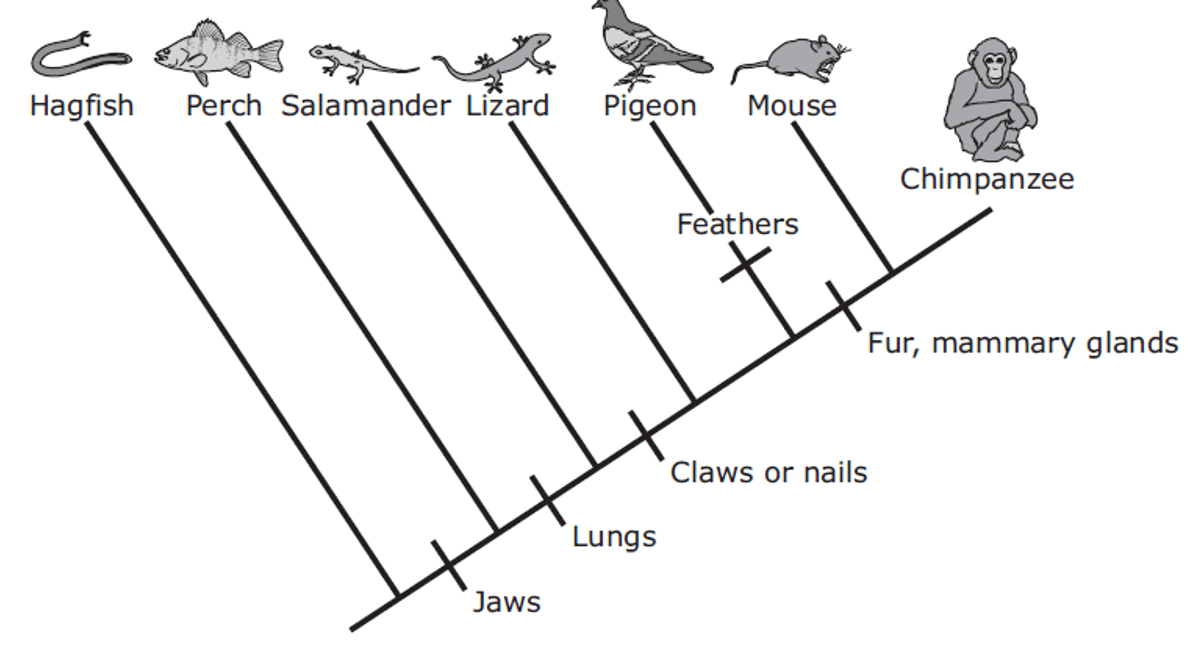
All the animals to the right of the salamander would have the common characteristic of ...
Fur
Claws or nails
Lungs
Jaws

In the blank cladogram, what type of information would go on the lines labeled A?
Derived characteristics
Common ancestors
DNA analysis
Organisms

In the blank cladogram, what type of information would go on the lines labeled B?
Shared characteristics
DNA analysis
Common ancestors
Organisms
The first life forms on Earth were similar to ...
Single cell organisms
Multicellular organisms
Flowering plants
Dinosaurs
All the animals above the hagfish would have the common characteristic of ...
Fur
Claws or nails
Lungs
Jaws

Which of these animals does not have/produce an amniotic egg?
Turtle
Leopard
Lamprey
All three of these animals produce the amniotic egg
A paleontologist uncovers a series of fossils in a piece of rock.
-Fossil A was found 1 meter deep.
-Fossil B was found 3 meters deep.
-Fossil C was found 4 meters deep.
-Fossil D was found 10 meters deep.
Which fossil is the oldest?
Fossil A was found 1 meter deep.
Fossil B was found 3 meters deep.
Fossil C was found 4 meters deep.
Fossil D was found 10 meters deep.
The Law of ____ states that older rocks are in deeper layers and rock layers on the top are younger.
Conservation
Old Rocks
Superposition
Young Rocks
Does the climate on Earth change over time?
True
False
The Law of Superposition helps scientists to determine what?
The absolute age of rock layers.
The age of bones.
The relative age of sedimentary rock layers.
The super powers of rocks.

According to the Law of Superposition, the oldest fossils are found ...
At the top of the rock layers
Near the bottom of the rock layers
In the middle of the rock layers

The Geologic Time Scale is a record of what?
Old geologists.
A list of every living thing ever.
The known history of rocks and fossils.
Humans, birds, whales, and lizards all have similar arm bones. What is the reason for this?
The function of these bones is the same in all animals.
They live in similar environments.
They have a common ancestor.
All organisms resemble humans.
Which of the following pieces of evolution evidence deals with aged and identified fossils?
Fossil record
Comparative embryology
Comparative anatomy
Which of the following pieces of evolution evidence deals with comparing similar structures in various species?
Fossil record
Comparative embryology
Comparative anatomy
Embryos of chickens, fish and humans look very similar. They all have folds known as gill pouches in the neck region. What may this suggest?
They all formed in the ocean.
They all evolved from a common ancestor.
They are all going extinct.
A species is ...
A type of DNA
A group of different colored frogs
A group of organisms that can mate with each other

What is comparative embryology?
Compares embryos of different species, showing how all animals are related.
Medical research that uses embryonic stem cells.
The act of sequencing DNA of embryos.

In stage one (top row) of these embryos, most of the embryos ____.
look very similar
have very different features
show different stages of development
have only a tail if they are non-human

In the the third embryonic stage (bottom row), mammal embryos _____.
have more characteristics in common with each other than with reptiles or birds
are still hard to tell from reptiles and birds
have the same features as fish, reptiles, and birds
do not have tails
The more similar the stages of embryonic development, the more likely that organisms share ____.
a common ancestor
embryos
eggs
embryology

What stage of embryonic development is shown?
The earliest stage
The most advanced stage
The middle stage

