wayground logo

Free Printable Worksheets

NEW

Font size

S
M
L
XL
Worksheets

Density

Total questions: 70

Worksheet time: 1hrs 10mins

Name
Class
Date
1.

What two types of measurements make up DENSITY?

a)

Mass and Volume

b)

Temperature and Mass

c)

Grams and Centimeters

d)

Volume and Weight

2.

Look at this image. Which object has the LOWEST density in water?

a)

The ping pong ball

b)

The bolt

c)

The soda cap

3.

Rishab has a rock. The rock has a mass of 14g and a volume of 2cm3. What is the density of the rock?

a)

7 mL

b)

7 g/cm3

c)

28 g/cm3

d)

1/7 g/cm3

4.
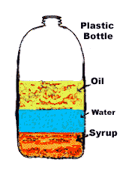
Why do the liquids form different layers?
a)
They have different densities.  
b)
They have different masses.  
c)
They have different volumes.  
d)
They are different temperatures.  
5.
What units can be used to express density?
a)
g/mL
b)
grams
c)
millimeters
d)
milliliters
6.
If an object has a density of .6 g/mL and you put it into water, will it sink or float?  
a)
sink
b)
float
7.
If an object has a density of 3.6 g/mL and you put it into water, will it sink or float?  
a)
sink
b)
float
8.
Which liquid has the highest density? 
a)
corn syrup
b)
lamp oil
c)
rubbing alcohol
d)
honey
9.

Mekiah has an eraser. It has a mass of 4g, and a volume of 2cm3. What is its density?

a)

8 g/cm3

b)

2 g/cm3

c)

1/2 g/cm3

d)

24 g/cm3

10.
Frank has a paper clip. It has a mass of 9g and a volume of 3cm3. What is its density?
a)
3 g/cm3
b)
1/3 g/cm3
c)
27 g/cm3
d)
39 g/cm3
11.
What units are used to measure mass?
a)
g
b)
cm3
c)
g/cm3
d)
cm3/g
12.
An object should float in a liquid if it is 
a)
Denser than the liquid 
b)
Less dense than the liquid
c)
Lighter than metal
d)
 Shaped like a ball 
13.

Archimedes used density to discover if the crown of gold was real because

a)

Substances have their own unique densities

b)

Substances can change densities depending on their size

c)

Substances can change densities depending on their mass

d)

Substances can change densities depending on their volume

14.
Why do ice cubes float in a  glass of water?
a)
the ice cubes are more dense than the water
b)
the water is more dense than the ice cubes
c)
the water is more dense than the glass
d)
the ice is more dense than the glass
15.

Put the liquids in order from MOST dense to LEAST dense.

a)

4, 3, 2, 1

b)

1, 2, 3, 4

c)

3, 4, 2, 1,

d)

4, 3, 1, 2

16.
Which liquid is the least dense?
a)
oil
b)
water
c)
syrup 
d)
plastic bottle
17.

Why do objects sink or float in water?

a)

Because their densities are higher or lower than compared to water

b)

Because their densities are using gravity to pull down

c)

Because their densities are heavier or lighter

d)

Because their mass and volumes are equal

18.
What is the formula for density?
a)
density = mass x volume
b)
density = mass / volume
c)
density = mass + volume
d)
density = mass - volume
19.

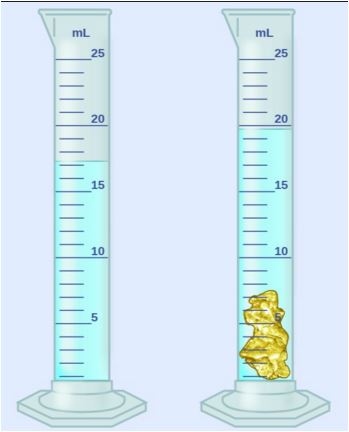
What is the volume of Object X?

a)

10.0 cm3

b)

15.0 cm3

c)

20.0 cm3

d)

25.0 cm3

20.
Helium balloons rise on earth because
a)
helium is less dense than air
b)
helium is more dense than air
c)
helium is cooler than air
d)
helium is warmer than air
21.

Which units of measurement are used for volume?

a)

grams

b)

centimeters

c)

grams/milliliter

d)

milliliter

22.
A crayon has a mass of 10g and volume of 5 mL. What is the density?
a)
30 g/mL
b)
15 g/mL
c)
1 g/mL
d)
2 g/mL
23.

What is the formula for Volume?

a)

Mass/Volume

b)

Density x Volume

c)

Mass/Density

24.

What is the formula for Mass?

a)

Mass/Volume

b)

Density x Volume

c)

Mass/Density

25.

True or False: The density of a specific type of material does not change.

a)

True

b)

False

26.

What do we know about the density of lamp oil, rubbing alcohol, and vegetable oil?

a)

Each of their densities is greater than 1.0 g/mL

b)

Each of their densities is less than 1.0 g/mL

c)

Each of their densities is equal to 1.0 g/mL

d)

Each of their densities can not be determined

27.
Calculate the density of the cube.
a)
2 g/cm3
b)
4 g/cm3
c)
6 g/cm3
d)
8 g/cm3
28.
Calculate the density of the cube.
a)
2 g/cm3
b)
4 g/cm3
c)
6 g/cm3
d)
8 g/cm3
29.
Calculate the density of the cube.
a)
.33 g/cm3
b)
.4 g/cm3
c)
.6 g/cm3
d)
.5 g/cm3
30.
Calculate the density of the cube.
a)
3 g/cm3
b)
4 g/cm3
c)
2 g/cm3
d)
5 g/cm3
31.

You know the mass of an object. What other variable do you need to know to calculate the object's density?

a)

Color

b)

Weight

c)

Volume

d)

Length

32.
Which would be the most useful for identifying an unknown liquid?
a)
Weight
b)
volume
c)
mass
d)
density
33.
A rock has a mass of 14g and a volume of 2cm3. What is the density of the rock?
a)
7 mL
b)
7 g/cm3
c)
28 g/cm3
d)
1/7 g/cm3
34.
What is the density of a liquid that has a mass of 27g and a volume of 30mL?
a)
0.9 g/mL
b)
3 g/mL
c)
57 g/mL
d)
810 g/mL
35.
Which box has a greater density?  
a)
Box A
b)
Box B
36.
What is the density of a substance that has a mass of 30g and a volume of 6 liters?
a)
24 g/L
b)
5 g/L
c)
36 g/L
d)
180 g/L
37.

What is the water displacement method?

a)

a procedure used to measure volume of a solid object by placing it in a known amount of water

b)

measures how much matter is present in a substance

c)

a metric unit of measurement used to measure small volumes of liquid

38.

What does mass measure?

a)

the amount of matter in a substance

b)

the amount of space in a substance

39.

Density is a physical property of matter.

a)

True

b)

False

40.
If two objects have the same volume but one has a greater mass, the one with greater mass 
a)
Has a lower density
b)
 Has a higher density
c)
Will float
d)
Will sink 
41.
Which of the following would float on water? Remember, water has a density of 1.0g/cm3
a)
Honey 1.30 g/cm3
b)
Lamp Oil .80 g/cm3
c)
Pepsi 1.04 g/cm3 
42.

In the water displacement method for finding volume...

a)

You subtract the final volume from the initial volume

b)

You subtract the initial volume from the final volume

c)

You add the initial and final volumes

d)

You divide the final volume by 2

43.
If you cut a wooden block in half, each half would have 
a)
Half the density of the original piece
b)
 Twice the density of the original piece 
c)
The same density as the original piece
d)
No density at all 
44.
Density is a characteristic property of a substance. This means that the density of water 
a)
Changes depending on the volume 
b)
Stays the same regardless of the volume
c)
Is greater for a greater mass of water
d)
Is less for a smaller mass of water 
45.

A tiny piece of sand is very small but sinks in water. This is because

a)

Sand is a solid

b)

Sand is less dense than water

c)

There is more water than sand

d)

Sand is denser than water

46.

The water displacement method is often used to find the volume of

a)

a rectangular solid

b)

an irregular solid

47.
An irregularly shaped stone was lowered into a graduated cylinder holding a volume of water equal to 2 ml. The height of the water rose to 7 ml. If the mass of the stone was 25 g, what was its density?
a)
5 ml
b)
16 g
c)
.20 g/ml3
d)
5 g/cm3
48.

An empty beaker has a mass of 60 grams. When mercury is added to the graduated cylinder, it has a mass of 200 grams. What is the mass of the mercury?

a)

140 grams

b)

200 grams

c)

140 mL

d)

260 g

49.

The density of this material is 2 g/cm3.

The volume is 24 cm3. Find the mass.

a)

12 grams

b)

48 grams

c)

12 g/cm3

d)

48 g/cm3

50.
Find the volume of this piece of brass.  
a)
50 g
b)
10 cm
c)
6 cm3
d)
12 cm3
51.
What is the volume of the fish?
a)
18.0 cm3
b)
6.0 cm
c)
38.0 cm3
52.
Find the density of a 2 cm x 2 cm x 2 cm cube with a mass of 64 g.
a)
6 cm3
b)
12 g/cm3
c)
128 g/cm3
d)
8  g/cm3
53.
Density is...
a)
the amount of mass in an object
b)
the amount of space an object takes up
c)
the amount of mass in a given space
d)
the weight of an object
54.

Calculate the density of the object.

a)

84 g/cm3

b)

0.09 g/cm3

c)

736 g/cm3

d)

11 g/cm3

55.

Calculate the density of the ring.

a)

4 g/cm3

b)

0.875 g/cm3

c)

1 g/cm3

d)

16 g/cm3

56.

Calculate the density of the object.

a)

10 g/cm3

b)

0.14 g/cm3

c)

7 g/cm3

d)

60 g/cm3

57.

Calculate the mass of the unknown object.

a)

0.25 g

b)

4 g

c)

3 g

d)

5 g

58.

Calculate the mass of the unknown object.

a)

0.625 g

b)

1.6 g

c)

7 g

d)

10 g

59.

Calculate the density of the block.

a)

0.5 g/cm3

b)

8 g/cm3

c)

2 g/cm3

d)

4 g/cm3

60.

Calculate the density of the block.

a)

2 g/cm3

b)

6 g/cm3

c)

0.5 g/cm3

d)

4 g/cm3

61.

An irregularly shaped item was lowered into a graduated cylinder holding a volume of water equal to 17 ml. The height of the water rose to 20 ml. If the mass of the object was 27 g, what was its density?

a)

9 g/mL

b)

10.5 g/mL

c)

6.5 g/mL

d)

8 g/mL

62.

An irregularly shaped rock was lowered into a graduated cylinder holding a volume of water equal to 50 ml. The height of the water rose to 75 ml. If the mass of the stone was 250 g, what was its density?

a)

15 g/mL

b)

5 g/mL

c)

10 g/mL

d)

20 g/mL

63.
An irregularly shaped stone was lowered into a graduated cylinder holding a volume of water equal to 200 ml. The height of the water rose to 280 ml. If the mass of the stone was 240 g, what was its density?
a)
3 g/mL
b)
4 g/mL
c)
2 g/mL
d)
5 g/mL
64.
How much water has been displaced in the image shown?
a)
40 mL
b)
65 mL
c)
20 mL
d)
25 mL
65.
An irregular shaped object was lowered into a graduated cylinder holding a volume of water equal to 50 ml. The height of the water rose to 57 ml. If the mass of the stone was 140 g, what was its density?
a)
57 g/mL
b)
50 g/mL
c)
20 g/mL
d)
107 g/mL
66.
What is the volume of Spongebob Squarepants based on the displacement of the water in the graduated cylinder. 
a)
50mL
b)
52mL
c)
102mL
d)
2mL
67.
A block of aluminum occupies a volume of 15.0 mL and weighs 40.5 g. What is its density?
a)
2.8g/mL
b)
2.7g/mL
c)
2.66.g/mL
d)
2.5g/mL
68.
A bar of copper has a mass of 216g and a volume of 24cm3. What is the density of copper?  
a)
9g/cm3
b)
.11g/cm3
c)
5184g/cm3
d)
322mL
69.
What is the density of a plastic ball that has a volume of 6cm3 and a mass of 12g? 
a)
2g/cm3
b)
.5g/cm3
c)
72g/cm3
d)
4mL
70.
What is the density of a book that has a mass of 400g and a volume of 600cm3?
a)
1.5g/cm3
b)
2400g/cm3
c)
325mL
d)
.7g/cm3