wayground logo

Free Printable Worksheets

Font size

S
M
L
XL
Worksheets

OPTIONAL - Unit 1 Test - PRACTICE 3

Total questions: 69

Worksheet time: 3hrs 19mins

Name
Class
Date
1.
Which of the following lists the level of biological organization in order, from least inclusive to most inclusive? 
a)
individual, community, population, ecosystem, biosphere, biome 
b)
individual, population, community, ecosystem, biome, biosphere 
c)
individual, community, ecosystem, population, biome, biosphere 
d)
individual, population, ecosystem, community, biosphere, biome 
2.
Epiphytes are plants that grow on other plants. They do not harm the plants that they grow on. Instead they obtain what they need for survival from the air and the sun. Some species of orchids like the one pictured above are examples of epiphytes because they grow on tree trunks in tropical rain forests.  Which of the following correctly identifies the relationships between orchids and tropical rain forest trees? 
a)
mutualism
b)
commensalism
c)
parasitism
d)
predation
3.
Oxpeckers are birds that sit on zebras and rhinos and eat ticks and other parasites that live on their skin. The oxpeckers get food and in return the zebras and rhinos get pest control. When there is danger, the oxpeckers fly upward and scream a warning to help the zebras and rhinos.  Which of the following correctly identifies the symbiotic relationship between the oxpeckers and the zebras? 
a)
parasitism
b)
commensalism
c)
mutualism
d)
competition
4.
According to the food web, which of the following organisms can be classified into more than one trophic level? 
a)
grasshopper
b)
owl
c)
rabbit
d)
frog
5.
What best describes the type of relationship that occurs between grasshoppers and mice? 
a)
Commensalism
b)
Predation
c)
Mutualism
d)
Competition
6.
Barnacles attach themselves to whales. The whales are so large that they are seemingly unaffected. The barnacles get a habitat and food when the whale enters an area with abundant food resources. What type of relationship exists between the whale and the barnacle?
a)
mutualism
b)
commensalism
c)
parasitism
d)
predation
7.

Which of the following determines the carrying capacity of an ecosystem?

a)

the most limited resources required for survival

b)

the amount of disease affecting organisms in the ecosystem

c)

the amount of rainfall the habitat receives

d)

the number of predators in the area

8.
All of the living and nonliving things in an area that interact with each other are called a/an ______.
a)
community
b)
habitat
c)
population
d)
ecosystem
9.
Two or more members of a particular species living and interacting in the same area
a)
Community
b)
Population
c)
Organisms
d)
Biosphere
10.
Different populations living and interacting with each other in the same area
a)
Biome
b)
Ecosystem
c)
Community
d)
Niche
11.
A living relationship between two species in which one organism is harmed is called...
a)
mutualism
b)
commensalism
c)
parasitism
d)
niche
12.
The image provided is an example of a(n):
a)
Producer
b)
Autotroph
c)
Consumer
d)
Insect
13.
The amount of energy that usually transfers from one trophic level to the next...
a)
10%
b)
20%
c)
80%
d)
50%
14.
An illustration that uses arrows to show the many possible directions in which matter and energy can pass through the organisms in an ecosystem.
a)
Food chain
b)
Food web
c)
Energy Pyramid
d)
Succession Map
15.
In the energy pyramid here, which organisms have the most energy available?
a)
Producers
b)
Carnivores
c)
Herbivores
d)
Top Predator
16.
If there is 1000 Kcal available in the producers in trophic level 1, how much energy is available in the herbivores in trophic level 2?
a)
10 Kcal
b)
1 Kcal
c)
100 Kcal
d)
1000 Kcal
17.

Which of the following best explains why there are usually no more than five trophic levels in a food chain

a)

there are not enough organisms to fill more than five levels

b)

there is too much competition among the organsims at the lower levels to support high levels

c)

the statement is not true: there can be unlimited trophic levels

d)

energy is lost at each trophic level

18.
After a forest fire, an ecosystem would start regrowth through -
a)
primary succession
b)
secondary succession
c)
climax community
d)
limiting factors
19.
The wolves of Yellowstone are a keystone species because 
a)
they are the only predator within Yellowstone.
b)
their population affects many species within their ecosystem.
c)
their population is higher than that of any other species in the ecosystem.
d)
they feed on a greater variety of prey than all other predators.
20.
A herd of zebras would be considered a
a)
community
b)
species
c)
ecosystem
d)
population
21.
Refer to the diagram of the survivorship curve.
Which curve best describes an organism that invests a lot of energy in parenting?
a)
A
b)
B
c)
C
d)
this is not a survivorship curve
22.
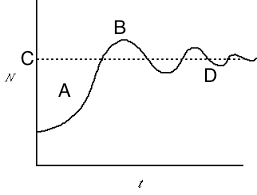
Which letter shows the the exponential growth of a population?
a)
A
b)
B
c)
C
d)
D
23.
The maximum population size for a species based on the environmental factors is called
a)
ecological footprint
b)
carrying capacity 
c)
population growth
d)
environmental capacity
24.
When two species of cattails are grown together, they grow at different water depths and coexist.  When grown alone, they grow at similar water depths.  Which of the following is best demonstrated by the data?
a)
natural selection
b)
character displacement
c)
resource partitioning
d)
ecological succession
25.
Two organisms of different species exist in a relationship in which each individual benefits from the activity of the other:
a)
commensalism
b)
parasitism
c)
herbivory
d)
mutualism
26.
Which of the following is an example of a density-independent limiting factor?
a)
A parasite
b)
A natural disaster
c)
A decrease in prey
d)
A food shortage
27.
All energy for life comes from ______________.
a)
the sun
b)
the decomposers
c)
the Producers
d)
Mr. Cook
28.
primary succession vs. secondary succession
a)
no soil vs starting with soil
b)
starting with soil vs no soil
c)
none of the other choices
d)
the Whomping Willow
29.

Ecology is the scientific study of organism's ______ and their __________.

a)

Interactions and environment

b)

habitat and food-webs

c)

Trophic levels and environment

d)

Interactions and species

30.
Which of the following statements best describes Carry Capacity (K)?
a)
The number of individuals supports in a population
b)
The number of any particular species or individuals that can be supported in an environment
c)
The environmental limitations a population must face
d)
When the birth rate is greater than the death rate in a given species or population.
31.
__________ growth shows growth of a population under environmental constraints (carrying capacity-K) that sets a maximum population size 
a)
logistic
b)
exponential
c)
niche
d)
uniform
32.
Which of the following represents the food chain of the pyramid?
a)
green plant -> rodent -> snake -> hawk
b)
rodent -> green plant -> snake -> hawk
c)
snake -> green plant -> rodent -> hawk
d)
hawk -> snake -> rodent -> green plant
33.
The snake is acting as a 
a)
producer
b)
primary consumer
c)
secondary consumer
d)
autotroph
34.
Which species is the producer?
a)
A
b)
B
c)
C
d)
D
35.
How do matter and energy flow differently?
a)
Energy flows in one direction, matter is recycled
b)
Matter flows in one direction, Energy is recycled
c)
Energy and Matter are both recycled
d)
Energy and Matter both flow in one direction
36.

In most ecosystems, net primary productivity is important because it represents the

a)

Energy used in respiration by herbivores

b)

Total solar energy converted to chemical energy by producers

c)

Biomass for all producers

d)

Energy available for trophic levels above producers

37.
A species that exerts a large, positive impaction on its ecosystem is known as a:
a)
Keystone species
b)
Invasive species
c)
Indicator species
d)
Poached species
38.

Based on the figure you can conclude that interspecific competition

a)

allows for both rock barnacles and stellate barnacles to inhabit the same area.

b)

causes the stellate barnacles to grow more slowly than they would normally grow.

c)

restricts stellate barnacles to a smaller portion of the intertidal zone.

d)

causes the rock barnacles to grow more slowly than they would normally grow.

e)

causes the stellate barnacles to grow more quickly than they would normally grow.

39.
density-independent limiting factor
a)
disease
b)
parasitism
c)
fire
d)
competition
40.
Which type of growth is best illustrated by this rabbit population?
a)
exponential
b)
logistic
c)
S-shaped
d)
predator-prey
41.
The carrying capacity of an environment for a particular species at a particular time is determined by the
a)
number of individuals in the species.
b)
distribution of the population.
c)
reproductive potential of the species.
d)
supply of the most limited resources
42.
Which survivorship curve represents a species where most of the individuals live through their lives and die of old age?
a)
Type 1
b)
Type 2
c)
Type 3
43.

This graph has an S shape. What type of growth does this represent?

a)

Exponential

b)

Logistic

44.

This graph is a J shape. What type of growth does this represent?

a)

Exponential

b)

Logistic

45.

Which of the following is a density dependent factor?

a)

predation

b)

tornado

c)

hurricane

d)

fire

46.
What type of symbiosis?  Hummingbirds feed on nectar from flowers.  The flowers are pollinated by hummingbirds as they move from flower to flower.
a)
commensalism
b)
mutualism
c)
parasitism
d)
predation
47.
The direction of the flow of energy in a food web is represented by ___.
a)
Light bulbs
b)
Dotted Lines
c)
Arrows
d)
Bubbles
48.
An organism`s role in its community is its __________, and where it lives is its _________.
a)
habitat; niche
b)
role in community; niche
c)
niche; role in the community
d)
niche; habitat
49.
A relationship in which two species live closely together.
a)
resource
b)
mutualism
c)
succession
d)
symbiosis
50.
Several species of warblers can live in the same spruce tree ONLY because they
a)
have different habitats within the tree.
b)
don’t eat food from the tree.
c)
occupy different niches within the tree.
d)
can find different temperatures within the tree.
51.
___ states that two species cannot exist together if they compete for the same resources. One will either die out or migrate, or they will adapt to separate resources.
a)
Hardy-Weinberg Principle
b)
Limiting Nutrient Principle
c)
Competitive Exclusion Principle
d)
Tolerance Principle
52.
Starfish are considered ___ because if the species is negatively affected, it’s going to have a disproportionately greater effect on the whole ecosystem.
a)
a keystone species
b)
an invasive species
c)
an exotic species
d)
an introduced species
53.
According to the competitive exclusion principle, two species cannot continue to occupy the same:
a)
Habitat
b)
Niche
c)
Territory
d)
Range
54.
Resource partitioning is best described by which of the following statements?
a)
Competitive exclusion results in the success of the superior species.
b)
Slight variation in niche allows closely related species to coexist.
c)
Two species can coevolve and share the same niche.
d)
Species diversity is maintained by switching between prey species.
55.
Food, water, sunlight, shelter, and space are resources that are often __________.
a)
limiting factors
b)
wet
c)
messy
d)
found in rocks
56.

Which of the following survivorship curves represents species with high juvenile mortality (very low chance of surviving childhood).

a)

Type I

b)

Type II

c)

Type III

d)

None of the above

57.

Which of the following has a relatively constant chance of survival across all ages?

a)

Type I

b)

Type II

c)

Type III

d)

None of the above

58.

Check all that apply to an energy budget

a)

Energy intake/energy produced or consumed

b)

Existence energy/energy used by organism to stay alive

c)

Energy used for reproduction

d)

Energy loss due to excretion of wastes and heat loss

e)

Energy gained by drinking water

59.

Each species has certain conditions in which they survive the best. These conditions in terms of abiotic factors are called -

a)

optimal range

b)

range of intolerance

c)

succession

d)

symbiosis

60.

Outside of the optimal range, but within the range of tolerance, are a set of conditions in which the population is in a state of physiological stress. What are the consequences of this?

a)

Some individuals will die and the population will be larger than it would be in the optimal range.

b)

Individuals will reproduce more and the population will be larger than it would be in the optimal range.

c)

Some individuals will die and the population will be significantly smaller than it would be in the optimal range.

d)

The population will become locally extinct.

61.

Check all that can be important abiotic factors in an ecosystem.

a)

Temperature

b)

Sunlight

c)

Water

d)

Soil nutrients

e)

pH

62.
The process of burning is called _____.
a)
decomposition
b)
combustion
c)
respiration
63.
When humans burn fossil fuels, most of the carbon quickly enters the                       as carbon dioxide.
a)
Water
b)
Atmosphere
c)
Sun
d)
Air
64.
Which one of these does not add CO2 to the atmosphere?
a)
cooking with gas
b)
planting trees
c)
burning wood
d)
riding in a bus
65.
In the carbon cycle, producers take in the gas __
a)
carbon dioxide
b)
oxygen
c)
nitrogen
d)
carbon monoxide
66.
Which of the following removes carbon from the atmosphere?
a)
Combustion
b)
Respiration
c)
Photosynthesis
d)
Death
67.
Carbon dioxide is created by 
a)
Burning fossil fuels 
b)
Cellular respiration
c)
Decomposing organic matter
d)
All answers are correct
68.

In the oceans; algae, plants, and other organisms use carbon from the atmosphere for ________________.

a)

respiration

b)

decomposition

c)

transpiration

d)

photosynthesis

69.
What is happening at 1?
a)
respiration: releasing CO2
b)
decomposing CO2 in the soil
c)
photosynthesis: absorbing CO2
d)
turning CO2 from the atmosphere into organic molecules