wayground logo

Free Printable Worksheets

Font size

S
M
L
XL
Worksheets

Unit 1 Test Review: Safety, Graphing, Macromolecules

Total questions: 82

Worksheet time: 1hrs 22mins

Name
Class
Date
1.

These foods contain A LOT of which Bio-molecule that our body LOVES to use for Energy?

a)

Protein

b)

Nucleic Acids

c)

Baconidis

d)

Carbohydrates

2.

Subatomic particle with a positive charge...

a)

electron

b)

proton

c)

neutron

d)

nucleus

3.

The smallest unit of matter that has the chemical properties of a particular element...

a)

ion

b)

compound

c)

cell

d)

atom

4.

All ecosystems combined...

a)

biosphere

b)

community

c)

habitat

d)

population

5.

The smallest unit of life that is able to carry out all the functions of living things...

a)

subatomic particle

b)

organelle

c)

atom

d)

cell

6.

DNA is an example of a(n)...

a)

atom

b)

element

c)

molecule

d)

ion

7.

The smallest unit that makes up the known elements.

a)

Molecule

b)

Organelle

c)

Cell

d)

Atom

8.

The smallest unit

of a compound consisting of two or more atoms

bonded together.

a)

Organelle

b)

Cell

c)

Molecule

d)

Atom

9.

Any single living individual, and can refer to a single human, animal, plant,

Protista, bacteria, or fungi.

a)

Community

b)

Cell

c)

Population

d)

Organism

10.

Structures in a cell that have specialized jobs.

Similar concept to organs for the human body.

a)

Tissue

b)

Molecule

c)

Atom

d)

Organelles

11.

Where life is found on earth.

a)

Community

b)

Habitat

c)

Ecosystem

d)

Biosphere

12.
What does polar mean?
a)
Unequal charge
b)
Equal charge
c)
Arctic area
d)
Bear that drinks Coca-Cola
13.
Which biomolecule is made of nucleotides and contain you DNA?
a)
Carbohydrate
b)
Lipids
c)
Protein
d)
Nucleic Acid
14.
Which biomolecule is made of amino acids?
a)
Nucleic Acid
b)
Carbohydrate
c)
Protein
d)
Lipid
15.
Which biomolecule is your main source of quick energy?
a)
Nucleic Acid
b)
Protein
c)
Lipid
d)
Carbohydrate
16.
If you want a reaction to speed up you need an _________.
a)
nucleic acid
b)
enzyme
c)
nerve cell
d)
carbohydrate
17.
Once an enzyme does it's work, the enzyme is ___________.
a)
destroyed
b)
unchanged
c)
duplicated
d)
changed
18.
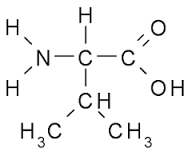
Which biomolecule is this a picture of?
a)
Protein
b)
Nucleic Acid
c)
Lipid
d)
Carbohydrate
19.
Carbon, Hydrogen, Oxygen and Nitrogen are elements in what biomolecule?
a)
Carbohydrate
b)
Lipid
c)
Protein
d)
Nucleic acid
20.
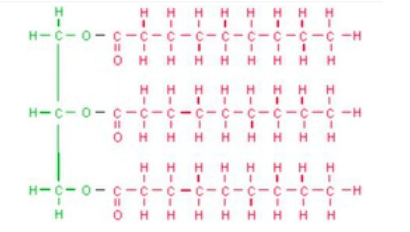
Which biomolecule is this a picture of?
a)
Protein
b)
Nucleic Acid
c)
Lipid
d)
Carbohydrate
21.

How do you feel about the Unit 1 Exam?

a)

Awesome! Let's rock this!

b)

Pretty good.

c)

Um, what are we covering in this unit?

d)

Still need to study quite a few of the concepts.

22.
All chemicals in the lab are to be considered dangerous
a)
True
b)
False
23.

A scalpel is used for

a)

stirring liquids

b)

cutting my friend's hair

c)

itching my nose

d)

dissection

24.

If I accidentally break glassware during lab, I should immediately

a)

hide it so no one finds out

b)

pick it up with my bare hands

c)

tell the teacher or lab manager

d)

sweep it and put it in the regular trash can

25.

When working with preserved biological specimens a student should always-

a)

wear safety goggles

b)

wear protective gloves

c)

be careful not to hold in fumes

d)

do all the above

26.

What should we usually do with any extra or waste chemicals in the laboratory?

a)

throw them away in the trash can

b)

put them back into the container they came from

c)

Get specific disposal directions from the teacher

d)

Pour them down the lab sink

27.

When it comes to glassware...

a)

don't use it if it's chipped/cracked

b)

don't pick it up if it breaks (let the teacher do it)

c)

dispose of it in the correct container

d)

all of the above

28.
On a graph, which axis shows the dependent variable?
a)
x-axis
b)
y-axis
c)
neither
d)
it changes
29.
On a graph, which axis shows the independent variable?
a)
x-axis
b)
y-axis
c)
neither
d)
it changes
30.
A(n) _____________ variable depends on or is changed by another variable.
a)
dependent
b)
independent
31.

In the table, Bubbles is the ______________.

a)

independent variable

b)

dependent variable

32.
The independent variable is the ONE thing you _____ to test your hypothesis.
a)
change
b)
keep the same
c)
experiment with
d)
investigate
33.
Catherine is testing which soil will help grass grow the tallest.  The height of the grown grass is the __ variable.
a)
constant (stays the same)
b)
independent (it's what you change)
c)
dependent (it's what you measure)
34.
What would the INDEPENDENT variable be in an experiment testing which  paper airplane design goes furthest?
a)
the paper used
b)
the paper airplane design
c)
the distance of each plane's flight
d)
how hard the plane is thrown
35.
When experimenting with plants to see if they grow better with or without fertilizer, a scientist uses six bean plants and one type of fertilizer. What type of variable is the fertilizer?
a)
Dependent
b)
Independent
c)
Control
d)
Compound
36.

Which of these can change when new evidence is presented?

a)

theory

b)

law

37.

Which of these explain how a natural phenomenon works or happens?

a)

theory

b)

law

38.

Which of these describes a natural phenomenon or relationship that always occurs under specific conditions

a)

theory

b)

law

39.
Scientific theories are based on
a)
general assumptions of how systems work.
b)
mathematical principles that can be proven true.
c)
large amounts of data collected over time.
d)
observations from within only one scientific discipline.
40.
Scientific theories do not change once they have been written down.
a)
True
b)
False
41.
A scientific theory...
a)
is based on lots of evidence
b)
is not valid
c)
is not reliable
d)
has not been tested many times
42.

A scientific observation is:

a)

Based on facts

b)

based on your personal beliefs

c)

Based on opinions

d)

Based on a rumor you heard in the bathroom

43.

An inference is based on:

a)

both scientific observations and known facts

b)

known facts

c)

scientific observations

d)

a rumor you started in the bathroom

44.

What is an observation?

a)

Something you measure or detect with your senses.

b)

The way you feel about something

c)

An educated guess

d)

A theory that has been disproved

45.

What is an educated guess, opinion, or explanation of an observation?

a)

Prediction

b)

Observation

c)

Inference

d)

Scientific question

46.

Which step of the scientific method uses an "If...Then..." statement to provide a possible answer to the question?

a)

Purpose

b)

Research

c)

Hypothesis

d)

Conclusion

47.
What is an inference?
a)
An observation
b)
Conclusions or deductions based on observation
c)
A safety rule
d)
The unit of measurement for mass
48.
A prediction or guess based on observations.
a)
data
b)
scientific process
c)
hypothesis
d)
question
49.

An object becomes positively charged by...

a)

gaining negative charges.

b)

losing negative charges.

c)

gaining positive charges.

d)

losing positive charged.

50.

An object becomes negatively charged by...

a)

gaining negative charges.

b)

losing negative charges.

c)

gaining positive charges.

d)

losing positive charged.

51.

A substance that is 3 on the pH scale would be a(n):

a)

acid

b)

base

c)

neutral

d)

solute

52.
Bases are located where on the pH scale?
a)
any number can be a base
b)
below 7
c)
above 7
d)
number 7 is a base
53.
At what location on the pH scale can you find acids?
a)
number 7 on the pH scale is acidic
b)
below 7
c)
above 7
d)
you can find acids all throughout the scale
54.
The substance that dissolves the solute in a solution is the ____.
a)
solvent
b)
sour
c)
solute
d)
hydrogen ions
55.
Which of the following is neutral?
a)
milk
b)
eggs
c)
gummy worms
d)
pure water
56.

How does a catalyst work in speeding up a reaction?

a)

By lowering the activation energy or reaction

b)

by giving them more energy

c)

by making them more available

57.

What are the two kinds of nucleic acids? (check all that apply)

a)

RNA

b)

DNA

c)

Amino Acids

d)

5-Carbon Sugar

58.

What is the function of DNA?

a)

Tells you it is a nucleic acid and not a protein

b)

Carrier of genetic information

c)

Creates proteins

d)

Allows things to enter and leave the cell

59.

What is the monomer of Proteins?

a)

Nucleotides

b)

Amino Acid

c)

Fatty Acids

d)

Monosaccharides

60.

What is the monomer of Nucleic acids?

a)

Monosaccharides

b)

Fatty Acids

c)

Nucleotides

d)

Amino Acid

61.
Which macromolecule is shown?
a)
lipid
b)
protein
c)
nucleic acid
d)
carbohydrate
62.
Amino acids are joined together in order to form
a)
DNA
b)
ribosomes
c)
proteins 
d)
RNA
63.

Which nucleic acid holds the information that makes you unique?

a)

Ribonucleic Acid

b)

Deoxyribonucleic Acid

c)

Amino Acids

d)

Lipids

64.

What is DNA's purpose?

a)

It has the instructions for making proteins which ultimately give us our traits.

b)

It holds genetic information.

c)

It has the code for what makes you unique.

d)

All of these

65.

The totality of an organism's chemical reactions is called

a)

catabolism

b)

anabolism

c)

metabolism

d)

fabulism

66.

What does poly- mean?

a)

Many

b)

One

67.

How many macromolecules are there?

a)

There are too many to count

b)

3

c)

4

d)

10

68.

What element must all molecules have in order to be considered organic?

a)

Sulfur

b)

Helium

c)

Carbon

d)

Potassium

69.
Which of the following elements make up nucleic acids?
a)
C, H, O
b)
C, H, O, N
c)
C, H, O, N, P
d)
C, H, O, Ca, S
70.
What is the monomer of carbohydrates?
a)
starch
b)
monosaccharide
c)
polysaccharide
d)
amino acids
71.
Nucleotides are monomers of
a)
Carbohydrates
b)
Lipids
c)
Proteins
d)
Nucleic Acids
72.
Enzymes need certain environmental conditions in order to function properly.  What happens when enzymes are heated to a high temperature?
a)
they die
b)
they denature
c)
they change their amino acid sequence
d)
they work better
73.
What kind of reaction links monomers together to form polymers?
a)
dehydration synthesis
b)
hydrolysis
74.
Carbohydrates are made of... 
a)
C H O
b)
C H O N
c)
C H O N P
d)
C H O N S
75.
Which macromolecule contains mostly carbon and hydrogen and a very small amount of oxygen?
a)
lipids
b)
proteins
c)
nucleic acids
d)
carbohydrate
76.
What kind of reactions break down polymers into individual monomers?
a)
hydrolysis
b)
dehydration synthesis
77.
Waxes, oils and fats are examples of
a)
Carbohydrates
b)
Lipids
c)
Proteins
d)
Nucleic Acids
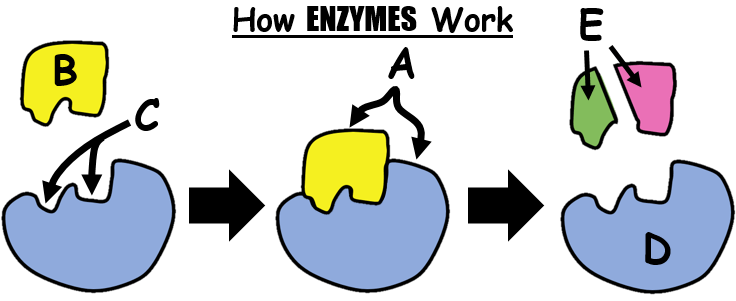
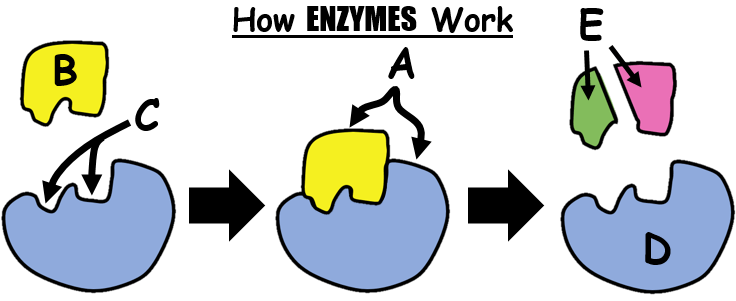
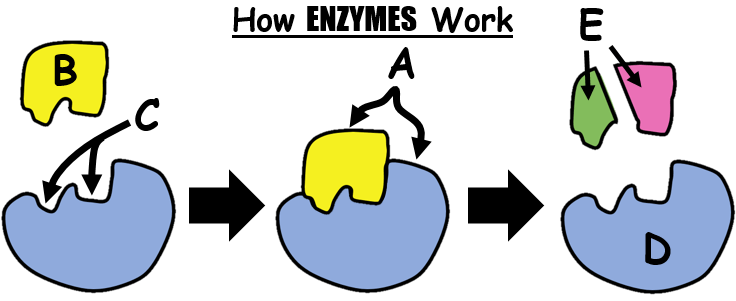
78.
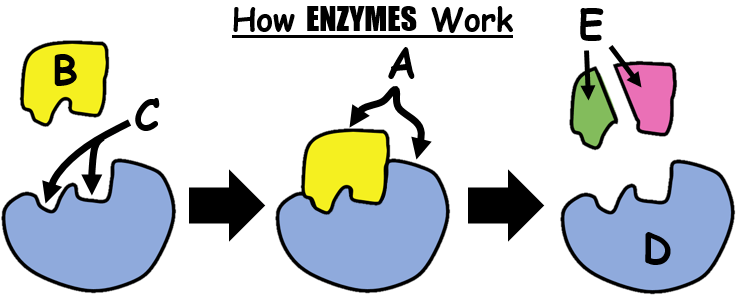
Letter D...
a)
active site
b)
enzyme
c)
substrate
d)
products
79.
Letter B...
a)
active site
b)
enzyme
c)
substrate
d)
products
80.
Letter C...
a)
active site
b)
enzymes
c)
substrate
d)
products
81.
Letter E...
a)
active site
b)
enzyme
c)
substrate
d)
products
82.
When a piece of liver is dropped into hydrogen peroxide, the peroxide bubbles vigorously as the hydrogen peroxide (H2O2) decomposes into water (H2O) and oxygen (O2). This rapid change in reaction rate suggests 
a)
that liver contains lots of germs
b)
 the liver contains an enzyme that breaks down hydrogen peroxide
c)
 that liver is a substrate for hydrogen peroxide
d)
that hydrogen peroxide is a powerful enzyme