
 Worksheets
Wave properties quiz 1
Total questions: 67
Worksheet time: 2hrs 57mins
Name
Class
Date
1.
How often a wave occurs is the wave's __________________
a)
crest
b)
frequency
c)
wavelength
d)
resting point
2.
The distance between 2 corresponding parts of a wave (example- crest to crest) is its _____________________
a)
trough
b)
frequency
c)
amplitude
d)
wavelength
3.
Mechanical waves are created when a source of energy causes a medium to _________________.
a)
vibrate
b)
expand
c)
move
d)
compress
4.
Any material that a wave travels through is called a ____________________.
a)
vibration
b)
compression
c)
medium
d)
crest
5.
In what type of wave does the medium vibrate parallel to the direction of the wave?
a)
surface wave
b)
longitudinal wave
c)
transverse wave
d)
electromagnetic wave
6.
What are the highest parts of a transverse wave called?
a)
amplitude
b)
trough
c)
resting point
d)
crest
7.
In longitudinal waves, the parts where the coils are spread apart are called what?
a)
rarefactions
b)
compressions
c)
mechanicals
d)
longitudes
8.
In what type of wave does the medium move perpendicular to the movement of the wave?
a)
Transverse
b)
Longitudinal
c)
Electromagnetic
d)
Radio
9.

What number represents the wavelength?
a)
1
b)
2
c)
3
d)
4
10.
As the frequency of a wave increases, the __________________ decreases.
a)
amplitude
b)
resting point
c)
wavelength
d)
crest
11.
In a longitudinal wave, the parts where the coils are close together are called what?
a)
longitudes
b)
rarefactions
c)
compressions
d)
contractions
12.
Waves that require a medium are called
a)
mechanical waves
b)
transverse waves
c)
light waves
d)
gamma rays
13.
What happens when you increase the amplitude of a sound?
a)
it makes the sound louder
b)
it makes the sound travel faster
c)
it increases the wavelength of the sound
d)
it increases the frequency of the sound
14.

What kind of wave is pictured below?
a)
compressional wave
b)
transverse wave
c)
sound wave
d)
mechanical wave
15.
What can electromagnetic waves travel through?
a)
mediums
b)
empty space
c)
solely solids
d)
both mediums and empty space
16.
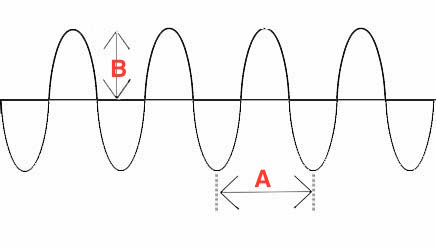
What property of this wave is represented by the letter "A"
a)
amplitude
b)
crest
c)
trough
d)
wavelength
17.
What do waves carry from place to place?
a)
Energy, but not matter or particles
b)
Energy and matter or particles
c)
Matter or particles but not energy
d)
Neither energy nor matter or particles
18.

Which wave is pictured?
a)
Transverse
b)
Longitudinal
c)
Both
d)
Neither
19.
A wave carries...?
a)
energy only
b)
matter only
c)
energy and matter
d)
neither
20.
What type of wave move a slinky back and forth?
a)
longitudinal
b)
transverse
21.
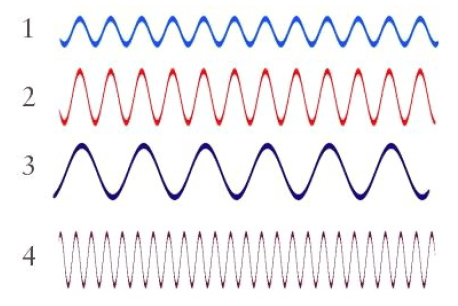
Which wave in the diagram has the greatest frequency?
a)
1
b)
2
c)
3
d)
4
22.
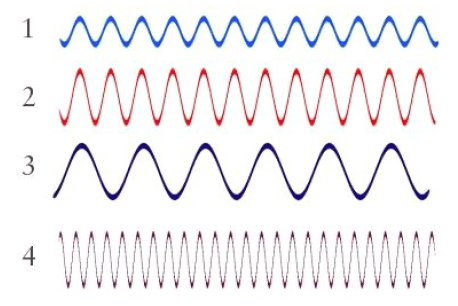
Which wave in the diagram has the greatest wavelength?
a)
1
b)
2
c)
3
d)
4
23.
Which of the following can sound travel through?
a)
solid
b)
liquid
c)
gas
d)
all of the above
24.
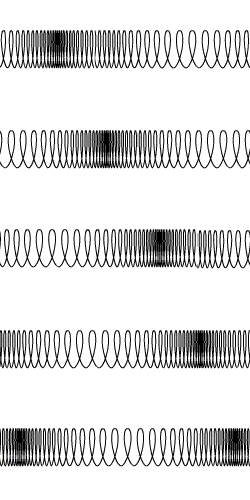
What type of wave is this?
a)
Longitudinal
b)
Transverse
25.

Which of the following is NOT a mechanical wave?
a)
sound
b)
light
c)
ocean
d)
seismic
26.

The highest point on a wave is:
a)
the crest
b)
the trough
c)
the top
d)
the coast
27.
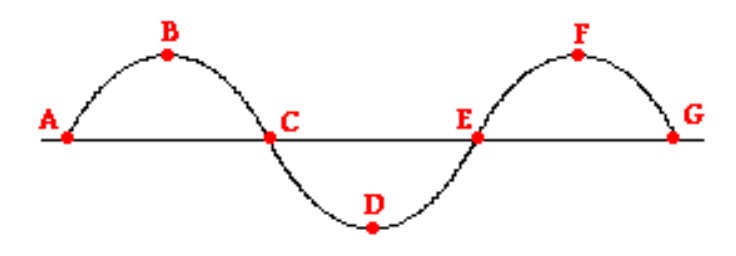
Which letter(s) represent the trough of the wave?
a)
A
b)
B & D
c)
D
d)
C & G
28.

Which wave has a greater frequency?
a)
A
b)
B
29.

How would a person measure the wavelength on this sound wave?
a)
dense to less dense
b)
trough to crest
c)
compression to compression
d)
beginning of illustration to the end
30.

You can't hear sounds in outer space because there is no
a)
medium
b)
light
c)
energy
d)
heat
31.

All waves carry ________ as they travel from one place to another.
a)
matter
b)
space
c)
energy
d)
water
32.

What type of wave is this?
a)
Transverse
b)
Longitudinal
33.

Distance from 'y' to 'y' is a _______
a)
Wavelength
b)
Amplitude
c)
Compression
d)
Rarefaction
34.

Distance from an 'x' to an 'x' is a________
a)
wavelength
b)
amplitude
c)
rarefaction
d)
compression
35.

What is represented by the letter 'y'?
a)
Compression
b)
Rarefaction
c)
Wavelength
d)
Amplitude
36.

What is represented by the letter 'x'?
a)
Crest
b)
Compression
c)
Rarefaction
d)
Wavelength
37.

What is represented by the blue lines?
a)
Trough
b)
Crest
c)
Wavelength
d)
Amplitude
38.

What part is represented by the blue lines?
a)
Crest
b)
Resting Point
c)
Wavelength
d)
Amplitude
39.

What part is the arrow pointing to?
a)
Crest
b)
Trough
c)
Amplitude
d)
Wavelength
40.

What part is the arrow pointing to?
a)
Crest
b)
Trough
c)
Amplitude
d)
Wavelength
41.
Which answer best explains what causes a wave?
a)
Shaking
b)
Potential energy
c)
Light
d)
Vibrations
42.
What two factors effect the amount of energy a wave has?
a)
Frequency and wavelength
b)
Frequency and amplitude
c)
Amplitude and rest
d)
Wavelength and crest
43.

What is the amplitude of this wave?
a)
4
b)
8
c)
2
d)
6.3
44.
When the frequency of a wave increases, what happens to the wavelength?
a)
The wavelength is not directly affected by the frequency of a wave.
b)
The wavelength increases.
c)
The wavelength decreases.
d)
More specific information is needed to form a conclusion about the wavelength.
45.
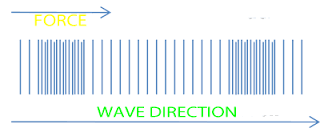
What type of waves have compressions and rarefactions?
a)
longitudinal
b)
transverse
46.

Which part of a longitudinal wave is where particles are packed closely together?
a)
compression
b)
rarefaction
c)
crest
d)
amplitude
47.

What does a wave transmit?
a)
mass
b)
energy
c)
matter
d)
don't get this wrong
48.
What kind of wave moves at right angles (perpendicular) to the direction of the wave?
a)
compressional waves
b)
mechanical waves
c)
transverse waves
d)
ultraviolet rays
49.

What do we call the part of a compressional / longitudinal wave that is when the waves are squeezed together?
a)
compression
b)
rarefaction
c)
crest
d)
trough
50.

What do we call the part of a compressional / longitudinal wave that is spread apart?
a)
compression
b)
rarefaction
c)
crest
d)
trough
51.
In which direction does a Longitudinal wave travel compared to the medium?
a)
parallel
b)
perpendicular
c)
At right angles to the medium
d)
Anywhere it wants to go
52.
What is another name for wave height?
a)
Frequency
b)
Amplitude
c)
Wavelength
d)
Origin
53.
What is measured from crest to crest or trough to trough?
a)
Frequency
b)
Amplitude
c)
Wavelength
d)
Origin
54.
If I have a wave of 2 different amplitudes, the wave that has the higher amplitude will
a)
have a longer wavelength.
b)
have less energy.
c)
have no energy.
d)
have more energy.
55.
What is the amplitude?
a)
length
b)
height
c)
# of waves
56.
If the frequency gets higher, the wavelength gets
a)
longer
b)
shorter
57.
If the wavelength gets longer, the frequency gets
a)
higher
b)
lower
58.
The pitch of the sound depends on
a)
frequency
b)
amplitude
c)
wavelength
59.
The loudness of the sound depends on
a)
wavelength
b)
amplitude
c)
frequency
60.

Which EM wave has the lowest frequency?
a)
radio
b)
xray
c)
gamma
d)
infrared
61.

Which EM wave has the longest wavelength?
a)
light
b)
radio
c)
ultraviolet
d)
red
62.

Which color has the lowest frequency?
a)
red
b)
green
c)
blue
d)
violet
63.

Which color has the highest frequency?
a)
blue
b)
yellow
c)
orange
d)
violet
64.
Frequency is
a)
Amount of time it takes for one wavelength
b)
How many wavelengths are completed in one second
c)
Distance between two crests or two troughs
d)
Amount of energy in a wave
65.
which material does sound travel the fastest?
a)
solid
b)
liquid
c)
gases
66.
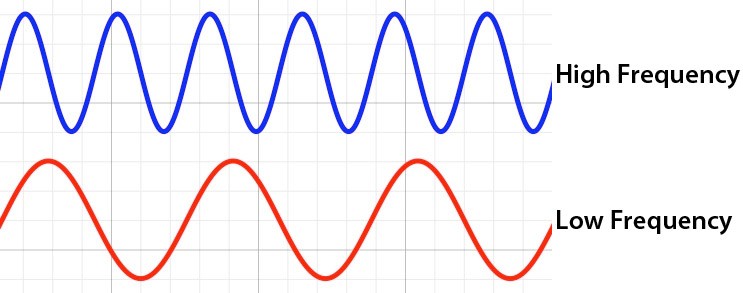
Frequency is measured in
a)
Newtons
b)
Joules
c)
Hertz
d)
Decibels
67.
Which is the correct equation for calculating the speed of a wave?
a)
T = 1/f
b)
Speed= Wavelength x Period
c)
Speed = Wavelength/Frequency
d)
Speed= Wavelength x Frequency
100 %

