
 Worksheets
Yr9 waves
Total questions: 145
Worksheet time: 3hrs 28mins
What type of energy does a sound wave have?
Mechanical
Radiant
Electrical
Sound
Sound is produced by -----
Heat energy
Low temperatures
Vibrations
Friction
True or False: Sound needs a medium.
True
False
Sound waves are also known as ----- waves.
Compression
Longitudinal
Neither
Both longitudinal and compression
True or False: Sound waves are faster than light.
False
True

Areas of increased pressure on a sound wave are known as a ----
Rarefaction
Compression
Frequency
Amplitude

The distance from the beginning of one compression to the beginning of the next compression is called a -----
Rarefaction
Frequency
Wavelength
Compression

Spread out areas or areas of decreased pressure on a sound wave are known as a ---
Rarefaction
Amplitude
Compression
Hertz
The unit for measuring frequency is the ---
Joule
Hertz
Gram
Newton

The measure of the amount of energy in a wave is ----
Wavelength
Hertz
Frequency
Amplitude
The speed of sound depends on these two things:
The type of medium and the temperature of the medium
Speed of the medium and temperature of the medium
Temperature of the medium and sound of the medium
None of the above
Sound waves travel the fastest through ---
Liquids
Gases
Solids
Sound waves that are beyond the range of human ear are known as ----
Infrasonic waves
Ultrasonic waves

Sonar and echolocation use ----- to detect objects under water.
Refraction
Reflection
Sound cannot travel in a vacuum.
true
false
Loudness of sound is determined by the __________________ of the sound waves.
amplitude
frequency
Tuning forks are used
eat food
show how vibrations produce sound
Sound waves can reflect off objects.
true
false
Scientists use reflected sounds waves to locate objects underwater, using ________________.
sonar
radar
The ________________ is the organ in that converts mechanical sound vibrations into nerve signals.
cochlea
pinna
Human ears are designed to hear in ________________.
air
water

A student ties two strings of the same lengths and thicknesses between two stands, as shown. When the student plucks the strings, string 2 produces sound with a pitch higher than string 1. What explains the differences in pitch?
A slack string vibrates slower, producing a lower volume sound.
Increasing tension in the string makes it vibrate faster, producing a higher pitch sound.
A firm string spreads vibrations faster throughout the string, producing a lower pitch.
Decreasing tension in the string spreads vibrations slower, increasing the loudness.

Two students make a device to talk from one end of a hallway to the other. When one student speaks into one can, the other student listens by keeping the other can on an ear. What design modification would help the students transfer louder, clearer sounds?
Loosen the string
Twist hte string
Keep the string tight
Swing the string while talking

A student wants to conduct an experiment to study how tension affects the pitch of sound. The student makes a large opening on the top of a cardboard show box, as shown.
The student needs to attach materials across the opening in the box to produce sounds with different pitches. What is the BEST material to use?
Cotton threads
Paper Strips
Plastic straws
Rubber bands
Which statement about sound is TRUE?
Sound cannot move through water.
Sound can travel through empty space.
Sound moves better through some materials than others.
Sound cannot move from one material to another.


When light waves move from passing through air to passing through a glass lens when happens to them?
They slow down and change direction
They speed up and change direction
They maintain the same speed and change direction
They maintain their same speed and direction

How does a concave lens differ from a convex lens?
A convex lens is another way to describe a plane mirror; a concave lens is curved
A concave lens is curved inward on both sides; a convex lens is on only one side
A convex lens has a thick center and thin edges, a concave lens has a thin center and thicker edges
A convex lens has a thin center and thick edges. a concave lens has a thick center and thinner edges

A concave lens has an inward curved shape. It refracts light outward from the lens. They light rays spread apart as they exit the lens. Which represents a concave lens?
A
B
A and B
neither A or B
What type of lens do you have in your eye?
Concave
Prismatic
Objective
Convex
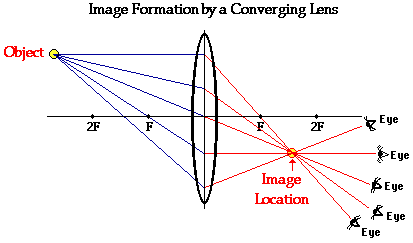


An image behind the mirror is...
virtual
real
inverted
upright
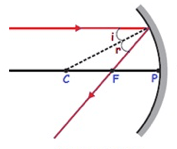
This ray diagram is for which mirror?
concave
convex
plane
window
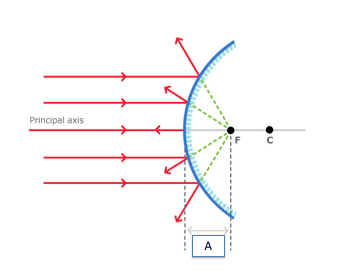
In the image, all the rays meet at F, What is F
focal length
focal point
center of curvature
reflection
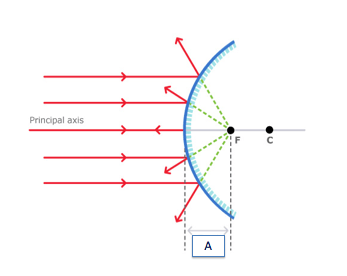
This image is showing a convex mirror because the image is (choose 2 answers)
real light rays meet behind the mirror
real light rays don't meet
the focal point is in front of the mirror
the focal point is behind the mirror
A dentist uses a small dental mirror to help magnify teeth in your mouth. What type of mirror is this?
a convex mirror
a concave mirror
a convex lens
a concave lens
The side view mirrors on your car help shrink the image on both sides of the car, allowing you to see a larger field of view. What type of mirror is this?
a convex mirror
a concave mirror
a convex lens
a concave lens
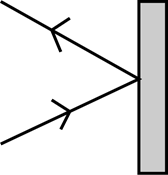
In the illustration, the light ray striking the object is-
Why can you see most objects?

Given that the angle of incidence = 30 degrees
a. Draw a ray diagram, labelling clearly the normal, incident ray, angle of incidence, reflected ray and angle of reflection accurately.
Which is the correct diagam?
Which is NOT a source of light?
sun
lightbulb
fire
car
Your light-sensing organ is your
ear
finger
brain
eye
In order to see a picture it must
produce light
reflect light
absorb light
To get the best reflection from a mirror you need
a very shiny surface to reflect lots of light
to stand right in front of it
to shine a bright light on it
it to produce light
According to the laws of reflection, if i = angle of incidence and r = angle of reflection,

If a capital letter R is seen in an ordinary mirror, what does it look like?


In the diagram, which letter represents the angle of incidence?
A
B
C
D

Which diagram represents specular reflection?
A
B

What is the best explanation for Mickey seeing himself in the mirror?
refraction
absorbed
reflection
flipped

Which diagram shows the correct image of the key in a plane mirror?
The word SONAR is derived from
(a)
The reflected signal is known as
(a)
The distance of the sea can be calculated using the formula
d=2v
d=4v×l
d=2v×t
d=4v×t

What is SONAR used for?
mapping the ocean floor and detecting objects in the ocean
some animals use it to find food in the dark
communication between sea mammals
finding missiles in the sky
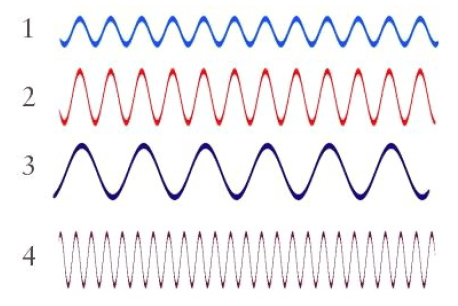
A guitar string vibrates with a frequency of 320 hz. If the wavelength of the vibration is 0.23 meters what is the speed of the wave?
320.23 m/s
1391.3 hz
73.6 m/hz
73.6 m/s

Wavelength= .5m
Frequency= 150 hertz
Wavelength= 2.0m
Frequency= _________
Sound is an example of what type of wave?
Transverse
Longitudinal

The speed of a wave is 74m/s. If the wavelength is 12m, what is the frequency?
6.2 Hz
16.2 Hz
888 Hz
0.16 Hz

The frequency of a wave is 3.3 Hz. If the wavelength is 7.4 m, how fast is the wave moving?
2.24 m/s
24.4 m/s
0.45 m/s
0.24 m/s

What are the spaced out sections of this wave called?
Reflections
Rarefactions
Wavelength
Compressions
The lowest part of the wave is called the ?
Frequency
Amplitude
crest
trough

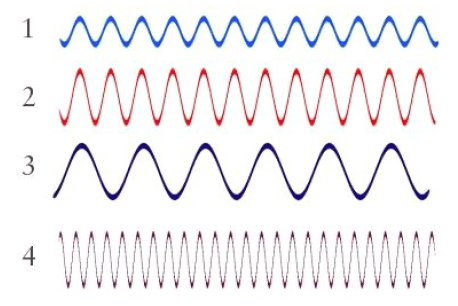

What does reflection mean?
Soaks up light
Passes through
light bounces off


The type of waves shown here is a ___________ wave
EM
Light
Sound
Water
The type of waves shown here is a(n) ___________ wave
EM
Temporal (time)
Transverse
Longitudinal
Gamma rays are part of the EM spectrum, they are commonly used for?
Artificial tanning in a tanning salon
Communicating between mobile phones
Destroying cancer cells in cancer tumors
As an aid for restful sleep
X-rays are part of the EM spectrum, they are commonly used for?
Artificial tanning in a tanning salon
Communicating between mobile phones
Detecting broken bones
As an aid for restful sleep
UV rays are part of the EM spectrum, they are commonly used for?
Artificial tanning in a tanning salon
Communicating between mobile phones
Detecting broken bones
As an aid for restful sleep
Visible light part of the EM spectrum, it is commonly used for?
Artificial tanning in a tanning salon
Communicating between mobile phones
Detecting broken bones
As an aid for reading at night
IR rays are part of the EM spectrum, they are commonly used for?
Artificial tanning in a tanning salon
Remote control devices at home
Extinguishing forest fires
As an aid for restful sleep
Microwave radiation is part of the EM spectrum, it is commonly used for?
Heating convenience foods at home
Remote control devices at home
Extinguishing forest fires
Freezing foods for longer life
Radio waves are part of the EM spectrum, they are commonly used for?
The sound we hear in the car
Finding lost dogs
Cooking roast in the oven
Listening to music on an old fashioned radio receiver
Tanning salons are considered dangerous, because they can sometimes cause?
Skin cancer from the UV they use
A horrible rash on your feet
Overheating from the microwaves they use
Distortion in the music you are listening to
The type of EM radiation used in a tanning salon is?
UV
X-rays
Gamma
Visible
Ultra violet (UV) radiation is dangerous because it can cause?
Skin cancer
Headaches
Sore toes
Blindness in worms
IR rays are part of the EM spectrum, they are more commonly called?
Gamma
Heat
Cold
Clouds
Which parts of the EM spectrum would be used to cook the Sunday roast.
Gamma
Infra red (IR)
Ultra violet (UV)
Visible light like the rainbow
Sound waves and light waves are similar because?
They both transfer matter without transferring energy
The particles vibrate in the same direction
Both need a medium to travel
They both transfer energy without transferring matter
Longitudinal waves and transverse waves are similar because?
They both transfer matter without transferring energy
The particles vibrate in the same direction
Both need a medium to travel
They both transfer energy without transferring matter
Longitudinal waves and transverse waves are different because?
A candle can only be seen at night
The particles vibrate in different directions
Transverse waves do not require a medium to travel
They both transfer energy without transferring matter
Which of the following is TRUE for sound waves?
Sound waves cannot travel through space
Sound waves travel much slower than light waves
Sound waves do not require a medium to travel
None of these are true
Which of the following is TRUE for longitudinal waves?
Longitudinal waves cannot travel through space
Longitudinal waves travel much slower than light waves
Longitudinal waves do not require a medium to travel
None of these are true
Which of the following is TRUE for light waves?
Light is an example of a transverse wave
Light waves travel much slower than sound waves
Light waves do not require a medium to travel
All of these are true
Which of the following is TRUE for transverse waves?
Light and water are examples of transverse waves
The particles move perpendicular to the motion of the wave
Sound is not a transverse wave
All of these are true

