Wayground logo

Free Printable Worksheets

Font size

S
M
L
XL
Worksheets

Transport of food and minerals in plants (8-T)

Total questions: 50

Worksheet time: 50mins

Name
Class
Date
1.

The plant tissue that carries food materials DOWNWARD from the leaves to the rest of the pant is the ______.

a)

Phloem

b)

Stomata

c)

Chlorophyll

d)

Xylem

2.

Vascular tissue that transports water and minerals UPWARDS from a plant's roots is know as ______.

a)

Chlorophyll

b)

Phloem

c)

Stomata

d)

Xylem

3.

How do water enter the roots from the soil?

a)

diffusion

b)

osmosis

c)

transpiration

d)

active transport

4.

water leaves the plant by ....

a)

the stomata

b)

the epidermis

c)

the palisade cells

d)

the spongy mesophyll

5.

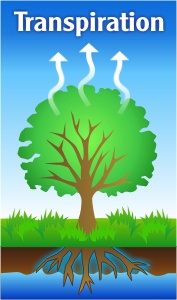
Transpiration is

a)

the movement of water through a plant from the roots up the stem

b)

the loss of water from the leaves of a plant by the process of evaporation

c)

the flow of water into plant roots by osmosis from the soil

d)

the process of minerals and sugars moving through plant veins

6.

Why is the evaporation of water from leaves important?

a)

It cools leaves and helps move water up the plant.

b)

It makes the plant wilt

c)

It helps the plant to respire

7.

Where is xylem vessels found in plants

a)

roots and stems only

b)

leaves and root only

c)

roots, stems and leaves

d)

root hair cells and veins

8.

What do the guard cells do?

a)

Control active transport

b)

control nutrient moving into the cell

c)

Controls loss of water through the leaf

9.

What does the phloem transport

a)

water

b)

sugar

c)

minerals

d)

air

10.

How will lowered humidity affect the rate of transpiration?

a)

it decreases

b)

it increases

c)

it causes no change

d)

it depends on other factors

11.

An increase in wind or temperature will ________________ transpiration

a)

increase

b)

decrease

c)

not affect

d)

stop

12.

The equation for photosynthesis is

a)

oxygen + water --> glucose + carbon dioxide

b)

oxygen + glucose --> carbon dioxide + water

c)

carbon dioxide + water --> glucose + oxygen

d)

carbon dioxide + glucose --> oxygen + water

13.

The diagram shows the internal structure of a leaf.


Which region contains cells that are responsible for the transport of manufactured food?

a)

A

b)

B

c)

C

d)

D

14.

A leafy shoot was placed in the apparatus shown. The rate of movement of the air bubble was measured.


Which change would make the air bubble move faster?

a)

blowing dry air over the shoot

b)

decreasing the air temperature around the shoot

c)

increasing the humidity around the shoot

d)

removing some leaves from the shoot

15.

The diagram shows a section through a typical leaf.


How does water move from point X to point Y?

a)

diffusion and evaporation only

b)

evaporation only

c)

osmosis, evaporation and diffusion

d)

osmosis only

16.

Is mature xylem alive or dead?

a)

Alive

b)

Dead

17.

Water and minerals move in which direction within the plant

a)

Upward

b)

Down

18.

What does phloem transport?

a)

Water

b)

Minerals

c)

Fruit

d)

Sugar

19.

Are phloem cells alive or dead?

a)

Alive

b)

Dead

20.

Where does sugar transport begin?

a)

Roots

b)

Leaves

c)

Root hairs

d)

Vascular bundles

21.
Most stomata are usually found in underside of leaves.  Why?
a)
conserve water
b)
get more CO2
c)
prevent infection
d)
none
22.
Most chloroplast are found in the
a)
palisade mesophyll
b)
spongy mesophyll
c)
epidermis
d)
xylem
23.
The pores on  leaves are called
a)
stomata
b)
guard cells
c)
collenchyma
d)
phloem
24.
Xylem vessel elements are strengthened by
a)
lignin
b)
cellulose
c)
melanin
d)
pericycle
25.
Water travels through
a)
phloem
b)
xylem
c)
veins
d)
tubes
26.
How will lowered humidity affect the rate of transpiration?
a)
decrease it
b)
increase it
c)
no change
d)
it depends
27.
An increase in wind or temperature will ________________ transpiration
a)
increase
b)
decrease
c)
no change
d)
none
28.
The plant tissue that carries food materials DOWNWARD from the leaves to the rest of the pant is the ______.
a)
Phloem
b)
Stomata
c)
Chlorophyll
d)
Xylem
29.
Vascular tissue that transports water and minerals UPWARDS from a plant's roots is know as ______.
a)
Chlorophyll
b)
Phloem
c)
Stomata
d)
Xylem
30.
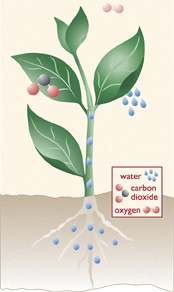
Plant absorbs water through the _________. 
a)
stem
b)
roots 
c)
leaves 
d)
all of the above
31.
The plant transport system are made up of ____ types of tubes.
a)
1
b)
2
c)
3
d)
many
32.
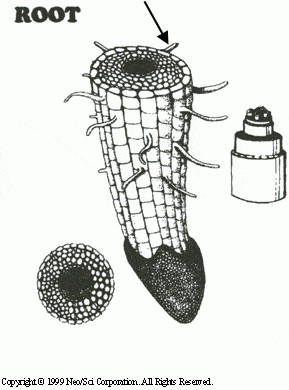
What is the name of the part of the root that allows water and minerals enter?
a)
root hairs
b)
epidermis
c)
phloem
d)
phyla
33.
what is the function of root hair?
a)
it is place to store the food
b)
it has large surface area to absorb more water
34.
How do water enter the roots from the soil?
a)
diffusion
b)
osmosis
c)
transpiration
d)
active transport
35.
Water vapour exits a plant leaf by
a)
the stomata
b)
the epidermis
c)
the palisade cells
d)
the spongy mesophyll
36.
Transpiration is
a)
the movement of water through a plant from the roots up the stem
b)
the loss of water from the leaves of a plant by the process of evaporation
c)
the flow of water into plant roots by osmosis from the soil
d)
the process of minerals and sugars moving through plant veins
37.
This is the definition for which word:The movement of particles down a concentration gradient (from a high concentration to a low concentration)
a)
Osmosis
b)
Diffusion
c)
Active transport
d)
Transpiration
38.
This is the definition for which word:The movement of water molecules from a high concentration of water to a low concentration of water across a partially permeable membrane.
a)
Osmosis
b)
Diffusion
c)
Active transport
d)
Transpiration
39.
The plant tissue that carries food materials DOWNWARD from the leaves to the rest of the pant is the ______.
a)
Phloem
b)
Stomata
c)
Chlorophyll
d)
Xylem
40.
Why is the evaporation of water from leaves important?
a)
It cools leaves and helps move water up the plant.
b)
It makes the plant wilt
c)
It helps the plant to respire
41.
Which of these is true?
a)
Xylem vessels carry water and dissolved minerals up the plant
b)
Phloem tissue carry water and dissolved minerals up the plant
c)
Xylem vessels carry dissolved sucrose up and down the plant
42.
What happens to the transpiration rate as light intensity increases?
a)
It increases
b)
It stays the same
c)
It decreases
43.

Where is xylem found in the plant?

a)

leave -> roots -> stem

b)

roots -> stem -> leaves

c)

root hairs -> leaves -> veins

d)

stem -> roots

44.
Plant transports food made in the leaves to __________. 
a)
roots 
b)
stem
c)
flowers 
d)
all of the above
45.
There are more chloroplasts in the palisade mesophyll cells than in spongy mesophyll cells.
a)
True
b)
False
46.
The lamina is broad to increase surface area for maximum absorption of light energy.
a)
True
b)
False
47.
The thin film of moisture on the surfaces of mesophyll cells allow glucose to dissolve in it to aid faster rate of diffusion of glucose.
a)
True
b)
False
48.
Stomata open to allow gas exchange to take place during photosynthesis. 
a)
True
b)
False
49.
The equation for photosynthesis is
a)
oxygen + water --> glucose + carbon dioxide
b)
oxygen + glucose --> carbon dioxide + water
c)
carbon dioxide + water --> glucose + oxygen
d)
carbon dioxide + glucose --> oxygen + water
50.
Chlorophyll traps light energy and converts it to chemical energy during photosynthesis.
a)
True
b)
False