Wayground logo

Free Printable Worksheets

Font size

S
M
L
XL
Worksheets

Chapter 1

Total questions: 85

Worksheet time: 2hrs 35mins

Name
Class
Date
1.
Which part of an atom is POSITIVELY charged?
a)
protons
b)
neutrons
c)
electrons
d)
atoms
2.
What part of an atom is NEGATIVELY charged?
a)
protons
b)
neutrons
c)
electrons
d)
atoms
3.
Which part of an atom has no charge?
a)
protons
b)
neutrons
c)
electrons
d)
atoms
4.
What is the picture displayed?
a)
Atom
b)
Element
c)
Molecule
d)
Compound
5.

What is the picture displayed?

a)

atom

b)

element

c)

compound

6.
What is the picture displayed?
a)
atom
b)
element
c)
molecule
d)
compound
7.

What is the picture displayed?

a)

compound

b)

element

c)

molecule

8.
What is at the center of every atom?
a)
An electron
b)
A compound
c)
A nucleus
d)
A molecule
9.
Which two particles make up the nucleus of an atom?
a)
protons and electrons
b)
protons and neutrons
c)
molecules and compounds
d)
neutrons and electrons
10.
What determines the type of element an atom makes?
a)
The size of the nucleus
b)
The number of protons
c)
How much an atom weighs
d)
The number of neutrons
11.

Which of the following cannot be broken down into something simpler?

a)

A compound

b)

An element

c)

A mixture

12.

How many elements are in C6H12O6?

a)

1

b)

2

c)

3

d)

6

13.
What do we call a chemical substance made up of 2 or more different types atoms bonded together?
a)
formula
b)
atom
c)
subscript
d)
compound
14.

How many Hydrogen atoms are present in H20?

a)

2

b)

4

c)

1

d)

0

15.
The element oxygen, represented by the symbol O, is classified as
a)
a pure substance
b)
a compound
c)
a mixture
d)
a solution
16.
Atoms combine to form _______. 
a)
electrons
b)
molecules
c)
nuclei
d)
neutrons
17.
How are covalent bonds formed?
a)
Sharing of electrons
b)
Transfer of electrons
18.
What is a valence electron?
a)
The sum of neutrons and protons.
b)
The # of electrons in the last shell.
c)
A type of bond.
d)
A popular compound.
19.
Why do elements bond?
a)
To be friends
b)
To create a new element
c)
To become stable
20.

When atoms bond it is called a ___________________ because they make a new substance.

a)

chemical reaction

b)

physical reaction

21.

Covalent Bonds ______________ valence electrons.

a)

give

b)

take

c)

keep

d)

share

22.
Atoms gain lose, gain, or ______electrons to get a stable outer energy level.
a)
share
b)
split
c)
create
d)
destroy
23.
A ____________is the force that holds atoms together in a compound.
a)
Chemical Formula
b)
Chemical Reaction
c)
Chemical Bond
d)
Synthesis Reaction
24.
How many atoms are in the molecule of methane?  CH4
a)
1
b)
3
c)
5
d)
7
25.
Atoms joined together by SHARING electrons are?
a)
Ionic bonds
b)
Covalent bonds
c)
Metallic Bonds
d)
James Bonds
26.

A bond that is formed when a electron is transferred to form ions (lose or gain electrons)

a)

Ionic Bond

b)

Covalent Bond

c)

Metallic Bond

d)

Barry Bonds

27.

This is a chemical reactions. Number one shows?

a)

Products

b)

Reactants

c)

Enzyme

28.

This is a chemical reactions. Number two shows?

a)

Products

b)

Reactants

c)

Enzyme

29.

________________ are mixtures that have different parts that can be seen.

a)

Solution mixture

b)

Pure mixture

c)

Homogenous mixture

d)

Heterogenous mixtures

30.

___________________ are mixtures that have a uniform or same appearance throughout it.

a)

Heterogenous mistures

b)

Homogenous mixtures

c)

Solution mixtures

d)

Pure mixtures

31.
True or False
In a chemical reaction, no new atoms are created, and no atoms are destroyed. 
a)
true
b)
false
32.
The left side of the equation below is called
a)
Products
b)
Reactants
33.
The right side of the equation below is called the
a)
products
b)
reactants
34.

A chemical reaction that absorbs (takes) heat

a)

Single replacement

b)

Exothermic

c)

Endothermic

d)

Decomposition

35.

A chemical reaction that releases (loses) heat

a)

Single replacement

b)

Exothermic

c)

Endothermic

d)

Decomposition

36.
Enzymes are considered to be 
a)
Lipids
b)
Carbohydrate
c)
Protein
d)
Nucleic Acid
37.
What is the purpose  of an enzyme?
a)
give permission for the reaction
b)
raise activation energy
c)
speed up reactions
d)
control how many reactions occur
38.
Where do substrates bind on an enzyme?
a)
voltage-gated channels
b)
surface receptor
c)
calcium channels
d)
active site
39.
What is the name for the mechanism of enzyme activity?
a)
Lock and key
b)
jigsaw puzzle
c)
hammer and nail
d)
two hands pattern
40.
What makes an enzyme substrate specific?
a)
Size
b)
Shape
c)
Name
d)
Location it is found in
41.
The part of the enzyme that the substrate bonds to is called the _____.
a)
active site
b)
activation energy
c)
bond site
d)
peptide bond
42.
Enzymes are...
a)
nucleic acids
b)
proteins
c)
lipids
d)
carbohydrates
43.
What is structure D?
a)
Substrate
b)
Active site
c)
Enzyme
d)
Products
44.
What is structure A?
a)
Substrate
b)
Active site
c)
Enzyme
d)
Products
45.
True or false water is a polar molecule? 
a)
True 
b)
False 
46.

This is the part of a solution that dissolves (salt+sugar)

a)

Solute

b)

Solvent

c)

Solution

d)

Mixture

47.

The substance that does the dissolving

a)

Solute

b)

Solvent

c)

Solution

d)

Miscibility

48.

This is a type of mixture where one substance dissolves into another (solute+solvent)

a)

Solution

b)

Miscibility

c)

Compound

d)

Solubility

49.

Solutions are composed (made from) of __________ .

a)

salts and solutes

b)

solvents and salts

c)

solutes and alloys

d)

solutes and solvents

50.
In a sample of salt water, NaCl would be considered the ______.
a)
Solution
b)
Solute
c)
Solvent
d)
Solvation
51.
Proteins are made of monomers called ___________
a)
Nucleotides
b)
Monosaccharides
c)
Amino Acids
d)
Glycerol and fatty acids
52.
DNA and RNA are examples of 
a)
Carbohydrates
b)
Lipids
c)
Proteins
d)
Nucleic Acids
53.
Nucleotides are monomers of
a)
Carbohydrates
b)
Lipids
c)
Proteins
d)
Nucleic Acids
54.
Monosaccharides are monomers of
a)
Carbohydrates
b)
Lipids
c)
Proteins
d)
Nucleic Acids
55.
Waxes, oils and fats are examples of
a)
Carbohydrates
b)
Lipids
c)
Proteins
d)
Nucleic Acids
56.
What is the function of nucleic acids?
a)
store genetic information
b)
store energy (long-term)
c)
store energy (short-term)
d)
build skin, hair, nails, muscles
57.

Which macromolecule stores energy, insulates يعزل us, and makes up the cell membrane?

a)

lipids

b)

proteins

c)

carbohydrates

d)

nucleic acids

58.
What are the monomers of DNA?
a)
glycerols
b)
amino acids
c)
fatty acids
d)
nucleotides
59.
All polymers are made up of...
a)
monosaccharides
b)
monomers
c)
proteins
d)
None of these
60.
All organic compounds contain the element
a)
carbon
b)
nitrogen
c)
phosphorus
d)
sulfur
61.

Enzymes belong to which class of macromolecules?

a)

lipids

b)

carbohydrates

c)

proteins

d)

nucleic acids

62.

Sugar belongs to which class of macromolecules?

a)

proteins

b)

lipids

c)

nucleic acids

d)

carbohydrates

63.
An example of a carbohydrate would be?
a)
potatoes 
b)
T-bone steak
c)
chicken leg
d)
cheese
64.
A good example of a nucleic acid would be?
a)
sugar
b)
DNA
c)
fat
d)
glucose
65.
Humans get most of their energy from eating what type of food?
a)
protein
b)
carbohydrates
c)
lipids
d)
meat
66.
Which is an example of a lipid
a)
fat
b)
starch
c)
glucose
d)
hemoglobin
67.
Glucose (sugar) is an example of a
a)
Carbohydrate
b)
Lipid
c)
Protein
d)
Nucleic Acid
68.

True or False?

Macromolecules are small molecules that cells need.

a)

True

b)

False

69.

True or false: bases are sometimes called alkaline.

a)

True

b)

False

70.

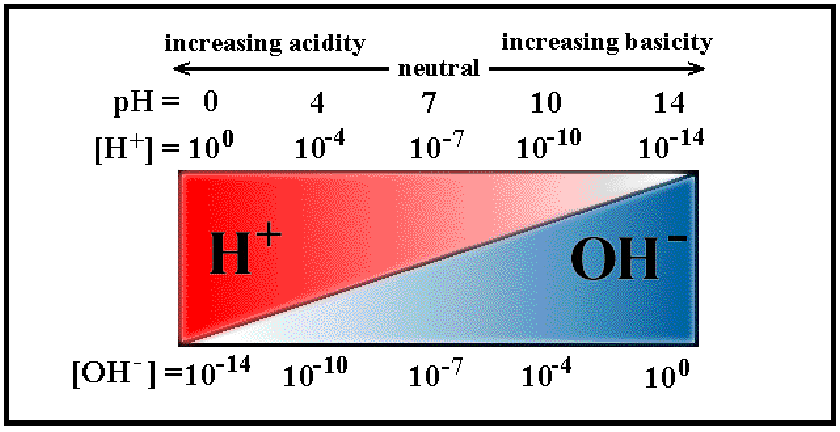
Neutral solutions have a pH of:

a)

0

b)

1

c)

7

d)

14

71.

True or false: a neutral solution has equal amounts of H+ and OH-.

a)

True

b)

False

72.

Which is true?

a)

pH of less than 7 is basic; pH of more than 7 is acidic

b)

pH of less than 7 is acidic; pH of more than 7 is basic

73.

Vinegar, fruit juice, and cola are examples of:

a)

strong acids

b)

strong bases

c)

strong bases

d)

weak acids

74.

NaOH may be found in drain cleaners and as a component of soaps. Is NaOH an acid or a base?

a)

Acid

b)

Base

c)

Neither (Neutral)

75.

HCl is found in household products, including some toilet bowl cleaners. Is HCl an acid or a base?

a)

Acid

b)

Base

c)

Neither (Neutral)

76.

Is pure water acidic, basic, or neutral?

a)

Acidic

b)

Basic

c)

Neutral

77.

Vinegar is an example of:

a)

An acid.

b)

A base.

c)

Neither an acid nor a base.

78.

pH is the measure of the concentration of ______.

a)

Acids

b)

H+ ion

c)

OH- ion

d)

Bases

79.
If a solution is basic which ion will be more present?
a)
H+
b)
K+
c)
OH-
d)
H-
80.

A substance that is 3 on the pH scale would be a(n):

a)

acid

b)

base

c)

neutral

d)

solute

81.
A substance that is a 10 on the pH scale would be a(n) ____.
a)
acid
b)
neutral
c)
base
d)
indicator
82.
At what location on the pH scale can you find acids?
a)
number 7 on the pH scale is acidic
b)
below 7
c)
above 7
d)
you can find acids all throughout the scale
83.

Taste bitter المريره

a)

acids

b)

bases

c)

neutral

d)

pH paper

84.

Taste sour الحامض

a)

acids

b)

bases

c)

neutral

d)

pH scale

85.

The bond between amino acids is called:

a)

Ionic Bond

b)

Peptide bond

c)

Covalent bond

d)

Van der waals forces