wayground logo

Free Printable Worksheets

NEW

Font size

S
M
L
XL
Worksheets

Cell Membrane

Total questions: 43

Worksheet time: 41mins

Name
Class
Date
1.

Define plasma membrane

a)

lipid that helps minimize effects of temperature

b)

only on the outer surface of the plasma membrane and are attached to proteins or lipids; form distinctive cellular markers

c)

flexible boundary of a cell that separates a cell from its surroundings

d)

may extend partway into the plasma membrane, cross the membrane entirely, or be loosely attached to its inside or outside face

2.

Which type of biological macromolecule is the main component of the plasma membrane?

a)

carbohydrate

b)

lipid

c)

protein

d)

nucleic acid

3.

This image is an example of a phospholipid. Which part of a phospholipid is HYDROPHOBIC?

a)

the phosphate "head"

b)

the lipid "tails"

4.

This image is an example of a phospholipid. Which part of a phospholipid is HYDROPHILIC?

a)

the phosphate "head"

b)

the lipid "tails"

5.

What is the "big idea" of the fluid mosaic model of plasma membranes?

a)

the plasma membrane creates a specialized FLUID that looks like a MOSAIC.

b)

the plasma membrane is a MOSAIC.

c)

the fluid mosaic model is NOT related to the plasma membrane.

d)

a plasma membrane is a MOSAIC of components that move FREELY and FLUIDLY.

6.

What does "hydrophobic" mean?

a)

water loving, associates with water

b)

water fearing, does not associate with water

c)

a world war II submarine

d)

an example would be solutes like sugar or salt

7.

What does "hydrophilic" mean?

a)

water loving, associates with water

b)

water fearing, does not associate with water

c)

a world war II submarine

d)

an example would be solutes like oil or fat

8.

Which are example is hydrophobic in nature.

a)

Oil

b)

Sugar

c)

Salt

d)

Water

9.
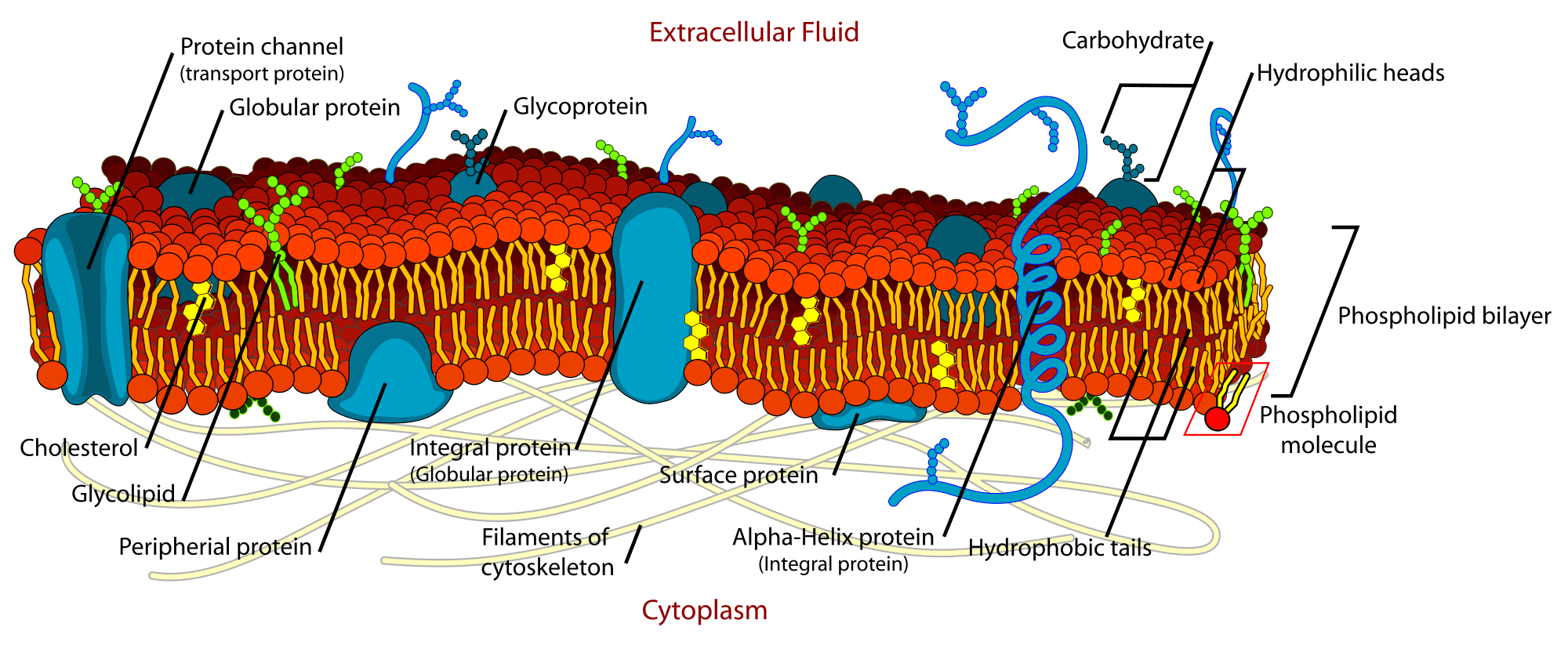
What is this image?
a)
cell membrane
b)
proteins
c)
carbohydrates
d)
lipids
10.
The function of the plasma membrane is....
a)
to regulate what enters and leaves the cell.
b)
fight bacteria and viruses that enter the cell.
c)
provide rigid support and protection to the cell.
d)
make sure each cell can move
11.
What is NOT TRUE about the cell membrane
a)
It controls what enters and leaves the cell
b)
Semipermeable
c)
Phospholipid bilayer
d)
Contains digestive enzymes
12.
What does "bilayer" mean?
a)
one layer
b)
two layers
c)
laminated
d)
bilateral
13.
Most of the cell membrane is made of...
a)
Lipids
b)
Carbohydrates
c)
Proteins
d)
Nucleic acids
14.
What is embedded in the phospholipid bilayer?
a)
proteins
b)
salt
c)
water
d)
trapped animals
15.

In passive transport, the concentration gradient goes from..

a)

Low to low

b)

High to low

c)

Low to high

d)

High to high

16.
The cellular process in which materials are moved across a membrane from an area of low concentration to an area of high concentration is called
a)
Osmosis
b)
Simple Diffusion
c)
Active Transport
d)
Passive Transport 
17.
Osmosis is the diffusion of __________.
a)
water
b)
glucose
c)
air
d)
passive transport
18.
Passive transport requires no
a)
concentration gradients
b)
osmosis
c)
motion
d)
energy
19.
This cell organelle helps organisms maintain homeostasis by controlling what substances may enter or leave cells.
a)
vacuole
b)
nucleus
c)
cell membrane
d)
cell wall
20.
Large molecules, such as glucose, can easily pass through the cell membrane without any help...
a)
True- they pass right through
b)
False- they need a protein channel 
21.
When particles move out of a cell through facilitated diffusion, the cell ____________.
a)
Gains energy
b)
Uses energy
c)
Releases energy
d)
Does not use energy
22.
What is another term for "selectively permeable"?
a)
porous
b)
completely permeable
c)
permanent
d)
semipermeable
23.
Hydrophilic portion of cell membrane?
a)
A
b)
C
c)
D
d)
24.
Hydrophobic region of the cell membrane?
a)
E
b)
B
c)
C
d)
25.
Small, non-polar molecules like COand O2 and NO can pass through the cell membrane using what type of transport?
a)
Diffusion
b)
Osmosis
c)
Facilitated Diffusion
d)
Endocytosis
26.
Which is true about active transport?
a)
It requires energy
b)
it does not require energy
c)
It moves substances down the concentration gradient
d)
it moves material from high to low concentration
27.
The concentration of water is higher in the soil than in plant root cells. Water moves into root cells of a plant by...
a)
Facilitated Diffusion
b)
Simple Diffusion
c)
Active Transport
d)
Osmosis
28.
Molecules diffusing with the concentration gradient through a protein channel is...
a)
Facilitated Diffusion
b)
Simple Diffusion
c)
Active Transport
d)
Osmosis
29.
In a nerve cell, ATP energy is used to pump sodium (Na) out of the cell and potassium (K) into the cell. This is an example of...
a)
Facilitated Diffusion
b)
Simple Diffusion
c)
Active Transport
d)
Osmosis
30.
Active transport requires ______, moves materials from __________________, and goes _______ the concentration gradient.
a)
No energy, low to high, against
b)
ATP, high to low, with
c)
ATP, low to high, with
d)
ATP, low to high, against
31.
The difference in the concentration of a substance from one location to another is called 
a)
diffusion
b)
osmosis
c)
concentration gradient
d)
passive transport
32.
What is homeostasis?
a)
How the body releases oxygen
b)
Passive transportation 
c)
How the body regulates itself for survival
d)
Active transport
33.
Two examples of passive transport are
a)
Earth and Sun
b)
Diffusion and Osmosis
c)
Energy and Wind
d)
None of the above
34.
Movement of particles from high to low concentration. 
a)
Passive Transport
b)
Active Transport
35.
Low to High
a)
Passive Transport
b)
Active Transport
36.
Lets some things pass through but not others
a)

Selectively permeable

b)
Selectively impermeable
c)
Partially permeable
d)
Particularly permeable
37.
What are the 2 kinds of passive transport?
a)
Osmosis and engulfing
b)
Engulfing and transport proteins
c)
Diffusion and osmosis
d)
Permeable and impermeable
38.
The air freshener spread throughout the room by
a)

osmosis

b)
diffusion
c)
active transport
d)
magic!
39.

A difference in the concentration of a substance across a space or between two solutions is called

a)

concentration gradient

b)

potential

c)

equilibrium

d)

balance

40.

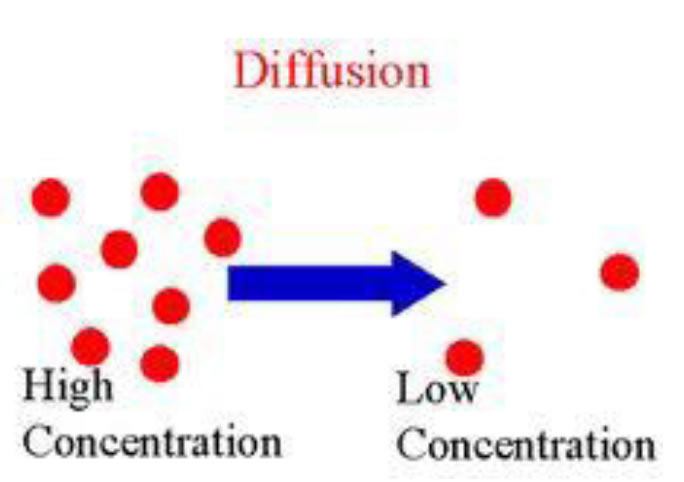
It is a type of passive transport which involves the movement of substances from a high concentration area to a low concentration area.

a)

effusion

b)

diffusion

c)

concentration gradient

41.

It is a type of passive transport which involves the movement of substances from a high concentration area to a low concentration area.

a)

effusion

b)

diffusion

c)

concentration gradient

42.

Osmosis is a process that requires energy to transport substances in and out of the cell.

a)

True

b)

False

43.

Diffusion is the movement of a substance from an area of low concentration to an area of higher concentration.

a)

True

b)

False