
Font size
 Worksheets
Cell Theory and Organelles 2020
Total questions: 52
Worksheet time: 3hrs 27mins
Which cell structure acts like the brain of the cell?
Cell Membrane
Cell Wall
Nucleus
Mitochondria
Which structures are unique only to plant cells?
Cell Membrane
Cell Wall
Mitochondria
Chloroplast
Which cell organelle helps break down food to release energy?
Mitochondria
Nucleus
Vacuole
Endoplasmic Reticulum
Which three statements are part of the cell theory?
Cells are the smallest unit of living things that can perform the processes necessary for life.
The basic components of life consist of a nucleus, cell membrane, and mitochondrion.
All living things are composed of cells
Living cells come only from other living cells
Atoms are composed of cells
Which organelle is much larger in plant cells than animal cells and is used to store food and waste?
Nucleus
Vacuole
Ribosomes
Chloroplasts
The jelly like substance in the cell is called --
cytoplasm
lysosomes
chromosomes
cytokinesis
What are organelles?
Parts that come together to make an organ system.
A group of similar cells that perform similar functions.
A group of organs that perform similar functions
Tiny structures within a cell that allow the cell to live, grow, and reproduce.
What is the function of a chloroplast?
Control center of the cell
Makes food (sugar) from sunlight
Protects the cell
Makes ribosomes
The hereditary material in a cells is...
Cytoplasm
ATP
DNA
ER
When compared to a prokaryotic cell, a eukaryotic cell ...
does not have a nucleus
has DNA that is circular
has more types of organelles
stores it's DNA in a nucleus rather than in the cytoplasm
There are 3 main differences between a plant and an animal cell. Plant cells contain .....
a cell membrane
a cell wall
a nucleus
a larger vacuole
chloroplasts
The rigid outer boundary of plant cells, giving them their boxy appearance is..
cell membrane
cell wall
mitochondria


Plants and animal cells have...
Mitochondria and chloroplasts
Nucleus and chloroplast
Cell wall and chloroplast
Mitchochodria and cytoplasm
Which organelle is the command center for eukaryotic (plant and animal) cells?
Cell wall
Nucleus
Mitochondria
Lysosome
what is the function of a lysosome?
To create energy for the cell
To command the cell what to do
To remove waste using digestive enzymes from the cell
To protect the cell
Which of the following are prokaryotic cells?
Plant
Animal
Bacteria
Plant and Animal
Which of the following is a eukaryotic cell?
Bacteria
Plant
Plant and animal
Animal
What is the difference between a prokaryotic cell and a eukaryotic cell?
Prokaryotes do not have a nucleus or organelles, but a eukaryotic cell does
Eukaryotic cells do not have a nucleus or organelles, but prokaryotes do
What is the purpose of the nucleus?
It is the command center, contains DNA, and cell division
It protects the cell
It stores energy for the cell
It gets rid of waste in the cell
The outermost layer of a plant cell and animal cell is...
Plant cell - cell membrane, animal cell - cell wall
Plant cell - cell wall; animal cell - cell membrane
Plant and animal cell - cell wall
Plant and animal cell - cell membrane
What does a plant cell have that an animal cell doesn't have?
Cell Membrane and Cell Wall
Cell Wall and Mitochondria
Cell Wall and Nucleus
Cell Wall and Chloroplast
What are the "protein-makers" of a cell?
Ribosomes
Mitochondria
ER
Golgi Body
What is the function of the nucleus?
Store DNA
Control everything the cell does
Act as the cells "Brain"
Help the cell produce food
What is the function of the vacuole?
To produce energy for the cell
To store water and other nutrients
To store genetic material (DNA)
To give the cell shape and support
The ___________ is the most basic unit of life.
atom
molecule
cell
organism
All cells come from...
nothing
existing cells
a nucleus
animal cells
This part of the cell stores food and water.
vacuole
mitochondria
nucleus
chloroplast
To be alive, an organism has to ...
have no nucleus
have a nucleus
be made of many cells
be made of at least one cell
This part of the cell produces most of the energy for the cell.
nucleus
cell membrane
mitochondria
ribosome
Which part of the cell protects plant cells and gives them their shape?
cell membrane
nucleus
cell wall
cytoplasm
ribosome
cell membrane
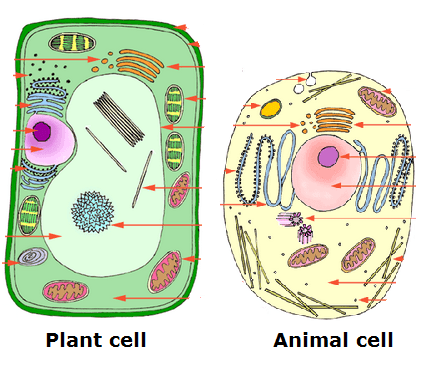
What distinguishes a plant cell from an animal cell? (How do you tell them apart) Hint: There's 3 ways (Check all 3)
Central Vacuole
Mitochondria
Cell Wall
Ribosomes
Chloroplasts

Cellular Respiration occurs within me and I am in BOTH plant and animal cells. I am a....
Nucleus
Golgi Body
Cytoskeleton
Mitochondria

I like to be thought of as the "storage bubble" for both plant and animal cells. I am a...
Cell Membrane
Cytoskeleton
Vacuole
Endoplasmic Reticulum

Photosynthesis takes place within me. I am a...
Mitochondria
Cell Wall
Chlorine
Chloroplast

I decide what goes in and out of the cell. I am fluid like and found in BOTH plant and animal cells. I am a...
Cell Wall
Cell Membrane
Cytoplasm
Golgi Apparatus

I provide plant cells their rigid shape. I am the...
Basketball that Nic Quarne left in Mr. Woller's room last week
Cytoskeleton
Cell Membrane
Cell Wall

I am found in a plant cell and I provide a "central" and LARGE amount of storage. I am a...
Central Vacuole
Cytoplasm
Central Membrane
Mitochondria
Animal and Plant Cells are...
Shopkoytes
Eukaryotes
Prokaryotes
The building blocks of non-living things
Why do we say Pro .... No....
They do not have a nucleus and membrane bound organelles
They do have a nucleus and membrane bound organelles
Sometimes they have a nucleus and membrane bound organelles
Often they have a nucleus and membrane bound organelles
What 4 parts do both Prokaryotic and Eukaryotic cells have?
cytoplasm, DNA, ribosomes, nucleus
cytoplasm, DNA, ribosomes, mitochondria
cytoplasm, DNA, ribosomes, cell/plasma membrane
cytoplasm, DNA, ribosomes, ER

