wayground logo

Free Printable Worksheets

Font size

S
M
L
XL
Worksheets

Chemistry Midterm Exam 2020

Total questions: 125

Worksheet time: 4hrs 2mins

Name
Class
Date
1.

In an atom, an orbital represents

a)

the most probably location of a proton

b)

the most probable location of an electron

c)

the least probably location of a neutron

d)

photons emitted as electrons move to lower energy levels

2.
DIFFERENT kinds of atoms chemically combined to form a substance are
a)
Mixture
b)
Element
c)
Compound
d)
Substance
3.

The element hydrogen has three naturally occurring isotopes. Which of the following describes the relationship of these isotopes?

a)

different mass, different atomic number

b)

same mass, different atomic number

c)

different mass, same atomic number

d)

same mass, same atomic number

4.

The number of which type of particle determines the identity of an element?

a)

electrons

b)

neutrons

c)

protons

d)

photons

5.

When experimenting with the growth of a plant, a scientist uses three (of the same type of) plants, two different fertilizers, equal light, and equal water. What type of variable is the fertilizer?

a)

Dependent

b)

Independent

c)

Control

d)

Compound

6.
This contains a variety elements and compounds that ARE NOT chemically combined.
a)
Water
b)
Mixture
c)
Elements
d)
Compounds
7.
Which of the following is an element?
a)
Sugar
b)
Salt
c)
Water
d)
Oxygen
8.
Water is an element
a)
true
b)
false
9.
When experimenting with the growth of a plant, a scientist uses three (of the same type of) plants, two different fertilizers, equal light, and equal water. What type of variable is the fertilizer?
a)
Dependent
b)
Independent
c)
Control
10.
Which variable is affected by what is being tested?
a)
Dependent
b)
Independent
c)
Control
11.
Which variable is the one being tested?
a)
Dependet
b)
Independent
c)
Control
12.

Which particle has a mass so small, it is considered to be 0 amu?

a)

proton

b)

hydrogen nucleus

c)

neutron

d)

electron

13.

Which one of the following methods is used to separate the colors in food dyes?

a)

winnowing

b)

Threshing

c)

Crystallization

d)

chromatography

14.
A salad is an example of which?
a)
element
b)
compound
c)
mixture
d)
solution
15.

Which is an example of a solution?

a)

trail mix

b)

cereal with milk and banannas

c)

a bag of candy

d)

tea

16.

Is melting butter for popcorn a chemical or physical change?

a)

chemical

b)

physical

17.
Which of the following is NOT an example of a physical change?
a)
crumpled paper
b)
pencil sharpening
c)
shrunken clothing
d)
rust
18.
A change where one or more new substances are created.
a)
Physical Change 
b)
Chemical Change 
19.

When you break a cracker into pieces it is a...

a)

Chemical change

b)

Physical change

20.
H is the chemical symbol for which element?
a)
Helium
b)
Hydrogen
c)
Mercury
21.
Na is the chemical symbol for which element? 
a)
Sodium
b)
Nitrogen
c)
Neon
22.
O is the chemical symbol for which element? 
a)
Osmium
b)
Odell
c)
Oxygen
23.

What quantity is the same among atoms of the same element?

a)

mass number

b)

atomic number

c)

number of neutrons

d)

number of nucleons

24.

An atom that has 8 protons and 10 neutrons is an isotope of the element

a)

nitrogen

b)

oxygen

c)

fluorine

d)

neon

25.

Which elements have the most similar chemical properties?

a)

Ge, As, and Sb

b)

Mn, Fe, and Co

c)

S, Se, and Te

d)

P, S, and Cl

26.

In a bond between an atom of hydrogen and an atom of chlorine, the hydrogen atom has a

a)

weaker attraction for electrons

b)

stronger attraction for electrons

c)

smaller number of first-shell atoms

d)

larger number of first-shell atoms

27.

Which atom has the lowest electronegativity?

a)

Nitrogen

b)

Oxygen

c)

Fluorine

d)

Neon

28.

What is the overall charge of an ion that has 9 protons, 11 neutrons, and 10 electrons?

a)

+1

b)

-1

c)

+2

d)

-2

29.

As the elements in Group 2 in the periodic table are considered in order of increasing atomic number, there is a general increase in

a)

stability

b)

atomic radius

c)

electronegativity

d)

first ionization energy

30.

How many electron pairs are shared between the atoms in an N2 molecule?

a)

1

b)

2

c)

3

d)

4

31.

How would you classify NaCl?

a)

element

b)

compound

c)

heterogeneous mixture

d)

homogeneous mixture

32.

Which pair of atoms will form ionic bonds?

a)

S and F

b)

Mg and O

c)

F and Cl

d)

H and Ne

33.

What quantity is the same among atoms of the same element?

a)

mass number

b)

atomic number

c)

number of neutrons

d)

number of nucleons

34.
Multiply:
(2 x 10⁵)(3 x 10³)
a)
6 x 10²
b)
6 x 10⁸
c)
5 x 10⁸
d)
5 x 10²
35.
Express the following in scientific notation:
.000457
a)
457 x 106
b)
457 x 10-6
c)
4.57 x10⁴
d)
4.57 x 10⁻⁴
36.

How do you write

8.317 x 10⁶

in standard form?

a)

8,371,000

b)

83,170,000

c)

837,100

d)

8,317,000

37.
What is the dependent variable in this question?
What affect will the shape of the airplane's nose have on the distance it flies?
a)
hang time
b)
distance
38.
What does the 6 represent above the C
a)
Symbol 
b)
Name 
c)
Mass Number 
d)
Atomic Number 
39.
How many electrons can be held in the first energy level ?
a)
1
b)
2
c)
8
d)
16
40.
How many electrons can the 2nd energy level hold ?
a)
2
b)
4
c)
8
d)
16
41.
How many electrons can the 3rd energy level hold?
a)
2
b)
8
c)
16
d)
18
42.
____________ can move from one energy level to another when they gain or lose energy.
a)
electrons
b)
protons
c)
neutrons
d)
atoms
43.
The __________ of an atom is the sum of the protons and neutrons in the nucleus of that atom.
a)
mass number
b)
atomic number 
c)
atomic weuight
d)
isotope weight
44.
Cations are _______ that form ____________ ions and __________ electrons.
a)
nonmetals, positive, lose
b)
nonmetals, negative, gain
c)
metals, positive, gain
d)
metals, positive, lose
45.
Anions are _______ that form ____________ ions and __________ electrons.
a)
nonmetals, positive, lose
b)
nonmetals, negative, gain
c)
metals, positive, gain
d)
metals, positive, lose
46.
If an atom gains 3 electrons, what charge will it have as an ion?
a)
+3
b)
-3
c)
+5
d)
-5
47.
What does the following ion mean
              Na +1
a)
sodium gains an electron
b)
sodium loses an electron
c)
sodium gains a proton
d)
sodium loses a proton
48.
What does the following ion mean 
                      S-2
a)
sulfur gains 2 electrons
b)
sulfur loses 2 electrons
c)
sulfur gains 2 protons
d)
sulfur loses 2 protons
49.
What's a valence electron?
a)
electrons in the second energy level
b)
electrons in the outermost energy level
c)
the atomic number
d)
electrons in the first level
50.
What element is represented in this Bohr Model? 
a)
Carbon
b)
Hydrogen
c)
Aluminum
d)
Lithium
51.

An electron is

a)

positively charged

b)

neutral

c)

negatively charged

52.

Conservation of mass means

a)

all the atoms present before a chemical reaction are not present after

b)

atoms present before chemical reactions are present after

c)

new substances and new elements are formed in a chemical reaction

53.

An elements is

a)

a substance that cannot be split into simpler substances

b)

a substance that can be split into simpler substances

54.

A pure substance that is a compound is made out of

a)

particles of more than one type of atom

b)

particles of the same type of atom

c)

a mixture of two or more substances that can be physically separated

55.
Which of the following are NOT signs that a chemical reaction occured?
a)
the properties changed
b)
bubbles of gas formed
c)
color stays the same
d)
smells different
56.
The group number tells us how many _________ there are in an element.
a)
groups
b)
valence electrons
c)
energy levels
d)
chemicals
57.
The ________________ tells you how many energy levels are used in an element.
a)
group number
b)
atom
c)
protons
d)
period number
58.
The element Tellurium has the atomic mass of 127.60 and its atomic number is 52. How many neutrons are in the element Tellurium?
a)
179.60
b)
127.60
c)
52
d)
76
59.
The characteristics or properties of metals include
a)
shiny and solid
b)
ductile and malleable
c)
lose electrons
d)
all of the above
60.
True or False - An energy level has to be full before moving on to the next energy level?
a)
true
b)
false
61.
Which particle contributes the negative charge to the atom?
a)
proton
b)
electron
c)
neutron
d)
nucleus
62.
Water is an element?
a)
true
b)
false
63.
Most of the mass in an atom is made up of _____________________?
a)
protons and electrons
b)
protons and neutrons
c)
neutrons and electrons
d)
electrons and quarks
64.

What is the atomic mass of this element?

a)

20

b)

60

c)

40

d)

41

65.
Physical properties are
a)
properties that can be observed without changing the identity of the substance
b)
properties that describe how a substance changes into a completely different substance
66.
Which is NOT a physical property?
a)
odor
b)
reacts with acid
c)
ability to conduct electric current
d)
hardness
67.
Which is NOT a physical property?
a)
odor
b)
reacts with acid
c)
ability to conduct electric current
d)
hardness
68.

Which of the following is a chemical property?

a)

flexibility

b)

ability to rust

c)

color

d)

luster

69.

melting an ice cube

a)

physical change

b)

chemical change

70.

making muffins

a)

physical change

b)

chemical change

71.
When does ionic bonding occur?
a)
In most non-metallic elements and in compounds of non-metals
b)
In compounds formed from metals combined with non-metals
c)
In metallic elements and alloys
72.
When does covalent bonding occur?
a)
In most non-metallic elements and in compounds of non-metals
b)
In compounds formed from metals combined with non-metals
c)
In metallic elements and alloys
73.

When you heat a sample of a solid, the sample gets a little bigger.

This is mainly because:

a)

a) The particles move faster and get a little further apart

b)

b) Heat helps the particles grow

c)

c) Heating the sample makes it lighter

d)

d) Heating helps the particles slide past each other

74.

Which of the following are a common phase of matter?

a)

solid

b)

liquid

c)

gas

d)

all of the them

75.

Chemistry is the study of:

a)

chemicals

b)

molecules

c)

matter

d)

life

76.

Air has mass.

a)

true

b)

false

77.
What is a covalent bond mean?
a)
lose protons
b)
lose electrons
c)
share electrons
d)
switch protons
78.
What does the chemical formula H2O mean?
a)
Hydrogen atom and 2 oxygen atoms
b)
2 hydrogen atoms and one oxygen atom
c)
two molecules of water
d)
2 hydrogen atoms and 2 oxygen atoms
79.
Matter that has a definite shape and a definite volume is
a)
a liquid. 
b)
an element. 
c)
a solid.
d)
a gas.
80.
Matter can be defined as anything that
a)
has weight.
b)
has mass and volume.
c)
is uniform throughout.
d)
exhibits both chemical and physical properties.
81.

The branch of chemistry which deals with the study of carbon compounds is ?

a)

Biochemistry

b)

Organic Chemistry

c)

Inorganic Chemistry

d)

Polymer Chemistry

e)

Physical Chemistry

82.
Anything that takes up space and has mass is known as _______________.
a)
Matter
b)
Molecules
c)
Compounds
d)
Stuff
83.

Which of these are steps in the scientific method?


Mark all that apply

a)

Experiment

b)

Observation

c)

Hypothesis

d)

Variable

84.

A well-tested explanation for a broad set of observations

a)

scientific law

b)

theory

c)

observation

d)

hypothesis

85.

A description of a material using measurements called a _____________________________ observation.

a)

qualitative

b)

quantitative

c)

direct

d)

sensory

86.

An observation based on the five senses, such as color or odor, is a ______________________ observation.

a)

qualitative

b)

quantitative

c)

sensory

d)

basic

87.

Accuracy is:

a)

how close to true value something is.

b)

the narrowness of a range of measurement.

c)

how would I know?

88.

What is the first step of the scientific method?

a)

Form a hypothesis

b)

Draw conclusions

c)

Ask a question

d)

Communicate results

89.
The __________ variable is the one that is measured; it "depends" on the change that we made.
a)
independent
b)
dependent
c)
constant
d)
control
90.

Describes a process in nature that can be tested by

repeated experiments.

a)

Theory

b)

Law

c)

Educated Guess

d)

Hypothesis

91.

Which one is a good hypothesis?

a)

If we add more soap to the mixture, then the mixture will bubble over because bubbles are created from a soap-to-water ratio

b)

We'll add more soap to the mixture, then it will bubble over.

c)

If we add more soap to the mixture, then the mixture will bubble over.

92.

One advantage of collaboration on a science experiment is that ____.

a)

people working together bring different skills and experiences to the project

b)

the results are more believable than when just one person works on it

c)

each person can determine how resources and work are distributed

d)

all participants agree on how the project will be performed

93.
What is measured with a graduated cylinder?
a)
Passage of time
b)
Distance from one thing to another
c)
Weight of an object
d)
Volume of liquid
94.

How many significant figures is the following number?

500 578

a)

4

b)

6

c)

3

d)

2

95.
How many significant figures is the following number?
1 001
a)
4
b)
1
c)
3
d)
2
96.
How many significant figures is the following number?
0.000 001
a)
7
b)
1
c)
6
d)
5
97.
120 mm = ______ cm 
a)
1,200
b)
20
c)
12
d)
120,000
98.
50,000 m = ____ km 
a)
5
b)
10
c)
5,000
d)
50
99.
Write 0.00000707 in scientific notation.
a)
7.07 x 10⁻⁶
b)
7.07 x 10⁶
c)
707 x 108
d)
707 x 10-8
100.
Write 6,700 in scientific notation.
a)
6.7 x 10³
b)
6.7 x10⁻³
c)
67 x 102
d)
67 x 10-2
101.

How close a measurement is to the accepted value is called..

a)

Accuracy

b)

Precision

c)

Significant

d)

Estimate

102.
When a measurement is repeatable and consistent it is said to have...
a)
High precision
b)
Low precision
c)
High accuracy
d)
Low accuracy
103.
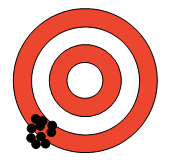
This bullseye demonstrates...
a)
High Accuracy & High Precision
b)
High Accuracy & Low Precision
c)
Low Accuracy & High Precision
d)
Low Accuracy & Low Precision
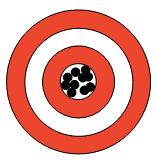
104.
?
a)
High Accuracy & High Precision
b)
High Accuracy & Low Precision
c)
Low Accuracy & High Precision
d)
Low Accuracy & Low Precision
105.

Which is the more precise measurement?

a)

4 mL

b)

4.3 mL

c)

4.30 mL

d)

4.300 mL

106.

The study of carbon containing compounds.

a)

Organic Chemistry

b)

Inorganic Chemistry

c)

Physical Chemistry

d)

Biochemistry

107.

The study of compounds that do not contain carbon.

a)

Organic Chemistry

b)

Inorganic Chemistry

c)

Biochemistry

d)

Analytical Chemistry

108.

The study of substances and processes occurring in living things.

a)

Biochemistry

b)

organic Chemistry

c)

inorganic Chemistry

d)

Applied Chemistry

109.

The identification of the components and composition of materials refers to___________________________

a)

Biochemistry

b)

Physical Chemistry

c)

Organic Chemistry

d)

Analytical Chemistry

110.
What atom matches this electron configuration?
1s22s22p63s23p64s23d10
a)
Zinc
b)
Copper
c)
Nickel
d)
Germanium
111.
What electron configuration matches an oxygen atom?
a)
1s22s22p63s2, 3p64s23d104p5
b)
1s22s22p4
c)
1s22s22p6
d)
1s22s22p63s23p64s23d1
112.
What is the electron configuration of Sulfur  using noble gas method
a)
[Ne]3s1
b)
[Ne]3s23p3
c)
[Ne]3s23p4
113.
The electron configuration of an atom is 1s22s22p6.  The number of electrons in the atom is 
a)
3
b)
6
c)
8
d)
10
114.
Which electron configuration belongs to Chlorine (Cl)?
a)
1s2s2p3s3p5
b)
1s2s2p3s3p6
c)
1s2s2p3s3p7
115.
Identify the Electron Configuration for Aluminum (Al)
a)
1s2s2p3s3p1
b)
1s2s2p3s3p3
c)
1s2s2p3s4p1
116.
Electrons occupy orbitals of lowest energy first is part of what electron configuration rule?
a)
Hund’s Rule
b)
Aufbau Principle
c)
Pauli Exclusion Principle
117.
What is the noble gas configuration for phosphorus?
a)
[Ar] 3p5
b)
[He] 3s2 3p5
c)
[Ne] 3s2 3p3
d)
[Na] 3s2 3p5
118.
What does Pauli exclusion principle state ?
a)
states that each electron occupies the lowest energy orbital available
b)
states that a maximum of two electrons can occupy a single atomic orbital, but if only if the electros have opposite spins
c)
states that single electrons electrons with the same spin must occupy each-energy orbital before additional electrons with opposite spins can occupy the same orbitals
119.
What does Hund's rule states ?
a)
states that single electrons electrons with the same spin must occupy each-energy orbital before additional electrons with opposite spins can occupy the same orbitals
b)
states that each electron occupies the lowest energy orbital available
c)
states that a maximum of two electrons can occupy a single atomic orbital, but if only if the electros have opposite spins
120.
What atom matches this electron configuration?
1s2s2p3s2
a)
Neon
b)
Magnesium
c)
Aluminum
d)
Potassium
121.
How many electrons can the d sublevel hold?
a)
14
b)
10
c)
2
d)
6
122.
How many electrons can the s sublevel hold?
a)
14
b)
10
c)
2
d)
6
123.

Each row on the periodic table represents:

a)

an energy level

b)

a sublevel

c)

an electron

d)

an orbital

124.

Energy levels are denoted by:

a)

letters

b)

numbers

c)

a combination of letters and numbers

d)

subscripts

125.

Which of the following is not a correct designation for a sublevel?

a)

zz

b)

p

c)

d

d)

f