wayground logo

Free Printable Worksheets

Font size

S
M
L
XL
Worksheets

Nervous system

Total questions: 60

Worksheet time: 20mins

Name
Class
Date
1.

Your spinal cord is part of your central nervous system.

a)

True

b)

False

2.
The nervous system is composed of the ___, ___, and ___.
a)
heart, brain, kidneys
b)
lungs, liver, stomach
c)
brain, spinal cord, nerves
d)
eyes, pancreas, veins
3.
What is the part highlighted in red?
a)
Cerebrum
b)
Cerebellum
c)
Brain Stem
d)
Diencephalon
4.
Identify the lobe of the brain that is highlighted.  
a)
frontal
b)
temporal
c)
occipital
d)
parietal
5.
Identify the lobe of the brain
a)
frontal
b)
temporal
c)
occipital
d)
parietal
6.
This part is known as the "Little Brain" and is in charge of balance and coordinating movements.  
a)
Thalamus
b)
Reticular Formation
c)
Hypothalamus
d)
Cerebellum
7.
Which systems work together when nutrients are dropped off for the cells in the brain?
a)
Circulatory, Excretory, Respiratory
b)
Circulatory, Digestive, Nervous
c)
Circulatory, Respiratory, Nervous
d)
Circulatory, Skeletal, Nervous
8.

What is the main function of the nervous system?

a)

to inhale oxygen and exhale carbon dioxide

b)

to break down food consumed by a person for nutrients

c)

to control the body's activities by relaying messages

d)

to control the body's movements

9.

A nerve cell is called a:

a)

neutron

b)

nerve

c)

neuron

d)

synapse

10.

Axons are part of a neuron that send electrical signals ________ the cell body

a)

to

b)

away from

c)

in between

11.

The space between an axon of a neuron that is communicating with a dendrite of another neuron is called a ________________.

a)

Neuron

b)

Brain message

c)

Stimulus

d)

Synapse

12.

When the spinal cord responds in an emergency to a stimulus before the brain, this is called a...

a)

response

b)

synapse

c)

cerebral response

d)

reflex

13.

Which of the following is NOT a sense?

a)

hearing

b)

nose

c)

smell

d)

touch

14.

True or False: the right side of the brain controls the right side of your body, while the left side of the brain controls the left side of your body.

a)

True

b)

False

15.

Someone who is "right-brained" is considered to be more...

a)

logical

b)

creative

16.

Our ______ receive messages and send them to the brain. The brain sends messages to our body on how to respond.

a)

heart

b)

lungs

c)

nerves

17.

Without the nervous system, you couldn't

a)

walk

b)

breathe

c)

think

d)

all of the above

18.
The part of the brain that controls conscious thoughts, senses, language  and memories.
a)
Cerebellum
b)
Cerebrum
c)
Dendrites
d)
Brain Stem
19.
Connected to spinal cord, controls heartbeat, breathing, blood pressure, digestion.
a)
Nerves
b)
Brain Stem
c)
Dendrites
d)
Brain
20.
Which part of the body is like a highway for sending messages?
a)
Blood
b)
Spinal Cord
c)
Atrium
d)
Ventricle
21.
When you react to catch a dropped ruler your body reacts in this order:
a)
1) muscles contract 2) eyes sense ruler move 3) message sent to brain 4) message sent to the muscles
b)
1) message sent to muscles 2) muscles contract 3) message sent to brain 4) eyes sense ruler move
c)
1) eyes contract 2) muscles sent to brain 3) message sense moves 4) ruler is sent to muscles
d)
1) eyes sense ruler move 2) message sent to brain 3) message sent to muscles 4) muscles contract
22.
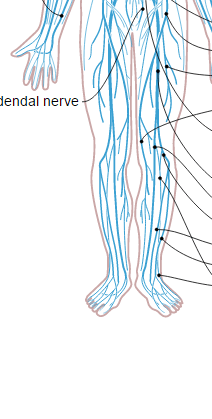
This is a picture of the 
a)
peripheral nervous sysyem
b)
central nervous system
c)
respiratory system
d)
circulatory system
23.
This insulating material forms a layer, around the axon of a neuron.  It enables electrical signals to travel down the axon at higher speeds.
a)
neuron
b)
myelin sheath
c)
dendrite
d)
neurotransmitter
24.
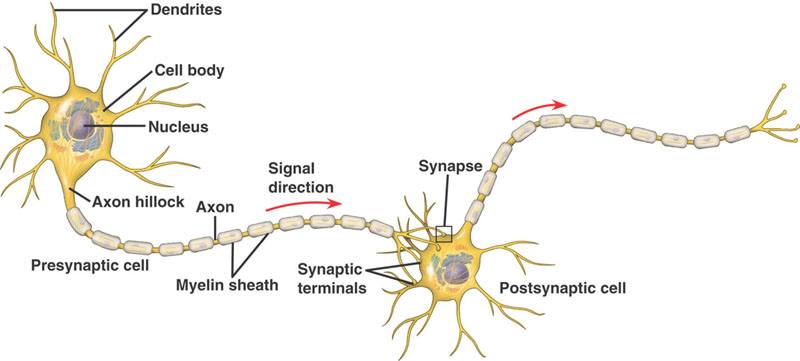
E
a)
Synapse
b)
Cell Body
c)
Axon 
d)
Dendrite
25.

What part of the brain deals with the thalamus and hypothalamus?

a)

Brain Stem

b)

Cerebellum

c)

diencephalan

d)

cerebrum

26.
A chemical produced by neurons that carries messages to other neurons
a)
myelin sheath
b)
neurotransmitter
c)
axon
d)
axon terminal
27.
This part of the neuron stores then releases neurotransmitters into the synapse.
a)
Axon 
b)
Dendrite
c)
Myelin Sheath
d)
Axon Terminal
28.

As organisms get more complex, cells become specialized to perform specific functions in the body. What is the function for the cell shown?

a)

contract and shorten movement

b)

provide coverage and protection

c)

carry impulses around the body

d)

connects parts together

29.

The human brain is made of 100 billion neurons. Each neuron has a nucleus that contains genes. Many neurons bind together to form a nerve.

a)

tissue

b)

system

c)

organ

d)

cell

30.

The urinary bladder is a muscular organ of the excretory system that collects urine excreted by the kidney. How does the nervous system help the urinary system in excretion?

a)

it signals the urinary bladder to absorb more water from the urine.

b)

It signals the urinary system to collect waste from the different parts of the body.

c)

It signals the urinary bladder to hold and release urine at appropriate times.

d)

It signals the urinary bladder to allow more urine to flow from the ureters.

31.
What are the 2 major divisions of the peripheral nervous system (PNS)?
a)
Sensory & Motor
b)
Peripheral & Central
c)
Somatic & Autonomic
d)
Brain & Spinal Cord
32.
What is the purpose of the myelin sheath on the axon?
a)
To maintain temperature
b)
To improve conductivity
c)
To protect the axon
d)
To release neurotransmitters
33.
What is NOT part of the peripheral nervous system (PNS)?
a)
axons
b)
sensory receptors
c)
spinal cord
d)
motor neurons
34.
nerve impulse
a)
action potential
b)
resting potential
c)
membrane potential
d)
synapse
35.
part of a neuron that receives information from other neurons
a)
axon
b)
dendrites
c)
myelin sheath
d)
synapse
36.
These carry signals from tissues and organs to the brain and spinal cord
a)
Sensory Neurons
b)
Motor Neurons
c)
Efferent Neurons
d)
Glial Cells
37.
These neuron processes transmit information from the sensory organs to the central nervous system
a)
efferent
b)
afferent
38.
The "fight or flight" response during threatening situations in the role of the:
a)
sympathetic nervous system
b)
parasympathetic system
c)
somatic nervous system
d)
cerebellum
39.
The _____part of the autonomic nervous system is active during resting.
a)
sympathetic
b)
parasympathetic
c)
somatic
d)
peripheral
40.
Myelinated fibers (tracts) form ________ matter while unmyelinated fibers form ________ matter. 
a)
sensory, motor
b)
gray, white
c)
motor, sensory
d)
white, gray
41.
The major role of the interneuron (association neuron) is to ________.
a)
carry information from the central nervous system to muscles and/or the viscera
b)
form a lipid-protein (lipoprotein) cell membrane on the outside of axons
c)
transmit nerve impulses from the skin and organs to the central nervous system   
d)
connect motor and sensory neurons in their pathways
42.
You're giving a speech in front of the class (most of you would feel this)
a)
sympathetic
b)
parasympathetic
43.
decreased respiration
a)
sympathetic
b)
parasympathetic
44.
Amy has an itch on her nose and would like to scratch it.  What part of her nervous system will control the movement of her arm to scratch her nose?
a)
Somatic
b)
Sympathetic
c)
Parasympathetic
d)
Autonomic
45.
What is the correct sequence of the Reflex Arc?
a)
Afferent Neuron ->
Affector ->
Interneuron ->
Effector ->
Efferent Neuron
b)
Affector ->
Afferent Neuron -> Interneuron ->
Efferent Neuron -> Effector
c)
Efferent Neuron ->
Effector ->
Interneuron ->
Affector ->
 Afferent Neuron
d)
Effector ->
Efferent Neuron ->
Interneuron ->
Afferent Neuron ->
Affector
46.

What information does the parietal lobe process?

a)

motor

b)

touch

c)

visual

d)

auditory

47.

What information does the frontal lobe process?

a)

motor

b)

touch

c)

visual

d)

auditory

48.

What is the walnut-looking part of the brain hanging from the bottom?

a)

cerebrum

b)

cerebellum

c)

brain stem

d)

diencephalon

49.

Potassium (K+) rushes out of the cell and makes the membrane potential more negative during:

a)

depolarization

b)

repolarization

c)

resting potential

d)

hyperpolarization

50.

Sodium (Na+) rushes into the cell and makes the membrane potential more positive during:

a)

depolarization

b)

repolarization

c)

resting potential

d)

hyperpolarization

51.

What is the threshold that must be hit for an action potential to occur?

a)

-70

b)

-55

c)

0

d)

+30

52.

What kind of glial cell produces the Myelin Sheath that wraps around the axon?

a)

astrocytes

b)

oligodendrites

c)

schwann cells

d)

satellite cells

53.

What causes a stroke?

a)

lack of blood supply and nitrogen

b)

lack of blood supply and oxygen

c)

lack of sleep

d)

physical exertion

54.

Which of the following allows messages to go between hemispheres of the brain?

a)

diencephalon

b)

corpus collosum

c)

cerebrospinal fluid

d)

meninges

55.

9. Which is NOT a meninge tissue?

a)

dura matter

b)

pia mater

c)

mitanoid

d)

arachnoid

56.

The organ that carries out a response to a message is called the:

a)

receptor

b)

effector

c)

stimulus

d)

response

57.
Which ions are involved in the electrical nerve impulse?
a)
Iodine and Sodium
b)
Potassium and Sodium
c)
Iron and Sodium
d)
Calcium and Iodine
58.
Gaps in the myelin sheath are called this.
a)
Nodes of Ranvier
b)
Axon terminals 
c)
Synapses
d)
Neurotransmitters
59.
What is structure labeled C in the picture?
a)
Dendrite
b)
Axon
c)
Cell Body
d)
Axon Terminal
60.

Pick out the WRONG statement

concerning the function of the nerve cell.

a)

It can convey impulses in both directions.

b)

It does not weaken the impulse passing through it.

c)

It conveys messages in the form of electrical impulses.

d)

It conveys impulses to the effector organs.