

wayground logo

Free Printable Worksheets

Font size

S
M
L
XL
Worksheets

Physics Unit 4 Practice Test

Total questions: 50

Worksheet time: 4hrs 10mins

Name
Class
Date
1.
Two like charges
a)
 neutralize each other.
b)
repel each other. 
c)
must be neutrons. 
d)
attract each other.
2.

When a balloon is rubbed on clothes it acquires a charge by ___________

a)

Induction

b)

reduction

c)

friction

d)

conduction

3.
When a glass rod is rubbed with silk and the glass rod becomes positively charged, what happens to the electrons?
a)
they are removed from the rod
b)
they are added to the rod
4.
What do you call the process of charging a conductor by bringing it near another charged object?
a)
induction
b)
polarization
c)
neutralization
d)
conduction
5.
The law of conservation of charge states that...
a)
all atoms have more protons than electrons
b)
only protons can be rubbed off of an atom
c)
charge cannot be created or destroyed
d)
charge cannot be transferred 
6.
Find the magnitude of the force between two charges of 1.0 C each which are 1.0 meter apart?
a)
9E-9 N
b)
9E9 N
c)
1.1E10 N
d)
1.1E-10 N
7.

Which is the value of the constant in Coulomb's equation?

a)

k = 9·10-9

b)

k = 9.8

c)

k = 6.67·10-11

d)

k = 9 ·109

8.

What happens to the electric force between two charges when the distance is tripled?

a)

3 times less electric force

b)

3 time more electric force

c)

9 times less electric force

d)

9 times more electric force

9.

What is the SI unit for charge?

a)

Joules

b)

Coulombs

c)

Newtons

d)

Meters

10.
What do you call the process of charging a conductor by bringing it near another charged object?
a)
induction
b)
polarization
c)
neutralization
d)
conduction
11.
If a negatively charged rod touches a conductor, the conductor will be charged by what method? 
a)
Friction
b)
Conduction
c)
Induction
d)
Convection
12.
A charged balloon is brought near an electroscope but DOES NOT touch the electroscope.  This is an example of charging by
a)
Conduction
b)
Convection
c)
Friction
d)
Induction
13.
Consider the electric field lines shown in the diagram below. From the diagram, it is apparent that object A is ____ and object B is ____.
a)
+,+
b)
+,-
c)
-,+
d)
-,-
14.
It is observed that Balloon A is charged negatively. Balloon B exerts a repulsive effect upon balloon A. Would the electric field vector created by balloon B be directed towards B or away from B and why?
a)
towards because electric field lines point away from negative charges
b)
towards because electric field lines point away from positive charges
c)
away because electric field lines point away from negative charges
d)
away because electric field lines point toward positive charges
15.

Based on the arrangement of the electric field lines in the diagram, what are the charges?

a)

both charges are the same

b)

the charges are opposite

c)

they are neutral; no charge

16.

Which statement describes what is happening in the image at the space indicated by the green arrow?

a)

The field lines are repelled by like charges.

b)

The field lines are repelled by opposite charges.

c)

The field lines are attracted by the like charges.

d)

The field lines are attracted by the opposite charges.
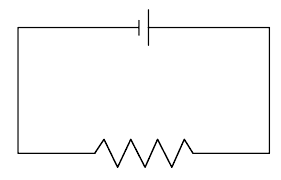
17.
What size resistor would produce a 3 Amp current flow with a 12 Volt battery
a)
1 Ohm
b)
3 Ohms
c)
4 Ohms
d)
12 Ohms
18.
What is current measured in?
a)
Ω (Ohms)
b)
V (Volts)
c)
A (Amps)
d)
W (Watts)
19.
What is current measured in?
a)
Ω (Ohms)
b)
V (Volts)
c)
A (Amps)
d)
W (Watts)
20.
What is resistance measured in?
a)
Ω (Ohms)
b)
V (Volts)
c)
A (Amps)
d)
W (Watts)
21.
What is Resistance?
a)
The flow of electrons
b)
Electric potential difference
c)
A battery
d)
The ability to reduce the flow of electrons
22.
Electricity that flows in a closed path is called a
a)
path
b)
current
c)
circuit
d)
light
23.
What is the Voltage of a circuit that has a resistance of 5 Ω and a current of 2 A?
a)
25 V
b)
10 V
c)
2.5 V
d)
0.4 V
24.
The mathematical relationship among Voltage, Current, and Resistance
a)
Faraday's Law
b)
Tesla's Law
c)
Edison's Law
d)
Ohm's Law
25.
If the Voltage stays the same and Resistance is increased, Current will 
a)
Increase
b)
Decrease
c)
Stay the same
d)
X
26.
How many Volts would we need to produce a current flow of 8 Amps through a 6 Ohm resistor
a)
12 volts
b)
24 volts
c)
1.3333
d)
48 volts
27.
This circuit has a 24 volt battery and the resistor is 8 ohms. How many amps are running through the circuit?
a)
3 Amps
b)
192 Amps
c)
2 Amps
d)
4 Amps
28.
What word means how hard it is for electrons to flow through.
a)
Current
b)
Voltage
c)
Resistance
d)
Power
29.
How many Volts would it take to push 1 Amp through a resistance of 1 Ohm
a)
10 volts
b)
1 volt
c)
48 volts
d)
5 volts
30.
What would the circuit resistance be if a 7.5 Amp draw was present with the engine running and the charging system producing 15 Volts
a)
15 Ohms
b)
4 Ohms
c)
0.3333 Ohms
d)
2 Ohms
31.

What is the formula for ohms law?

a)

1+2=3

b)

R X V = I

c)

V =I x R

d)

E= MC squared

32.

Current entering and leaving a point in a circuit should be

a)

equal

b)

decreasing

c)

increasing

d)

variable

33.

Current through each resistor when they are connected in series is

a)

different

b)

same

c)

decreasing

d)

increasing

34.

For the circuit shown, the resistances are R1 > R2 > R3. What is true about the current through each resistor?

a)

I1 = I2 = I3

b)

I1 > I2 > I3

c)

I1 > I3 > I2

d)

I1 < I3 < I2

35.

"The total current in a parallel circuit equals the sum of the individual branch currents."

a)

Ohm's Law

b)

Kirchhoff's Voltage Law

c)

Kirchhoff's Current Law

d)

Bolen's Law

36.

Three resistances 20 Ω, 30 Ω and 60 Ω are connected in parallel, their

combined resistance is given by

a)

110 Ω

b)

50 Ω

c)

20Ω

d)

10 Ω

37.

Combined resistance of 5 Ω and 10 Ω are connected in series is equal to

a)

10 Ω

b)

15 Ω

c)

20 Ω

d)

25 Ω

38.

Two 10 Ω resistors are connected in parallel, their equivalent resistance is

a)

5 Ω

b)

10 Ω

c)

15 Ω

d)

0.5 Ω

39.

When the current through a fuse gets too high, the wire inside the fuse will...

a)

create a spark

b)

melt

c)

sound an alarm

d)

do nothing

40.

Select the correct advantages of circuit breakers over fuses.

a)

Circuit breakers can be reset.

b)

Circuit breakers are cheaper.

c)

Circuit breakers stop the current faster.

41.

Which of the following are used in areas of the home that have significant amounts of moisture

a)

Ground Fault Circuit Interrupt

b)

Outlet

c)

Fuse

d)

Breaker

42.

If someone is being shocked, it is best to

a)

Turn off the power source

b)

Push them away from whatever is shocking them

c)

Call 911

d)

Tell them to stop drop and roll

43.

A (a)   contains multiple breakers and controls the flow of electricity in a building

44.

The third hole is a receptacle is for

a)

grounding

b)

allowing air to flow, keeping the outlet cool

c)

allows for water to run out in the event it gets into the outlet

45.

In a parallel circuit, voltage is

a)

shared

b)

the same

46.

In a series circuit, voltage is

a)

shared

b)

the same

47.

In a series circuit, current is

a)

shared

b)

the same

48.

In a parallel circuit, current is

a)

shared

b)

the same

49.
What types of charges attract?
a)
Positive and Positive
b)
Positive and Neutral
c)
Negative and Neutral
d)
Positive and Negative
50.
Current times Resistance equals
 (I X R)
a)
Power
b)
Voltage
c)
Amperage
d)
Ohm
