wayground logo

Free Printable Worksheets

Font size

S
M
L
XL
Worksheets

Medical Academy Practice Test 1

Total questions: 46

Worksheet time: 1hrs 1mins

Name
Class
Date
1.

What bone is highlighted?

a)

Skull (Cranium)

b)

Mandible

c)

Clavicle

d)

Scapula

2.

What bone is highlighted?

a)

Skull (Cranium)

b)

Mandible

c)

Scapula

d)

Clavicle

3.

What bone is highlighted?

a)

Skull (Cranium)

b)

Scapula

c)

Clavicle

d)

Mandible

4.

What bone is highlighted?

a)

Skull (Mandible)

b)

Clavicle

c)

Mandible

d)

Scapula

5.

What bone is highlighted?

a)

Radius

b)

Ulna

c)

Humerus

d)

Carpals

6.

What bone is highlighted?

a)

Vertebrae

b)

Radius

c)

Pelvis

d)

Ribs

7.

What bone is highlighted?

a)

Radius

b)

Ulna

c)

Humerus

d)

Carpals

8.

What bone is highlighted?

a)

Radius

b)

Ulna

c)

Humerus

d)

Carpals

9.

What bone is highlighted?

a)

Femur

b)

Tibia

c)

Fibula

d)

Humerus

10.

What bone is highlighted?

a)

Patella

b)

Pelvis

c)

Clavicle

d)

Femur

11.

What bone is highlighted?

a)

Patella

b)

Pelvis

c)

Clavicle

d)

Mandible

12.

What bone is highlighted?

a)

Tibia

b)

Fibula

c)

Femur

d)

Humerus

13.

What bone is highlighted?

a)

Tibia

b)

Fibula

c)

Radius

d)

Ulna

14.

From wrist to fingertip, what is the order of bones?

a)

Carpals, metacarpals, phalanges

b)

Phalanges, metacarpals, carpals

c)

Carpals, phalanges, metacarpals

d)

Metacarpals, carpals, phalanges

15.

What is the main function of the nervous system?

a)

to inhale oxygen and exhale carbon dioxide

b)

to break down food consumed by a person for nutrients

c)

to control the body's activities by relaying messages

d)

to control the body's movements

16.

What are the two divisions of the nervous system?

a)

Central and Lower nervous systems

b)

Central and Peripheral nervous systems

c)

Lower and Cerebral nervous systems

d)

Central and Muscular nervous systems

17.
The nervous system is composed of the ___, ___, and ___.
a)
heart, brain, kidneys
b)
lungs, liver, stomach
c)
brain, spinal cord, nerves
d)
eyes, pancreas, veins
18.
The nervous system works with these two systems to direct behavior and movement.
a)
respiratory and excretory
b)
skeletal and muscular
c)
respiratory and digestive
d)
skeletal and digestive
19.

Nerves that cause muscles to move are ____.

a)

axon nerves

b)

motor nerves

c)

sensory nerves

d)

feeling nerves

20.

The ____ is made of all the nerves that spread out from the brain and spinal cord.

a)

peripheral nervous system

b)

average nervous system

c)

central nervous system

d)

linear nervous system

21.
The brain is the ______ ______ of the body.
a)
nervous center
b)
nueropathy
c)
control center
d)
extension
22.
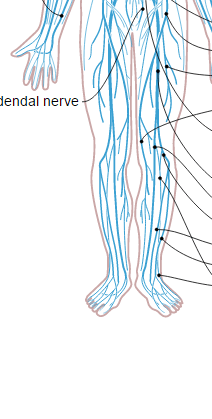
The red part of the picture shows the ________ which is part of the nervous system.
a)
brain
b)
spinal cord
c)
peripheral nerves
d)
neurons
23.
main organ of the nervous system. protected by the skull, and made of neurons, it is the control center for all actions, thoughts and emotions.
a)
brain
b)
electrical impulse
c)
gland
d)
heart
24.
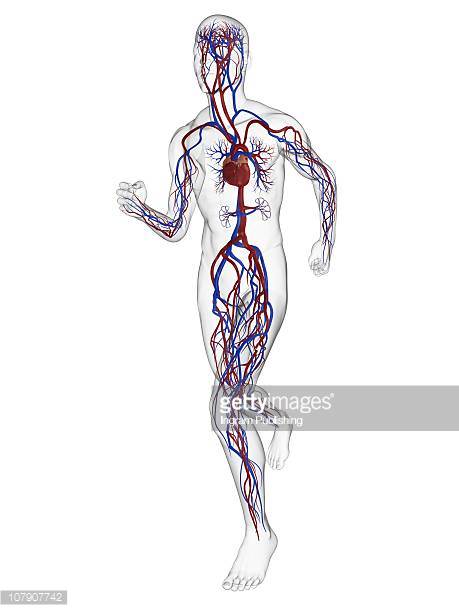
This is a picture of the 
a)
peripheral nervous sysyem
b)
central nervous system
c)
respiratory system
d)
circulatory system
25.

What are the senses that the nervous system receives messages from? (mark all that apply)

a)

Vision

b)

Hearing

c)

Smell

d)

Taste

e)

Touch

26.

What is the Peripheral Nervous System consist of?

a)

The brain

b)

The spinal Cord

c)

The nerves that connect the CNS to all parts of the body.

d)

All of the above.

27.

The nerves in your fingertips are part of the ___ nervous system

a)

central

b)

peripheral

28.

What is the main organ of the circulatory system?

a)

small intestine

b)

bone

c)

lungs

d)

heart

29.
How many types of blood vessels are in our body?
a)
1
b)
2
c)
3
d)
4
30.

Arteries carry oxygen rich blood away from the heart.

a)

True

b)

False

31.

Veins carry oxygen poor blood back to the heart.

a)

False

b)

True

32.

The job of the heart is to . . .

a)

pump blood around the body.

b)

send food to the small intestines.

c)

break down food.

d)

give energy to the body.

33.
The heart is made up of _________ chambers
a)
one 
b)
two 
c)
three
d)
four
34.
Oxygen deprived blood enters the heart through the 
a)
right ventricle 
b)
left ventricle
c)
right atrium
d)
left atrium
35.
Oxygen rich blood leaves the heart through the
a)
right atrium
b)
left atrium 
c)
right ventricle
d)
right atrium
36.
On and off switches to let blood in and out of the heart are known as
a)
ventricles
b)
valves
c)
buttons
d)
pulses
37.
Arteries carry nutrient and oxygen rich blood _____________ from the heart.
a)
back to
b)
away
c)
parallel
38.
Blood vessels are 
a)
veins
b)
capillaries
c)
arteries
d)
all of them
39.
Capillaries join together
a)
veins and arteries
b)
veins and the heart
c)
arteries and veins
d)
heart and valves
40.
A capillary is an extremely small blood vessel located within the __________ of the body, that transports blood from arteries to veins.
a)
organelles
b)
tissues
c)
cells
41.
True or false:  The circulatory system includes all of your bones.
a)
True
b)
False
42.
The upper chambers of the heart are known as...
a)
valves
b)
ventricles
c)
atria
d)
septum
43.
What is the largest artery in the human body called?
a)
Superior Vena Cava
b)
Aorta
c)
Inferior Vena Cava
d)
Pulmonary Artery
44.
Pulmonary referrs to the lungs, blood leaving the heart through the pulmonary artery is high in which gas?
a)
nitrogen
b)
carbon dioxide
c)
oxygen
d)
helium
45.

The ____________ carries blood throughout the body;

the ____________ carries blood only to and from the

lungs.

a)

systemic circuit; pulmonary circuit

b)

pulmonary circuit; systemic circuit

c)

venous circulation; arterial circulation

d)

arterial circulation; venous circulation

46.

Compared with those of the systemic circulation, arteries of the pulmonary circulation:

a)

Have lower blood pressure.

b)

Have less elastic tissue.

c)

Carry blood that contains less oxygen.

d)

All of them.