
Font size
 Worksheets
F1 Revision
Total questions: 58
Worksheet time: 19mins


When a single-celled organism splits into 2 new organisms it is called _________________.
fragmentation
fission
budding
sporulation
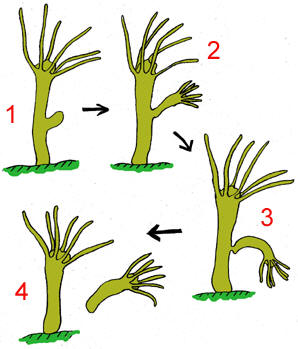
When an offspring grows off from the body of a parent organism it is called __________________.
budding
fission
fragmentation
sporulation
Some advantages of sexual reproduction include: (select all that apply)
genetic variation
improves chances of adapting to the environment
helps species survive catastrophes
it doesn't take as much energy as asexual reproduction
What are some disadvantages to sexual reproduction? (select all that apply)
it takes a lot of energy to find a mate
you don't need another mate
it requires a male and a female
more genetic errors can occur
What are some advantages of asexual reproduction are: (select all that apply)
it only requires one organism
it takes less energy than sexual reproduction
offspring are already well-adapted for the environment
there is a lot of genetic variety
Genetically identical offspring are _____________ the parent organism.
opposite of
clones of
superior to
inferior to
____________________ occurs when a male gamete (sperm) combines with a female gamete (egg).
sporulation
fertilization
fission
regeneration
In fission, how does the DNA of the daughter cells compare to the DNA of the parent cell?
it is exactly the same
it is different due to meiosis
it is mostly the same with slight changes
it is better than the parent DNA
If a sex cell has 10 chromosomes, how many chromosomes will there be after fertilization?
5
10
15
20


A mode of reproduction in which an organism arises from two organisms and inherits half of its DNA from each parent
Sexual Reproduction
Asexual Reproduction
Cloning
Fragmentation

Fertilisation takes place in the ___________________
Ovary
Uterus
Fallopian tube
Vagina
During fertilisation, nucleus in the head of sperm fuses with the ovum nucleus to form a ___________________
embryo
zygote
foetus
baby
Name the process where the embryo implants onto the uterine lining of uterus.
Plantation
Implantation
Pregnancy
Development
Choose the correct pathway of sperm to meet ovum for fertilisation.
Sperm duct > Penis> Vagina > Cervix > Uterus
Testis > Sperm duct > Urethra> Penis > Vagina> Fallopian tube
Testis > Sperm duct > Urethra > Penis > Vagina > Cervix > Uterus > Fallopian tube
Testis > Sperm duct > Penis> Vagina > Uterus> Fallopian tube

After fertilisation, the zygote will divide to form ___________________
a baby
a foetus
an embryo
implantation


In week 10-19, embyro is known as__________.
embryo
zygote
baby
feotus

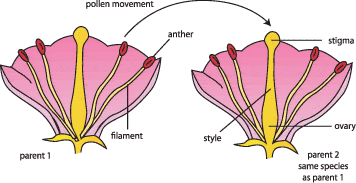
Germination is
When a seed starts to grow
When an egg and pollen join together
When Pollen moves stamen to stigma
When a plant makes its own food.
Which is NOT part of a seed?
seed coat
embryo
pollen
food store
Where does the seed get its energy from?
Food store
sunlight
embryo
animals
Seed structure that grows become stem and leaves
radicle
plumule
cotyledon
endosperm

Which of the following describes process no.2?
First leaves grow and carry out photosynthesis
Plumule becomes stem and leaves
Radicle becomes root
Seed coat is broken
Which of the following describes process no.1?
First leaves grow and carry out photosynthesis
Plumule becomes stem and leaves
Radicle becomes root
Seed coat is broken
Which of the following describes process no.4?
Leaves grow and carry out photosynthesis under sun
Plumule becomes stem and leaves
Radicle becomes root
Seed coat is broken

