wayground logo

Free Printable Worksheets

NEW

Font size

S
M
L
XL
Worksheets

Chp 7:Ionic BondingPRACTICE

Total questions: 50

Worksheet time: 36mins

Name
Class
Date
1.
A charged particle that has gained or lost electrons is called a _____.
a)
molecule
b)
ion
c)
isotope
d)
element
2.
A cation is a ____ ion.
a)
negative
b)
positive
c)
neutral
d)
ficticious
3.
A cation is a ____ ion.
a)
negative
b)
positive
c)
neutral
d)
ficticious
4.
A anion will be a ____ ion.
a)
negative
b)
positive
c)
neutral
d)
ficticious
5.
Beryllium will ____ valence electrons when forming an ionic bond.
a)
lose 4
b)
gain 4
c)
lose 2
d)
gain 2
6.
Ionic bonds form between metals and ____.
a)
metalloids
b)
metals
c)
nonmetals
7.
What determines how ionic bonds will form?
a)
Number of protons
b)
Mass of the atom
c)
Number of total electrons
d)
Number of valence electrons
8.
Ionic bonds happen because of the ____ of valence electrons.
a)
sharing
b)
transfer
9.
Nitrogen will ____ valence electrons when forming an ionic bond.
a)
gain 1
b)
lose 1
c)
gain 3
d)
lose 3
10.
What type of bond is this? Lithium with Fluorine?
a)
ionic
b)
covalent
11.
How many electrons are needed in the outer energy levels of an atom to be stable?
a)
2
b)
4
c)
6
d)
8
12.
Nitrogen will do what to gain a stable octet?
a)
Lose 3
b)
Gain 3
c)
Lose 1
d)
Gain 2
13.
Which of the following would produce an anion?
a)
Ca
b)
Al
c)
K
d)
F
14.

Which of the following is NOT a property of ionic compounds?

a)

They conduct electricity when molten

b)

They conduct electricity when in solution

c)

They have high boiling points

d)

They are insoluble in water

15.
In the chemical formula for an ionic compound, which item is written first?
a)
positive ion
b)
negative ion
c)
subscript
d)
the female
16.
Which of the following is a characteristic property of ionic compounds?
a)
They form hard, brittle crystals with characteristic shapes
b)
They have low melting points
c)
They have low boiling points
d)
They contain no charged particles
17.
In what form can an ionic compound conduct electricity?
a)
when dissolved in water
b)
as a solid
c)
as a crystal
d)
when warmed slightly
18.
An ionic bond is the attraction between:
a)
oppositely charged ions
b)
similarly charged ions
c)
neutral ions
d)
neutral atoms
19.
This type of model shows only the valence electrons of an element? 
a)
Bohr diagram 
b)
Childers model
c)
Lewis-dot diagram 
d)
What is a valence electron again?
20.
What is the charge on a Hydrogen ion?
a)
+1
b)
1
c)
2
21.
What is the charge on a chloride ion?
a)
-1
b)
1
c)
+2
d)
+1
22.
How many valence electrons does calcium have?
a)
2
b)
4
c)
6
d)
7
23.
When an atom loses an electron, it becomes a:
a)
positive ion
b)
negative ion
c)
neutral ion
d)
neutral atom
24.
What will be the compound name of the following chemical formula?
NaCl
a)
Potassium Chloride
b)
Sodium Chloride
c)
Calcium Chloride
d)
Sodium Chlorine
25.

The diagram represents a substance with ionic bonding.

a)

True

b)

False

26.

The reason a bond is formed between chloride ions and sodium ions is because an electron has been transferred between them.

a)

True

b)

False

27.
What is the ionic compound formed between Ca and O?
a)
CaO
b)
Ca2O
c)
Ca2O2
d)
CaO2
28.
What is the ionic compound formed between K and F?
a)
KF
b)
K2F
c)
KF2
d)
K2F2
29.

Lead Chloride is an ionic compound, made up from Pb2+ ions and Cl- ions. Which is the correct formula for this compound?

a)

PbCl3

b)

PbCl

c)

PbCl4

d)

PbCl2

30.
Which of the following is ionic?
a)
NO2
b)
MgO
c)
CO
d)
CH4
31.
Ions have unequal numbers of 
a)
neutrons and protons.
b)
protons and electrons.
c)
electrons and neutrons.
32.
When atoms form ions they obtain an electron configuration similar to a __________.
a)
metal
b)
halogen
c)
alkali metal
d)
noble gas
33.
When is an atom stable?
a)
when it has plenty of friends and family that love it
b)
when it has a full valence electron shell
c)
when it has an empty valence electron shell
d)
when its protons equal its neutrons
34.
_____ tend to form negative anions.
a)
metals
b)
nonmetals
35.
_____ tend to form positive cations.
a)
metals
b)
nonmetals
36.
As an ion, magnesium has a ____ charge.
a)
2+
b)
2-
c)
1+
d)
1-
37.
As an ion, nitrogen has a ____ charge.
a)
5+
b)
5-
c)
3+
d)
3-
38.
As an ion, bromine has a ____ charge.
a)
1+
b)
1-
c)
2+
d)
2-
39.
As an ion, potassium has a ____ charge.
a)
1+
b)
1-
c)
2+
d)
2-
40.
Phosphorus has a 3- charge, sodium has a 1+ charge. What is the formula for a sodium phosphide compound?
a)
NaP
b)
NaP3
c)
Na3P
d)
Na2P3
41.
Fluorine has a 1- charge, magnesium has a 2+ charge. What is the formula for a magnesium fluoride compound?
a)
MgF
b)
Mg2F
c)
MgF2
d)
Mg2F2
42.

Magnesium chloride is an ionic compound and has the formula of MgCl2 . How many magnesium and chloride ions are there?

a)

1 magnesium ion 1 chloride ion

b)

2 magnesium ions 1 chloride ion

c)

1 magnesium ion 2 chloride ions

d)

2 magnesium ion 2 chloride ion

43.

When naming binary ionic compounds, the name of the negative ion (nonmetal) ends in

a)

-ate.

b)

-ite.

c)

-ide.

d)

-ium.

44.

What do we call electrons in the highest energy level of an atom?

a)

orbital electrons

b)

cations

c)

anions

d)

valence electrons

45.

How many valence electrons are in one atom of oxygen

a)

6

b)

16

c)

2

d)

8

46.

As an ion, is oxygen likely to be a cation or an anion?

a)

cation

b)

anion

c)

both, it depends on what it bonds with

d)

neither, it is never an ion

47.
When an atom loses an electron, it becomes a:
a)
positive ion
b)
negative ion
c)
neutral ion
d)
neutral atom
48.
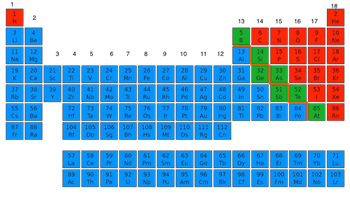
Where are the nonmetals located on the periodic table? 
a)
Blue
b)
Red
c)
Green
49.
What is the correct formula for this molecule?
a)
NH
b)
N3H
c)
NH3
d)
NH4
50.

Which structure has a sea of free electrons?

a)

Ionic

b)

Covalent

c)

Metallic

d)

All of the above