wayground logo

Free Printable Worksheets

NEW

Font size

S
M
L
XL
Worksheets

Unit 3 Periodic Table

Total questions: 63

Worksheet time: 2hrs 3mins

Name
Class
Date
1.

Which two particles are attracted to each other?

a)

Two neutrons

b)

A proton and an electron

c)

Two protons

d)

An electron and a neutron

2.

As two oppositely charged particles approach each other, what happens to the electrical force between them?

a)

The attractive force increases

b)

The magnitude of the electric force decreases

c)

The repulsive force increases

d)

The magnitude of their charges increases

3.
When distance increases, electrostatic force ____________; we call this relationship ____________ proportional
a)
decreases;directly
b)
decreases;inversely
c)
increases;inversely
d)
increases;directly
4.
The Electric Force is strongest when charges are...
a)
close together
b)
far apart
c)
the electric force is constant everywhere
5.

Coulomb's law says that the force between any two charges depends

a)

directly on the size of the charges

b)

inversely on the square of the distance between the charges

c)

both are correct

6.
What is ionization energy?
a)
Energy needed to destroy an atom
b)
Energy required to remove an electron
c)
Energy needed to split an electron
d)
Energy required to add an electron
7.
Energy is required to remove an electron from the atom.
a)
True
b)
False
c)
Not sure
8.

Which element has a greater force between its nucleus and outer electrons?

a)

Potassium

b)

Krypton

9.

What element would have a high ionization energy?

a)

Potassium

b)

Krypton

10.

How many valence electrons does this element have?

a)

1

b)

2

c)

8

d)

7

11.

Which electron is the closest to the nucleus?

a)

1

b)

3

c)

7

d)

8

12.
A single horizontal row in the periodic table is called a_________________.
a)
group
b)
period
c)
graph
d)
density
13.
Each vertical column in the periodic table is called a ________________.
a)
group
b)
period
c)
graph
d)
density
14.
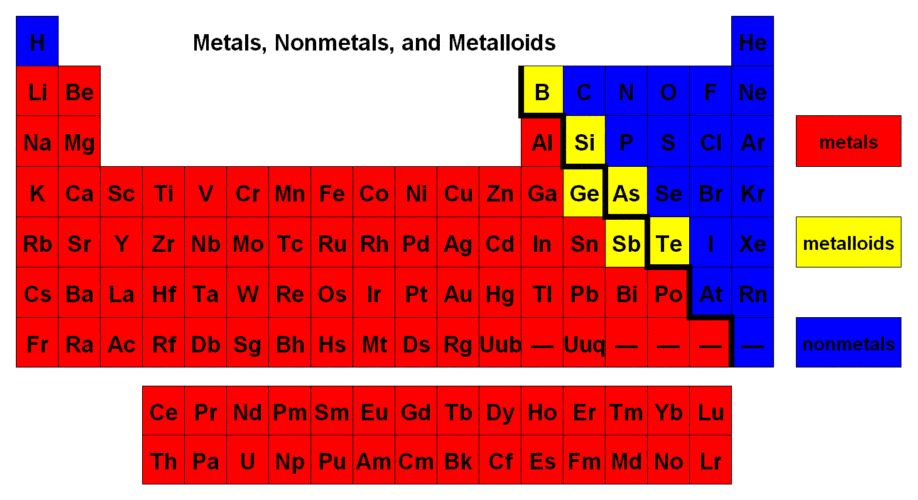
___________have properties of both metals and nonmetals.
a)
copper
b)
solids
c)
metalloids
d)
noble gases
15.
_________are not very shiny, malleable or ductile.
a)
metals
b)
transition metals
c)
alkaline earth metals
d)
nonmetals
16.
The period for Bromine is ___________.
a)
3
b)
2
c)
4
17.
Beryllium is in group number______.
a)
Group 2
b)
Group 3
c)
Group 4
d)
Group 7
18.
What is the name of the group that never reacts--ever ever they are stable with a full outermost ring!!!
a)
noble gases
b)
transition
c)
halogens
d)
borons
19.

Group 1 is also called

a)

halogens

b)

alkaline earth metals

c)

alkali metals

d)

noble gases

20.

Group 2 is also called

a)

halogens

b)

alkaline earth metals

c)

alkali metals

d)

noble gases

21.

Group 17 is also called

a)

halogens

b)

alkaline earth metals

c)

alkali metals

d)

noble gases

22.

Group 18 is also called

a)

halogens

b)

alkaline earth metals

c)

alkali metals

d)

noble gases

23.

Elements that are conductive, lustrous, and have a high melting point

a)

metals

b)

non-metals

c)

metalloids

24.

Elements that are poor conductors, dull, and have a low melting point

a)

metals

b)

non-metals

c)

metalloids

25.

Elements that share properties of metals and non-metals are called

a)

metals

b)

non-metals

c)

metalloids

26.
Which element is not a metal?
a)
Li
b)
Mg
c)
Al
d)
B
27.
The atoms along the staircase are called 
a)
metals
b)
nonmetals
c)
metalloids
d)
noble gases
28.
How many Valance electrons does Iodine Have?
a)
6
b)
16
c)
7
d)
17
29.
Elements in the same period have what in common? 
a)
same number of valence electrons
b)
react the same
c)
have the same protons 
d)
same number of energy levels
30.
Elements which are shiny, conduct electricity and heat are called
a)
metal
b)
nonmetal
c)
metalloid
d)
nonexistent
31.
Elements in the same group or family have all of this in common EXCEPT?
a)
same number of valence electrons
b)
React similarly
c)
have similar chemical properties
d)
have the same number of energy levels 
32.
Which group of nonmetals is the most reactive? 
a)
Group 1
b)
Group 17
c)
Group 18
d)
Group 2
33.
Which group of metals is the most reactive? 
a)
Group 1
b)
Group 17
c)
Group 18
d)
Group 2
34.
Which of the following statements best describes the trends and patterns of the periodic table? 
a)
the atomic number and atomic mass decrease from left to right across a period, energy levels decrease from top to bottom down a group
b)
the atomic number and atomic mass increase from left to right across a period, energy levels decrease from top to bottom down a group
c)
the atomic number and atomic mass increase from left to right across a period, energy levels increase from top to bottom down a group
35.

How many valence electrons are in a halogen?

a)

1

b)

2

c)

7

d)

8

36.

Despite helium, how many valence electrons do noble gases have?

a)

1

b)

2

c)

7

d)

8

37.
Sodium (Na) and potassium (K) are in the same group on the periodic table. Based on their locations, which statement about sodium and potassium is true?
a)
Sodium is less electronegative than potassium. 
b)
Sodium has fewer energy levels than potassium. 
c)
Sodium has a larger ionic radius than potassium. 
d)
Sodium has lower ionization energy than potassium. 
38.
Which of these elements has the greatest atomic radius? 
a)
H
b)
N
c)
Cl
d)
Cs
39.
The Periodic Table of the Elements is useful for revealing patterns and trends in the elements. Which statement accurately describes a pattern in the size of atomic radii in the Periodic Table of the Elements?
a)
Atomic radii decrease from left to right across a period and decrease from top to bottom in a group.
b)
Atomic radii increase from left to right across a period and increase from top to bottom in a group.
c)
Atomic radii decrease from left to right across a period and increase from top to bottom in a group.
d)
Atomic radii increase from left to right across a period and decrease from top to bottom in a group.
40.
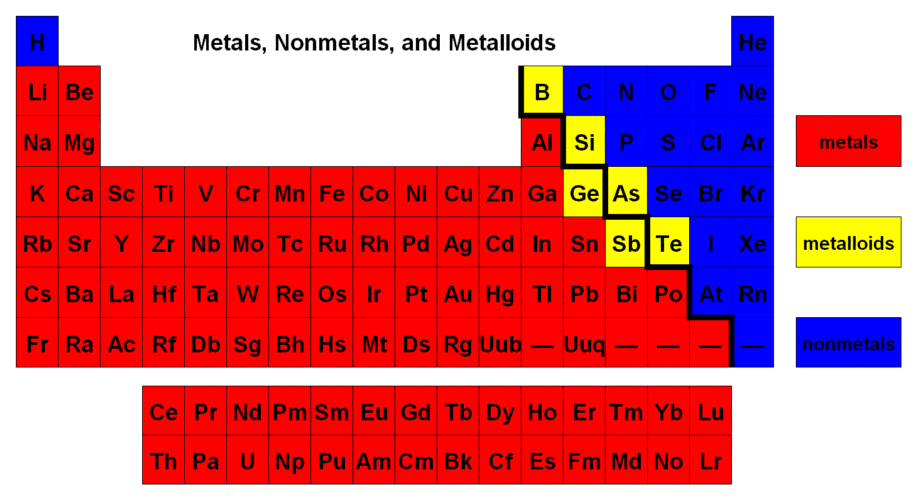
The symbols W, X, Y, and Z represent four elements shown on the outline of a periodic table.
Which element has the highest electronegativity?
a)
W
b)
X
c)
Y
d)
Z
41.
Fluorine, chlorine, bromine, and iodine all have the same number of valence electrons and have a tendency to gain electrons. Which element has the greatest ionization energy and electronegativity?
a)
fluorine
b)
chlorine 
c)
bromine 
d)
iodine 
42.
Which element has 2 valence electrons? 
a)
cesium (Cs) 
b)
magnesium (Mg)
c)
boron (B)
d)
argon (Ar) 
43.
Which of the following will have a lower ionization energy than Scandium (Sc)?
a)
Helium (He)
b)
Titanium (Ti)
c)
Calcium (Ca)
d)
Magnesium (Mg)
44.
Which atom has the largest atomic radius?
a)
potassium
b)
rubidium 
c)
francium
d)
cesium
45.
Electronegativity is...
a)
how good an atom is at attracting electrons
b)
the ability of an atom to lose electrons
c)
the energy required to remove an electron from a specific atom
d)
how easy it is to make friends. 
46.
Which of the following will have a larger radius than Zinc?
a)
Gallium
b)
Aluminum
c)
Magnesium
d)
Strontium
47.
As you move down the periodic table atoms get bigger.  This is because ____________.
a)
The atoms have more mass.
b)
The atoms have more protons.
c)
The atoms have more energy levels
d)
The atoms have more neutrons
48.
Which of the following will have a higher electronegativity than arsenic (As)?
a)
Carbon (C)
b)
Neon (Ne)
c)
Antimony (Sb)
d)
Germanium (Ge)
49.
Which of the following will have a larger radius than Zinc?
a)
Gallium
b)
Aluminum
c)
Magnesium
d)
Strontium
50.
Which of the following will have a lower ionization energy than Scandium (Sc)?
a)
Helium (He)
b)
Titanium (Ti)
c)
Calcium (Ca)
d)
Magnesium (Mg)
51.
As you move across the periodic table atoms tend to get smaller because, ______________.
a)
the atoms have more mass.
b)
the atoms have less mass
c)
the atoms have more protons.
d)
the atoms have less electrons.
52.
Ionization energy is...
a)
the energy required to add an electron to a specific atom
b)
how much energy it takes to remove an electron from an atom
c)
the energy required to shield the outer electrons from the nucleus
d)
a measure of the ability of an atom to attract electrons
53.
Electronegativity __________ from left to right within a period and __________ from top to bottom within a group.
a)
decreases, increases 
b)
increases, increases
c)
increases, decreases 
d)
stays the same, increases
54.
Atomic radius generally increases as we move __________.  
a)
down a group and from right to left across a period 
b)
up a group and from left to right across a period 
c)
down a group and from left to right across a period 
d)
up a group and from right to left across a period 
55.
The tendency of an atom to attract electrons and acquire a negative charge
a)
electronegativity
b)
charge
c)
bonding ability
d)
electron configuration
56.
What elements generally make an ionic bond?
a)
metal and nonmetal
b)
2 or more nonmetals
c)
metal
d)
none of the above
57.
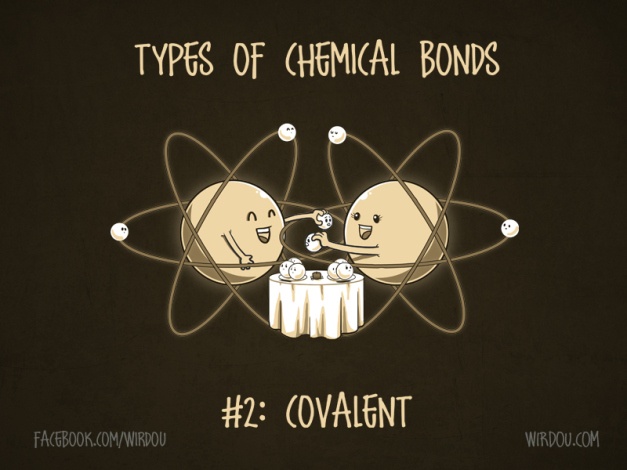
What elements generally make a covalent bond?
a)
metal and nonmetal
b)
2 or more nonmetals
c)
metal
d)
none of the above
58.
In chemical compounds, covalent bonds form when
a)
the electronegativity difference between two atoms is very large.
b)
electrons are completely transferred between two metals.
c)
pairs of electrons are shared between two nonmetal atoms.
d)
two nonmetal atoms are attracted to each other by opposite charges.
59.
An ionic bond forms when 
a)
Valence electrons are shared
b)
a sea of mobile electrons surround the cations
c)
valence electrons are transferred between atoms
d)
none of the above
60.
A chemical bond formed between shared atoms.
a)
chemical bond
b)
covalent bond
c)
oxidation #
d)
ionic bond
61.

The electrons in a polar covalent molecule are shared...

a)

Evenly

b)

Unevenly

c)

Electrons are not shared

d)

None of the Above

62.

The electrons in a nonpolar covalent molecule are shared...

a)

Evenly

b)

Unevenly

c)

Electrons are not shared

d)

None of the Above

63.

The polarity of a bond is determined by...

a)

The sum of the electronegativities of the two atoms

b)

The difference in the electronegativities of the two atoms

c)

The charges of the atoms

d)

None of the Above