
 Worksheets
Unit 1: Matter
Total questions: 57
Worksheet time: 57mins
Which answer below is an example of two physical properties of matter?
weight and toxicity
mass and reactivity
mass and volume
mass and pH
Which state of matter has an indefinite shape and a definite volume?
liquid
solid
gas
plasma
Which state of matter has a definite shape and a definite volume?
liquid
solid
gas
plasma
Mixtures are
physically combined and can usually be separated.
physically combined and can never be separated.
chemically combined.
We have no way of knowing how they combine.
A salt water solution can be separated by
filtration
a sieve
a centrifuge
evaporation
_________ is the amount of space an object takes up.
Mass
Matter
Volume
Density
Which type of matter can not be broken down into simpler substances by a chemical change?
an element
a solution
a mixture
a compound
Two grams of potassium chloride are completely
dissolved in a sample of water in a beaker. This
solution is classified as
an element
a compound
a homogeneous mixture
a heterogeneous mixture
Which statement describes a chemical property of sodium?
Sodium has a melting point of 371 K.
Sodium has a molar mass of 23 grams.
Sodium can conduct electricity in the liquid phase.
Sodium can combine with chlorine to produce a salt.
When a chemical change occurs, the substances you start and finish with have
the same chemical properties
different chemical properties

Which particle diagram represents a mixture of element X and element Z, only?


Which sample of matter is a mixture?
soil
ammonia
water
calcium
When a mixture of water, sand, and salt is filtered, what remains at the top of the filter paper?
salt and sand, only
sand, only
salt and water, only
salt, only
A beaker contains both alcohol and water. These liquids can be separated by distillation because the liquids have different
densities
particle sizes
boiling points
solubilities
What units are used to measure mass?
g
cm3
g/cm3
cm3/g
A beaker is used to measure volume in which metric unit?
Milliliters (mL)
Grams (g)
Meters (m)
Kilograms (kg)
Which is the best example of a pure substance?
peanut
milk
gold
air

An object has a density of 1.4 g/cm3. It is slowly lowered into a graduated cylinder whose water level was 65 mL. When the object is completely submerged the water level rises to 90 mL. What is the mass of the object?
25 g
15 g
35 g
18 g

Find the density of a block with a length of 4 cm, a width of 6 cm, a height of 0.5 cm, and a mass of 23 grams.
0.192 g/cm3
1.917 g/cm3
5.750 g/cm3
12.00 g/cm3
Filtration can be used to separate mixtures based on
boiling point
their densities
their melting points
the size of their particles

The chart lists the densities of various gemstones. A gemstone has a mass of 6.24 grams and a volume of 1.98 cm3. What is the identity of the gemstone?
opal
diamond
garnet
topaz
What is the Average Kinetic Energy of a substance called?
volume
temperature
pressure
movement
Phase change going from a Solid to a Gas...
Deposition
Sublimation
Condensation
Recombination
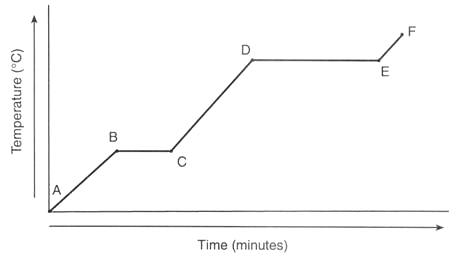
What is happening to the particles in the substance between points D and E?
Melting
Freezing
Vaporizing
Sublimating

Is the substance gaining or losing energy?
Gaining
Losing
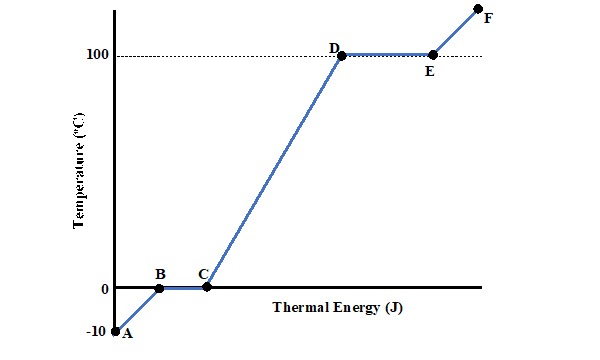
Between which two points is the solid cooling?
A <---- B
B <----> C
C <---- D
D <----> E
E <---- F
Between which two points is the gas heating up?
A ----> B
B <---- C
C ----> D
D ----> E
E ----> F




A sample of iron receives 50.J of heat energy that raises the temperature of the iron 25.0°C. If iron has a specific heat of 0.10 J/g°C, what is the mass of the iron sample?
25 g
30 g
20 g
50 g
What is the symbol for Thermal Energy?
Q
T
m
Cp
What unit do you use to measure Thermal Energy?
J/Kg ºC
Kg
ºC
J
The temperature of an unknown piece of metal with a mass of 30.00 g changes from 25.0 °C to 35.0 °C when the metal absorbs 350.0 J of energy. What is the specific heat of the metal?
1.17 J/g°C
-1.17 J/g°C
0.857 J/g°C
-0.857 J/g°C
How much energy is needed to raise the temperature of 5.0 grams of lead from 25°C to 35°C? [specific heat (c) = 0.129 J/(g•°C)]
6.45 J/(g•°C)
6.45 J
16.1 J/(g•°C)
d.16.1 J
Q= m c ∆T
The units for specific heat are:
If the specific heat of water is 4.18 J/g∙°C, how much heat is required to increase the temperature of 1.2 kg of water from 23 °C to 39 °C? (show your work)
-80,256 J
80.256 J
80,256 J
-80.256 J
What does "ΔT" mean?
A change in health
A change in heat
A change in height
A change in temperature
What is the mathematical relationship between the Celsius and Kelvin scales of temperature?
C = K + 273
K = C - 273
9/5C + 32 = K - 273
K = C + 273
How many Joules of energy are required to make 100 grams of ice at 0 οC completely melt? Ice has a heat of fusion of 334 J/g
200 J
400 J
33,400 J
2,000,000 J

