wayground logo

Free Printable Worksheets

Font size

S
M
L
XL
Worksheets

Periodic Trends

Total questions: 70

Worksheet time: 2hrs 54mins

Name
Class
Date
1.
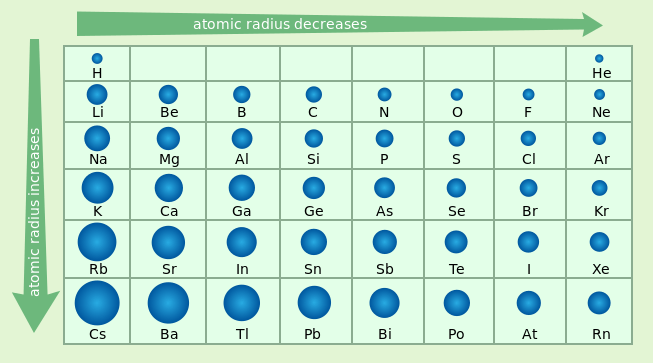
Atomic Radius is...
a)
the relative size of the atom's nucleus
b)
the relative size of the atom's electron cloud
c)
the energy required to shield the outer electrons from the nucleus
d)
a measure of the ability of an atom to attract electrons
2.
As you move down the periodic table atoms get bigger.  This is because ____________.
a)
The atoms have more mass.
b)
The atoms have more protons.
c)
The atoms have more energy levels
d)
The atoms have more nuetrons
3.
As you move across the periodic table atoms tend to get smaller because, ______________.
a)
the atoms have more mass.
b)
the atoms have less mass
c)
the atoms have more protons.
d)
the atoms have less electrons.
4.
Which atom has the largest atomic radius?
a)
potassium
b)
rubidium 
c)
francium
d)
cesium
5.
The atom with the largest atomic radius in Group 18 is - 
a)
Ar
b)
He
c)
Kr
d)
Rn
6.
Which periodic group has the smallest atomic radius?
a)
Alkali metals
b)
Halogens
c)
Noble Gases
d)
Transition metals
7.
Ionization energy is...
a)
the energy required to add an electron to a specific atom
b)
how much energy it takes to remove an electron from an atom
c)
the energy required to shield the outer electrons from the nucleus
d)
a measure of the ability of an atom to attract electrons
8.
Which of the following will have a lower ionization energy than Scandium (Sc)?
a)
Helium (He)
b)
Titanium (Ti)
c)
Calcium (Ca)
d)
Magnesium (Mg)
9.
Which of the following will have a higher ionization energy than arsenic (As)?
a)
Gallium (Ga)
b)
Neon (Ne)
c)
Antimony (Sb)
d)
Germanium (Ge)
10.
Electronegativity is...
a)
how good an atom is at attracting electrons
b)
the ability of an atom to lose electrons
c)
the energy required to remove an electron from a specific atom
d)
how easy it is to make friends. 
11.
Atoms that have a high electronegativity, _______________.
a)
give up their electrons more easily.
b)
hold on to their electrons more tightly.
c)
have more electron shells.
12.
Which of the following will have a higher electronegativity than arsenic (As)?
a)
Carbon (C)
b)
Neon (Ne)
c)
Antimony (Sb)
d)
Germanium (Ge)
13.
As atoms of elements in group 16 are considered in order from top to bottom, the electronegativity of each successive element....
a)
decreases
b)
increases
c)
remains the same
d)
none of the above
14.
The electronegativity of Cl is the highest in Period 2.  Why?
a)
Cl is the largest and has the greatest effective nuclear charge
b)
Cl is the smallest and has the lowest effective nuclear charge
c)
Cl is the largest and has the lowest effective nuclear charge
d)
Cl is the smallest and has the greatest effective nuclear charge
15.
Which has the greater EN: 
Cl or Al?
a)
Cl
b)
Al
16.
Which has the greater EN: 
N or C?
a)
C
b)
N
17.
Which statement correctly and completely identifies a trend?
a)
Atomic radius decreases across a period and increases down a group.
b)
Electronegativity decreases across a period and decreases down a group.
c)
Ionization energy increases across a period and increases down a group.
d)
Ionic radius increases across a period and increases down a group.
18.

The element with the lowest electronegativity in Period 3 is -

a)

Na

b)

Cl

c)

Ar

d)

Mg

19.
Atomic radius generally increases as we move __________.  
a)
down a group and from right to left across a period 
b)
up a group and from left to right across a period 
c)
down a group and from left to right across a period 
d)
up a group and from right to left across a period 
20.
Electronegativity __________ from left to right within a period and __________ from top to bottom within a group.
a)
decreases, increases 
b)
increases, increases
c)
increases, decreases 
d)
stays the same, increases
21.
As you move across the periodic table from left to right, the atomic radius decreases.  This is because - 
a)
the number of protons increases, so attraction to electrons increases
b)
the number of energy levels increases
c)
the number of electrons increases
d)
the atomic mass increases
22.
The atom with the largest atomic radius in Period 4 (row 4) is - 
a)
K
b)
Kr
c)
Fe
d)
Fe
23.
Francium (Fr) has the lowest ionization energy in Group 1 because - 
a)
it has the smallest number of valence electrons
b)
it has the greatest atomic mass
c)
it has the greatest number of protons, so it attracts its electrons the strongest
d)
its 1 valence electron is very far from the nucleus, so little energy is needed to remove it
24.
The energy required to remove electrons is the definition of: 
a)
Electronegativity
b)
Atomic Number
c)
Atomic Radius
d)
Ionization
25.
Families all have similar 
a)
Names
b)
atomic numbers
c)
atomic masses
d)
properties
26.
Which element could be lustrous and brittle?
a)
A
b)
B
c)
G
d)
L
27.
Which elements have the same number of valence electrons?
a)
A & C
b)
E & C
c)
F & A
d)
F & B
28.
Is silicon a metal, nonmetal or metalloid?
a)
Metal
b)
NonMetal
c)
Metalloid
29.
How many energy levels does an atom of Chlorine have?
a)
2
b)
3
c)
4
d)
7
30.
List the two most reactive families on the periodic table.
a)
Alkali metals & Transition Metals
b)
Noble gases & Oxygen Family
c)
Halogens & Alkali metals
d)
Halogens & Noble gases
31.

Which element is most likely to have six electrons in its 4th energy level?

a)

Oxygen (O)

b)

Selenium (Se)

c)

Krypton (Kr)

d)

Potassium (K)

32.
The core of an atom where most of the mass of an atom exists; contains protons and neutrons
a)
nucleus
b)
electron shell
c)
proton
d)
electron
33.
The more protons there are, the  ____ .
a)
Weaker the pull
b)
Smaller the electrons
c)
Stronger the pull
d)
The bigger the electrons
34.
Order the following in increasing atomic radii: 
Ra, Be, Ca, Rb, H
a)
Ra, Be, Rb, H, Ca
b)
Rb, H, Ca, Be, Ra
c)
Ra, Rb, Ca, Be, H
d)
H, Be, Ca, Rb, Ra
35.

Which statement correctly and completely identifies a trend?

a)

Atomic radius decreases across a period and increases down a group.

b)

Electronegativity decreases across a period and decreases down a group.

c)

Ionization energy increases across a period and increases down a group.

d)

Ionic radius increases across a period and increases down a group.

36.
As you move down the periodic table atoms get bigger.  This is because ____________.
a)
The atoms have more mass.
b)
The atoms have more protons.
c)
The atoms have more energy levels
d)
The atoms have more nuetrons
37.

Which of the following is arranged in order of increasing atomic radius

a)

Li, Ca, Mg, Ba, Sc

b)

Li, Mg, Sc, Ca, Ba

c)

Mg, Sc, Ca, Ba, Li

d)

Li, Mg, Ca, Sc, Ba

38.
Which of the following is true for alkaline earth metals as their atomic number increases?
a)
The atomic radius decreases.
b)
Ionization energy decreases.
c)
The number of valence electrons increases.
d)
The Coulombic attraction increases.
39.
Which of the following sequences corresponds to a correct trend in ionization energy?
a)
Cl > S > P > Al
b)
Sr > Ca > Mg > Be
c)
Rb > K > Na > Li
d)
Rb > Sr > I > Xe
40.
Put the following in order of increasing ionization energy:Strontium, Aluminum, Indium
a)
Strontium, Indium, Aluminum
b)
Strontium, Aluminum, Indium
c)
Indium, Aluminum, Strontium
d)
Aluminum, Indium, Strontium
41.
Which has the greater EN: 
N or C?
a)
C
b)
N
42.
The element with the lowest electronegativity in Period 3 is - 
a)
Na
b)
Cl
c)
Ar
d)
Mg
43.
 Which of the following generally applies to the noble gases? 
a)
high ionization energy, low electronegativity, high reactivity
b)
high ionization energy, high electronegativity, high reactivity
c)
low ionization energy, low electronegativity, low reactivity
d)
high ionization energy, low electronegativity, low reactivity 
44.
Chlorine and Fluorine are both very electronegative, as they are both missing a single electron from their valence energy level.  Why is Fluorine more electronegative than Chlorine? 
a)
Fluorine has less energy levels.
b)
Chlorine has more electrons in its outer shell
c)
Fluorine has more protons.
d)
None of these
45.
What elements have zero electronegativity?
a)
metals
b)
nonmetals
c)
metalloids
d)
noble gases
46.
List the following in order of weakest to strongest ionization energy.
P, Cs, Co, Sr
a)
P, Co, Sr, Cs
b)
Cs, Sr, Co, P
c)
Sr, Cs, Co, P
d)
P, Co, Cs, Sr
47.
The tendency of an atom to attract electrons and acquire a negative charge
a)
electronegativity
b)
charge
c)
bonding ability
d)
electron configuration
48.

Who developed the Periodic Table?

a)

Mendeleev, who was a chemist and teacher

b)

Pavlov, who was a teacher and physchologist

c)

Ladahoff, who was a teacher and biologist

49.
Choose the set that goes from lowest to highest electronegativity?
a)
Cu, Mg, Sr, Ca
b)
F, Cl, Br, Si
c)
Cs, Rb, Ca, Mg
d)
Zn, Cd, Ag, Cu
50.
Put these in order of increasing electronegativity:
Se, S, and O
a)
Se < S < O
b)
Se < O < S
c)
O < S < Se
d)
S < Se < O
51.

As you look down a group, electronegativity

a)

increases

b)

decreases

52.

As you look from left to right across a period, electronegativity

a)

increases

b)

decreases

53.
How many electrons can the first energy level hold?
a)
1
b)
2
c)
8
d)
0
54.

Of the following sublevels, which is the highest in energy?

a)

4s

b)

3d

c)

4p

d)

5s

55.

Electrons fill energy levels and sublevels _____ in energy first.

a)

lower

b)

higher

56.

According to the Octet Rule, atoms of elements react with each other in order to attain ____ electrons in their outermost energy level or shell.

a)

2

b)

4

c)

6

d)

8

e)

10

57.

Which of the following elements LOSES 1 electron in order to attain an octet?

a)

potassium

b)

calcium

c)

helium

d)

boron

e)

fluorine

58.

Each of the following elements will LOSE ELECTRONS in order to attain an octet EXCEPT _______

a)

iodine

b)

magnesium

c)

potassium

d)

copper

e)

strontium

59.
An electron occupies the lowest energy orbital that can receive it.
a)
Hund’s rule
b)
Pauli exclusion principle
c)
Bohr model of the atom
d)
Aufbau principle
60.
All orbitals of equal energy are occupied by one electron before any single orbital is occupied by a second electron.
a)
Aufbau principle
b)
Pauli exclusion principle
c)
Hund’s rule
d)
Core Notation
61.
No two electrons in the same atom can have the same four quantum numbers.
a)
Aufbau principle
b)
Pauli exclusion principle
c)
Hund’s rule
d)
Noble gas notation
62.
Which element is pictured?
a)
neon
b)
fluorine
c)
magnesium
d)
argon
63.
What is incorrect about this orbital diagram?
a)
Both arrows in the 2p box should be pointing up
b)
There is nothing incorrect with this diagram
c)
In the 2p box there should only be 1 electron in the first 2p box and one in the 2nd 2p box
d)
All the arrows should be pointing up.
64.

Identify the rule that is being violated

a)

Aufbau's Principle

b)

Hund's Rule

c)

Pauli's Exclusion Principle

d)

Heisenberg uncertainty principle

65.

Which is the electron configuration of Ar (Argon)

a)

1s2 2s2 2p6 3s2 3p6

b)

1s2 2s2 2p6 3s2 3p0

c)

1s2 2s2 3s2 4s2 4p6

d)

3s2 4f14 4s2

66.

In 1s2, the 2 means

a)

there are 2 electrons in this level

b)

it is the 2nd energy level

c)

there is a +2 charge

d)

there is a -2 charge

67.

Determine the group and periodicity of the following atoms!

a)

IIIA and 2

b)

IIA and 2

c)

VA and 3

d)

IVA and 1

68.
What is this element?
1s22s22p63s2
a)
Neon
b)
Magnesium
c)
Aluminum
d)
Potassium
69.
Identify the Electron Configuration for Aluminum (Al)
a)
1s2s2p3s3p1
b)
1s2s2p3s3p3
c)
1s2s2p3s4p1
70.

organized elements on the periodic table by positive charge or atomic number

a)

moseley

b)

mendeleev

c)

dalton

d)

rutherford