wayground logo

Free Printable Worksheets

NEW

Font size

S
M
L
XL
Worksheets

ESS1A Universe

Total questions: 59

Worksheet time: 3570secs

Name
Class
Date
1.

What is a light year?

a)

The distance that light travels in one year

b)

Buzz's name

c)

A large collection of stars, gas, and dust that is help together by gravity

d)

The measure of a star's brightness

2.

Which star has the greatest luminosity?

a)

Vega

b)

Aldebaran

c)

Sirius

d)

Betelgeuse

3.

Which star looks looks the brightest from Earth?

a)

Sirius

b)

Aldebaran

c)

Rigel

d)

Vega

4.

Which of these shows the correct order from coolest to hottest?

a)

red, yellow, white, blue

b)

white, blue, yellow, red

c)

yellow, white, blue, red

d)

blue, yellow, white, red

5.

If a star is 15 ly from Earth, how long does it take light from that star to reach Earth?

a)

15 minutes

b)

15 light years

c)

15 years

d)

15 hours

6.

Consider the color of the sun. Based on this color, what is the sun's approximate surface temperature?

a)

5,000-6,000

b)

6000-7500

c)

30000-60000

d)

<3500

7.

Which statement best describes stars?

a)

large planets that are composed mostly of gases

b)

celestial bodies made of gas that give off light

c)

faint dots of light that can be seen from Earth's surface

d)

objects that form in the outer parts of the solar system

8.

Absolute magnitude is defined as…

a)

mass of a star

b)

color of a star

c)

brightness of a star, as it appears from Earth

d)

brightness of a star independent from the distance of Earth

9.

About 90 percent of the stars in the universe, including the sun, are main sequence stars. What do all main sequence stars have in common?

a)

All main sequence stars are yellow like our sun.

b)

All main sequence stars are as bright as our sun.

c)

They are all undergoing fusion of helium into carbon within their cores

d)

They are undergoing fusion of hydrogen into helium within their cores

10.

White dwarfs stars are

a)

hot and dim

b)

cool and dim

c)

hot and bright

d)

cool and bright

11.
Which of the following is NOT a characteristic used to classify stars?
a)
Color
b)
Temperature
c)
Size
d)
Shape
12.
The brightness of a star as seen from earth is defined as:
a)
Apparent Brightness
b)
Absolute Brightness
c)
Brightness
d)
Candid Brightness
13.
A light year is a measurement of:
a)
Time
b)
Distance
c)
Gravity
d)
None of the Above
14.
Explosion of a high-mass star.
a)
White Dwarf
b)
Planetary Nebula
c)
Supernova
d)
Neutron Star
15.
An object whose gravity is so strong that nothing can escape.
a)
Planetary Nebula
b)
Supernova
c)
Neutron Star
d)
Black Hole
16.
Which of the following is a name used for stars:
a)
Neutron
b)
Supergiant
c)
White dwarf
d)
All of the above
17.

Stars are made of mostly which two gases?

a)

Hydrogen and Helium

b)

Hydrogen and Oxygen

c)

Hydrogen and Nitrogen

d)

Hydrogen and Carbon

18.

A star is born in a cloud of gas and dust called a __________.

a)

nebula

b)

galaxy

c)

asteroid

d)

black hole

19.

Stars give off heat and light in a process called ___________.

a)

nuclear fusion

b)

supernova

c)

luminosity

d)

spectroscopy

20.

Why does the sun look so big to us?

a)

It is the closest star to Earth.

b)

It is the biggest star.

c)

It is farthest star from Earth.

d)

It is the hottest.

21.

Why do most stars look so small in the sky?

a)

They are close to us.

b)

They are far away from us.

c)

They are running out of gas.

d)

They are new stars.

22.

What color is the hottest star?

a)

Red

b)

Yellow

c)

Blue

d)

White

23.

What color is the coolest star?

a)

Red

b)

Yellow

c)

Blue

d)

White

24.
Which is the correct order of stars from COOLEST to HOTTEST?
a)
blue, white, yellow, orange, red
b)
red, yellow, blue, white, orange
c)
red, white, yellow, orange, blue
d)
red, orange, yellow, white, blue
25.

All stars begin their life in a

a)

Main Sequence

b)

Nebula

c)

Protostar

d)

Black Dwarf

26.

Our sun is a ____________ star.

a)

main sequence G2

b)

massive star

c)

supernova

d)

red giant

27.

Average size stars will turn into a _____ star next.

a)

protostar

b)

red giant

c)

supergiant

d)

black hole

28.

A massive star can end it's life as a ______ or ___________.

a)

neutron star/black hole

b)

main sequence star/ nebula

c)

supernova

nebula

d)

red giant

supergiant

29.

What is the diagram called that shows the relationship between star size and temperatures?

a)

bar graph

b)

HR diagram

c)

star chart

d)

Star diagram

30.
What is the name of the gas/dust clouds that form stars?
a)
Nebulas
b)
Protostars 
c)
Supernova
d)
Neutron Star
31.
What word best describes our sun?
a)
Average
b)
Supergiant
c)
Dwarf
d)
Red Giant
32.
The H-R diagram is a graph that shows the relationship between ______________ for stars. 
a)
temperature and color
b)
temperature and brightness
c)
brightness and color
d)
distance and brightness
33.
______ is a force that causes dust particles to stick together in a nebula.
a)
nuclear fusion
b)
gravity
c)
hydrogen
d)
friction
34.
Most stars are made of which elements?
a)
Hydrogen only
b)
Hydrogen and Lithium
c)
Hydrogen and Sodium
d)
Hydrogen and Helium
35.

What will be the next stage in our star the sun's life cycle?

a)

supernova

b)

white dwarf

c)

blackhole

d)

red giant

36.
The color of a star tells us its
a)
magnitude
b)
temperature
c)
size
d)
age
37.
Which star is closest to Earth?
a)
Betelgeuse
b)
Orion
c)
the sun
d)
Antares
38.
The life cycles of stars are determined by their:
a)
mass (size)
b)
color
c)
distance from Earth
d)
luminosity
39.
The final stage of a low mass star is a 
a)
neutron star
b)
nebula
c)
black hole
d)
black dwarf
40.
When a nebula heats up, a "baby" star forms in the middle. It is called a
a)
supernova
b)
supergiant
c)
white dwarf
d)
protostar
41.
The color of the star tells us its 
a)
composition
b)
Temperature
c)
Luminosity 
d)
Mass
42.
Because the Earth is 93 million mies from the Sun, the light from this star takes_____ to reach us.
a)
8 hours
b)
1 hour
c)
8 minutes
43.
What is the term used for a cloud of gas and dust?
a)
gas giant
b)
solar dust
c)
solar cloud
d)
nebula
44.
An apparent shift in the position of an object when viewed from different locations. 
a)
Parallax
b)
Perihelion
c)
Solar Nebula
d)
Prominence
45.
What type of star will die the fastest
a)
Medium Mass
b)
Low Mass
c)
High Mass 
46.
This is what our sun will become at the end of its life cycle.
a)
red dwarf
b)
white dwarf
c)
blue supergiant
d)
black hole
47.
Consider two stars (Stars A and B) that both exhibit parallax. If Star A appears to move back and forth by a greater amount than Star B, which star is closer to you?
a)
Star A 
b)
Star B
c)
Both are at an equal distance
d)
More information is needed
48.
What is parallax?
a)
the angle formed by Earth and two celestial bodies located at 90 degrees from Earth
b)
the apparent difference in the position of an object, as we viewed from a different position
c)
the apparent difference in the position of an object, viewed at the same time each year
d)
the average distance between a celestial object and Earth
49.
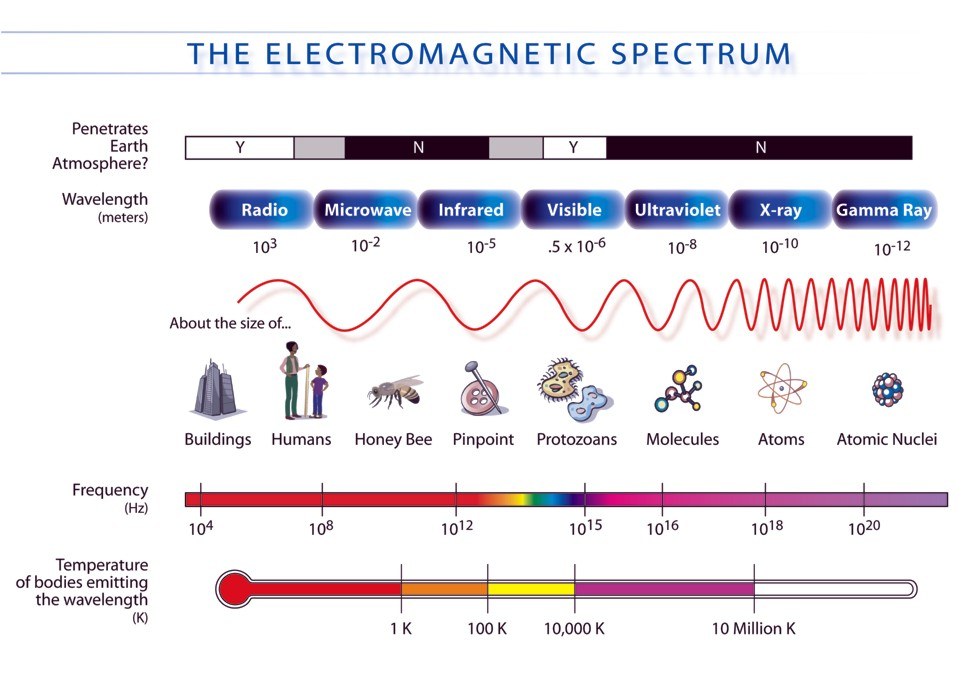
Select the correct order of waves on the EMS 
a)
Radio, Micro, Infra, Visible, Ultra, X-ray, Gamma
b)
Gamma, X-ray, Ultra, Vis, Infra, Micro, Radio
c)
Vis, Micro, Infra, Ultra, X-ray, Gamma, Radio
d)
Micro, Radio, Vis, Infra, Ultra, X-ray, Gamma
50.
Which has the SHORTEST wavelength and, therefore, the highest frequency/most energy
a)
Radio waves
b)
Ultraviolet Rays
c)
Gamma Rays
d)
X-rays
51.
Which section of the spectrum is the ONLY one we can see?
a)
X-rays
b)
Visible Light
c)
Gamma Rays
d)
Ultraviolet Rays
52.
Select the correct order of waves on the EMS from the longest wavelength to the shortest wavelength
a)
Radio, Micro, Infra, Visible, Ultra, X-ray, Gamma
b)
Gamma, X-ray, Ultra, Vis, Infra, Micro, Radio
c)
Vis, Micro, Infra, Ultra, X-ray, Gamma, Radio
d)
Micro, Radio, Vis, Infra, Ultra, X-ray, Gamma
53.
Which has the LONGEST wavelength and, therefore, the lowest frequency/energy
a)
Gamma Rays
b)
Radio Waves
c)
Visible Light
d)
Infrared rays
54.
Which has the SHORTEST wavelength and, therefore, the highest frequency/most energy
a)
Radio waves
b)
Ultraviolet Rays
c)
Gamma Rays
d)
X-rays
55.
Where are stars the most stable?
a)
Supergiant
b)
Main sequence
c)
White dwarf
d)
black dwarf
56.
Put the stars in order from hottest to coolest.
a)
Blue, Red, White, Yellow, Orange, 
b)
Red, White, Yellow, Orange, Blue
c)
Blue, White, Yellow, Red, Orange
d)
Blue, White, Yellow, Orange, Red
57.
Which star has the lowest luminosity?
a)
A
b)
B
c)
C
d)
D
58.
Which star is considered a Main Sequence Star?
a)
A
b)
B
c)
C
d)
D
59.

What kind of electromagnetic radiation do we feel as heat?

a)

Gamma rays

b)

Visible light waves

c)

Infrared waves

d)

X rays