
 Worksheets
The Atmosphere Unit Ongoing Review
Total questions: 118
Worksheet time: 2hrs 58mins
Atmosphere
The blanket of air that surrounds Earth
All the water that covers Earth
All the rocks and minerals that make up Earth
Which describes the stratosphere?
contains the ozone layer
pressure increases as altitude increases
temperature increases as altitude increases
density increases with altitude
Which describes the troposphere?
lowest layer
uppermost layer
temperature decreases as altitude increases, and pressure decreases as altitude increases
temperature increases as altitude increases, and pressure decreases as altitude decreases
Pressure
how much space something takes up
the force that air puts on an area
how much matter is in an object
Density
an object's mass divided by its volume
How much space something takes up
How much matter is in an object; measured in grams
a measure of how many particles are packed together into a certain amount of space
Ozone is a gas that...
that we need to breathe in
that we exhale
absorbs UV light
absorbs heat
The ozone layer is in the...
trophosphere
stratosphere
mesosphere
ionosphere
Concentration of nitrogen in the atmosphere
21%
55%
78%
95%
Concentration of oxygen in the atmosphere
15%
21%
78%
95%
What is a function of the atmosphere?
to provide water
to keep in heat
to prevent precipitation
to hold us on to Earth
In which layers does the temperature increase with increasing altitude?
thermosphere, stratosphere
troposphere, ionosphere
stratosphere, exosphere
thermosphere, troposphere
Biggest source of air pollutants
factories/industry
volcanoes
agriculture
burning fossil fuels
The mesosphere helps protect the crust from...
The impact of meteors.
Dangerous cosmic rays.
Dangerous solar flares.
Harmful weather.
The main factor that raises the rate of global warming is...
Ozone and Oxygen
Carbon Dioxide and Hydrogen
Carbon Dioxide
Carbon Dioxide and Dihydrogen Oxide
What are the conditions in the atmosphere over a short period of time called?
Climate
Environment
Weather
Front
How does the atmosphere heating up cause air pressure to happen?
cool air rises to create high pressure, and warm air sinks to create low pressure
warm air rises to create low pressure, and cool air sinks to create high pressure
cool air is pushed away from the equator and back into space, so there is less air pressure
electromagnetic solar energy is converted to mass, and gravity pulls this down to create pressure
How does ozone in the stratosphere affect life on Earth?
it absorbs UV radiation that would harm life on Earth’s surface
it makes the air we breathe smell good
ozone makes the sky appear blue
it causes breathing problems in people
What creates an El Nino condition?
the ocean currents change causing warmer than normal ocean temperatures
the shape of the coast changes and fish populations decline
storms and other weather events in the atlantic ocean create it
the prevailing winds get stronger
What is the role of conduction in heating Earth’s atmosphere?
the hot mantle heats the crust, which heats the air touching it
the hot Earth’s surface transfers heat energy to the air molecules touching it
heat molecules from the Sun heat the air molecules they hit at the top of the atmosphere
electromagnetic heat energy converts to conduction heat energy when ozone is formed

How does the Greenhouse Effect protect life on Earth?
It maintains Earth's temperature
It blocks harmful rays from the sun
It gives us gravity
It traps pollution in the sky

At higher altitudes, air pressure is...
Lower
Higher
The same
Increasing

In which sphere does most weather occur?
Thermosphere
Mesosphere
Stratosphere
Troposphere

What force creates air pressure on Earth?
Gravity
Magnetism
Electricity
Greenhouse Effect

What sphere do we live in?
Thermosphere
Mesosphere
Stratosphere
Troposphere

What are the layers in order starting from Earth's surface?
Troposphere, Thermosphere, Mesosphere, Stratosphere
Troposphere, Stratosphere, Mesosphere, Thermosphere
Thermosphere, Mesosphere, Stratosphere, Troposphere
Thermosphere, Stratosphere, Mesosphere, Troposphere

How does the atmosphere protect life on Earth?
It blocks harmful rays from the sun
It keeps our planet the right temperature
It provides oxygen to breathe
All of these protect life on Earth
The different genders in our class, boys and girls, are given the same test. Their scores were measured to see which group is smarter. What is the independent variable?
Test Score
Gender
Same test

Why does air pressure decrease as you move up in the atmosphere?
Because it gets colder
It doesn't, air pressure increases
Gravity weakens as you get farther away from the Earth's surface
Fewer harmful rays are hitting you

How does pollution effect Earth's temperature?
It traps more heat, warming the planet
It cools our planet
It does not effect our temperature

What would Earth be like without an atmosphere?
There would be no life
There would be no air
More radiation from the sun would harm the planet
All of these are true

_________________ is the short term changes in the atmosphere.
Weather
Climate
Climate change
Troposphere

_________________ is how the atmosphere behaves over relatively long periods of time.
Weather
Climate
Climate change
Latitude

Select all items that refer to weather forecasts.
Temperature
Humidity
Precipitation
Sunset
Wind

Weather is affected by ___________________.
Topography
Latitude


Which arrow shows the surface heating the air?
The arrow in the middle.
The arrow on the right.
The arrow on the left.
The arrow on the right and the left.

Air temperature changes the most because
The sun heats the air
The sun heats the surface and the surface heats the air
The sun heats ocean which heats the land.

Temperature is affected by
distance from continents
distance from landforms
distance from the equator

Which location is warmer?
The North and South pole
The equator

The lines that determine distance from the equator are called?
altitude
latitude
meters
The best way to stay safe in ALL extreme weather conditions is...........
have a plan for you and your family.
call your friends to see if they are safe.
run as fast as you can to get out of town.
collect food and clothes.
The best safety plan for a thunderstorm is.........
Stay away from water and electricity.
Key an eye on the sky
Call 911 if someone is struck by lightning.
All of the above
The most common winter storm is a blizzard.
False
True
Which one of these statements is false about Tsunamis?
Tsunamis can cause the sea level to rise.
Tsunamis can travel over 500 miles on land.
Tsunamis won't hurt you if your in a boat.
To be safe in a tsunami you must get to high ground.
Thunderstorms are ................... and ............................
pieces of ice that from a cloud
large storms
heavy rain
loud charges that create a loud boom
The best way to be safe in a Hurricane is to ............
Board up your windows
Have an evacuation plan
Secure or bring in items that might fly away
All of the above
Extreme Weather is
lots of rain
acts of nature that put people, animals and nature at risk
snow storm
big waves at the beach

How does a tornado form
from grass
From moist dry air mixed with cool
From ice
By a whirlpool
What is a Tsunami?
Its the same thing as a hurricane
Its a massive wave that are most often formed by underwater earthquakes.
Its a flood
Its a massive electrical discharge that comes from clouds

What causes a drought
Not receiving Water or snow
The sun gets to hot
There is no sun
What kind of wind do hurricanes need to form?
Low wind
Strong wind

WHICH WORD BETTER DESCRIBES THE PICTURE?
FLOOD
HAIL
HEAVY RAIN
2 things you use to protect your self from the sunlight:


The Sun heats the atmosphere of Earth unevenly. Which of the following statements is the most likely result of this uneven heating?
Convection in the atmosphere causes a change in air density, resulting in winds.
Conduction through the atmosphere causes evaporation to occur over oceans, resulting in rain.
Radiation from the Sun reflects through the atmosphere back into space resulting in cooler evenings.
Radiation from the Sun causes atmospheric moisture to collect over mountain ranges resulting in snowfall.

Where do we see radiation in a pot of boiling water on the stove?
The water heats up by touching the hot, metal pot.
The steam from the hot water rises out of the pot.
The heat from the fire can be felt on all sides.
Where do we see convection in a pot of boiling water on the stove?
The water heats up by touching the hot, metal pot.
The steam from the hot water rises out of the pot.
The heat from the fire can be felt on all sides.
Where do we see conduction in a pot of boiling water on the stove?
The water heats up by touching the hot, metal pot.
The steam from the hot water rises out of the pot.
The heat from the fire can be felt on all sides.

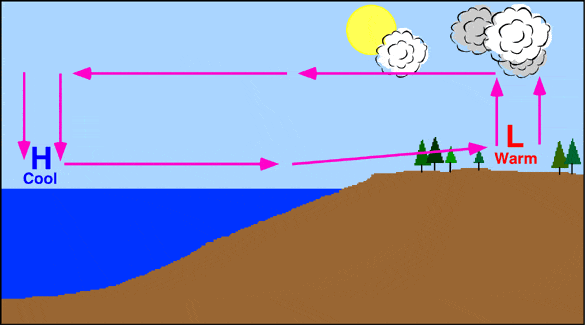
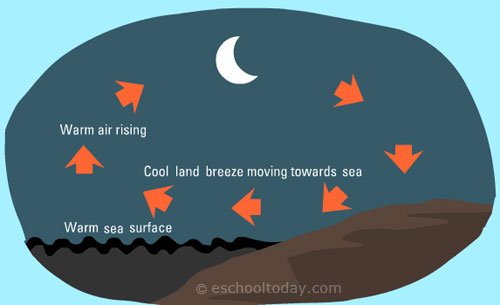
What kind of breeze is this and when would it form?
Land breeze - daytime
Land breeze - nighttime
Sea breeze - daytime
Sea breeze - nighttime
Why do land breezes occur at night?
Land cools off slower than water, so the air above water is cooler.
Water cools off faster than land, so the air above land is warmer.
Land heats up slower than water, so the air stays cooler during the day.
Water cools off slower than land, so the air above water is warmer.
How much UV radiation does the ozone layer normally filter out?
99%
10%
50%
0%
The amount of water vapor in the air is known as ___.
dew point
humidty
relative humidity
rain
Which will hold more water, warm air or cold air?
Warm Air
Cold AIr
colder air = higher humidty
warmer air = higher humidity
If the air is very humid...
Sweat evaporates very quickly
Persons are very comfortable
Sweat evaporates very slowly
The air in buildings get very dry


Both El Nino and La Nina have this in common
Influence birds that migrate over the ocean
Influence rainy / dry weather world wide
The weather at the polar regions
The directions that ships travel in the oceans
During an El Nino, it rains
in the central Pacific
in the FAR western Pacific
in the western Pacific
In all of the Pacific
A cold air mass is moving toward a warm air mass, and nimbostratus clouds are observed in the sky. Which weather conditions are most likely?
a cool, rainy day
a cool, sunny day
a warm, rainy day
a cool, sunny day

A cold front has just reached the area of Idaho that is marked with a star. Which numbered point will the cold front MOST likely reach next?
1
2
3
4
Ohio often has the weather that Indiana recently had because weather in the United States tends to move from
south to north.
north to south.
west to east.
east to west.
Which correctly compares low- and high-pressure weather systems?
A low-pressure system usually brings cool dry air and clear skies, while a high-pressure system brings clouds and precipitation.
A low-pressure system usually brings clouds and precipitation, while a high-pressure system brings cool dry air and clear skies.
A low-pressure system usually brings warm dry air and clear skies, while a high-pressure system usually brings warm moist air and precipitation.
The polar jet stream is an air current that flows across North America. It flows much faster in winter than it does in summer. Why is it faster in the winter?
Northern air has more oxygen in winter.
Northern air is warmer in winter.
Northern air is colder in winter.
Northern air is drier in winter.

Study the map of the polar jet stream above. What type of weather would MOST likely appear at the location marked X?
cold and dry
cold and wet
warm and dry
warm and wet
What will most likely result when the jet stream moves south of North Carolina?
North Carolina will experience tropical weather conditions.
North Carolina will experience hot, dry weather.
North Carolina will experience mild weather.
North Carolina will experience cold weather.
Which best describes a characteristic of the jet stream?
It forms a boundary between a cold air mass and a warm air mass.
It creates the high winds around the eye of a hurricane.
It forces the hot air along the equator to rise to areas in North America.
It causes high pressure air masses to rotate clockwise.
Which lists some effects of El Niño?
warmer temperatures and more rain
warmer temperatures and less rain
cooler temperatures and less rain
What is the cause of rising surface temperatures of the Pacific Ocean, drought in the western United States, and flooding on the Pacific coast of South America?
the Gulf Stream
the jet stream
La Niña
El Niño
How could La Niña affect weather during the summer in North Carolina?
It could decrease wind.
It could increase rainfall.
It could decrease rainfall.
What oceanic and atmospheric conditions DOES NOT occur during a La Niña?
changes in the intensity and distribution of rainfall in the Tropics
changes in the patterns of sea level pressure
atmospheric circulation that affect many areas worldwide.
cold oceanic patterns that occur near the Equator

Scientists design _____________________ to test ideas, theories, and hypothesis about the world around them.
experiments
observations
tests
fairs
Put the steps of the scientific method in the correct order.
Hypothesis, question or problem, experiment, conclusion, analysis
Analysis, questions or problem, hypothesis, experiment, conclusion
Question or problem, hypothesis, analysis, experiment, conclusion
Question or problem, hypothesis, experiment, analysis, conclusion
Which of the following is an example of a hypothesis?
I like coffee better than pop.
If I drink caffeine before bed, then it will take longer to fall asleep.
Dogs always chose the more expensive dog food.
What type of dog food will my dog like better?


The warm _____ brought rain to McDonough as it moved in over the cold air that was already here.
climate
back
front
fog

Violently rotating column of air in contact with the ground crossing land in a narrow path
hurricane
tornado
blizzard
thunderstorm

A large, swirling, low pressure system that forms over the warm Atlantic ocean. It has winds of at least 120 km/h and loses force/power when it reaches land.
precipitation
blizzard
tornado
hurricane

