wayground logo

Free Printable Worksheets

Font size

S
M
L
XL
Worksheets

Solids, liquids, gases, and particle theory

Total questions: 121

Worksheet time: 2hrs 52mins
Name
Class
Date
1.
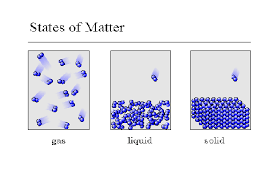
Matter is anything that has _________ and _________.
a)
length and width
b)
mass and volume
c)
a boiling point and a freezing point
d)
size and shape
2.
The smallest particles of matter are __________.
a)
elements
b)
compounds
c)
atoms
d)
molecules
3.
The amount of matter in a substance, or object, is its __________.
a)
volume
b)
length
c)
temperature
d)
mass
4.
A __________ is used to measure mass.
a)
balance
b)
thermometer
c)
beaker
d)
meter stick
5.
__________ is the amount of space matter takes up.
a)
Mass
b)
Liquid
c)
Volume
d)
Gas
6.
Particles in a __________ have very little movement and the object keeps its shape and volume.
a)
solid
b)
liquid
c)
gas
7.
__________ have a definite volume and tend to take the shape of their container. 
a)
solids
b)
liquids
c)
gases
8.
Water vapor is a __________.
a)
solid 
b)
liquid
c)
gas
9.
Water becomes a solid when __________.
a)
temperature is increased
b)
temperature is decreased
10.
Compress means to __________.
a)
flatten by pressure
b)
increase temperature
c)
melt
d)
decrease mass
11.
Solids __________.
a)
take the shape of their container
b)
have a fixed shape
c)
are compressible
d)
have particles that flow easily
12.
Gases __________.
a)
have a fixed shape
b)
are easily compressed
c)
have particles that do not flow easily
d)
have a definite volume
13.
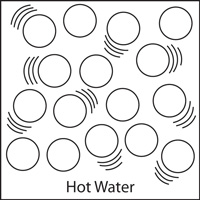
When the temperature of matter increases the particles...
a)
speed up and move closer
b)
speed up and move farther apart
c)
slow down and move closer together
d)
slow down and move farther apart
14.
Phase change from a solid to a gas.
a)
sublimation
b)
deposition
c)
condensation
d)
evaporation
15.
Which state of matter has molecules that slide past each other but stay close together? They do not form a regular pattern.
a)
solid
b)
liquid
c)
gas
16.
In which state are the particles least able to move?  (Which is the solid?)
a)
State A
b)
State B
c)
State C
d)
None
17.
At higher temperatures
a)
particles in an object have less energy
b)
particles in an object move faster
c)
a gas contracts
18.
What happens when a liquid freezes?
a)
The particle lose kinetic energy and turn into a gas
b)
The particles lose kinetic energy and turn into a solid
c)
The particles gain kinetic energy and turn into a solid
d)
The liquid turns cold
19.
Particles of a liquid
a)
are tightly packed together and stay in a fixed position.
b)
have no viscosity.
c)
decrease in volume with increasing temperature.
d)
are free to move around one another but still touch.
20.
The speed of the molecules determines the _____.
a)
volume
b)
density
c)
pressure
d)
temperature
21.
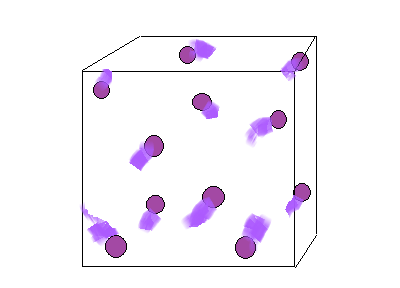
True of False:
When a gas turns into a liquid, the particles move faster and further apart.
a)
true
b)
false
22.
Sublimation is when _______ turns into a ___________.
a)
Solid ---> Gas
b)
Gas ---> Solid
c)
Solid ---> Liquid
d)
Liquid ---> Gas
23.
You put a cold glass of water outside on a hot, sunny day. After an hour, "sweat" begins to form on the outside of the glass. Where did this liquid come from?
a)
the liquid inside the glass moved to the outside
b)
someone sprayed the glass with a water bottle
c)
the water vapor in the air condensed into a liquid
d)
it rained
24.
At higher temperatures
a)
particles in an object have less energy
b)
particles in an object move faster
c)
a gas contracts
25.

Which phase is represented in the model.

a)

Solids

b)

Liquids

c)

Gas

d)

Carousso

26.
The boiling point of water is ______________.
a)
0° C
b)
50° C
c)
200° C
d)
100° C
27.
A solid is
a)
a substance that does not have a definite shape or volume
b)
a substance with a definite volume, but no definite shape
c)
a substance with a definite shape and volume
d)
a substance whose particles glide past one another
28.

Anything that has mass and volume

a)

volume

b)

liquid

c)

matter

d)

texture

29.

The state of matter that has particles that slide by each other

a)

volume

b)

liquid

c)

matter

d)

texture

30.

The measure of the energy of motion of particles of matter

a)

gas

b)

temperature

c)

density

d)

compress

31.

To squeeze gas into a smaller place

a)

gas

b)

temperature

c)

density

d)

compress

32.

The state of matter that expands to fill its container

a)

gas

b)

temperature

c)

density

d)

compress

33.

The name for the process when a liquid becomes a gas

a)

melting

b)

evaporating

c)

freezing

d)

condensing

34.

The name for the process when a liquid becomes a solid

a)

melting

b)

evaporating

c)

freezing

d)

condensing

35.

The name for the process when a solid becomes a liquid

a)

melting

b)

evaporating

c)

condensing

d)

freezing

36.

The name for the process when a gas becomes a liquid

a)

melting

b)

freezing

c)

evaporating

d)

condensing

37.

This is a diagram of a

a)

solid

b)

liquid

c)

gas

38.

This is a diagram of a ________. The particles are sliding by each other.

a)

solid

b)

liquid

c)

gas

39.

This is a diagram of a

a)

solid

b)

liquid

c)

gas

40.

Which measures temperature?

a)
b)
c)
41.

Which measures volume?

a)
b)
c)
42.

Which State of matter has an indefinite volume and an indefinite shape?

a)

Gas

b)

Liquid

c)

Solid

d)

None

43.

Which State of matter has an indefinite volume and an definite shape?

a)

Gas

b)

Liquid

c)

Solid

d)

None

44.

Which State of matter has a definite volume and an indefinite shape?

a)

Gas

b)

Liquid

c)

Solid

d)

None

45.

Which State of matter has a definite volume and an definite shape?

a)

Gas

b)

Liquid

c)

Solid

d)

None

46.

Which has more energy: Gas particles or Solid Particles?

a)

Gas

b)

Solid

47.

Which has less energy: Liquid particles or Solid Particles?

a)

liquid

b)

Solid

48.

A solid has a definite volume.

a)

True

b)

False

49.

If something has a definite shape, how do you get it to change its shape?

a)

add heat

b)

take away heat

50.

What is matter?

a)

Tiny particles/ atoms which make up the universe

b)

A way to measure what is important

c)

A material which can only be found in solids

d)

A force which transforms things into solids, liquids or gases

51.

What state of matter is ice?

a)

solid

b)

liquid

c)

gas

d)

plasma

52.

Which of the following states of matter is known for its ability to fill a container?

a)

Solid

b)

Liquid

c)

Gas

d)

Plasma

53.

Which of the following states of matter is known for its ability to be compressed/ squished?

a)

Solid

b)

Liquid

c)

Gas

d)

Plasma

54.

Define 'melting point'

a)

The temperature at which an object changes from a solid to a liquid

b)

The temperature at which an object changes from a gas to a liquid

c)

The temperature at which an object changes from a liquid to a gas

d)

The temperature at which an object changes from a gas to plasma

55.

Define 'Boiling point'

a)

The temperature at which an object changes from a gas to plasma

b)

The temperature at which an object changes from a liquid to a solid

c)

The temperature at which an object changes from a solid to a liquid

d)

The temperature at which an object changes from a liquid to a gas

56.

Ice cream on a hot day is an example of...

a)

freezing

b)

melting

c)

boiling

d)

evaporation

57.

A pot of water placed on a hot stove is an example of...

a)

freezing

b)

melting

c)

boiling/ evaporation

d)

condensation

58.
Number 2 represents a ________
a)
solid
b)
liquid
c)
gas
d)
plasma
59.
Particles in a _____________ are tightly packed together.
a)
solid
b)
liquid
c)
gas
d)
plasma
60.
Particles in a _________ take the shape of the container.
a)
solid
b)
liquid
c)
gas
d)
plasma
61.
As particles are exposed to warmer temperatures they __________
a)
speed up
b)
slow down
c)
stay the same
d)
vibrate
62.
As particles are exposed to colder temperatures they _____
a)
speed up
b)
slow down
c)
stay the same
d)
become ions
63.
What am I? I have a fixed mass, a fixed volume, I cannot be squashed and I have a shape that changes to fit the bottom of my container?
a)
solid
b)
liquid
c)
gas
d)
plasma
64.
An inflated balloon is placed in a refrigerator. Which statement describes the movement of the gas particles in the balloon?
a)
The particles move more slowly and become closer together.
b)
The particles move more slowly and become further apart.
c)
The particles move faster and become closer together.
d)
The particles move faster and become further apart. 
65.
The amount of matter in an object is a measure of the object's ________________.
a)
volume
b)
density
c)
mass
d)
solubility
66.
A student added sugar to a cup of water and stirred with a spoon.  After 10 minutes you could not see the sugar anymore.  What happened to the sugar?
a)
the sugar evaporated
b)
the sugar dissolved
c)
the sugar was magnetic
67.
As particles are exposed to warmer temperatures they __________
a)
speed up
b)
slow down
c)
stay the same
d)
vibrate
68.
As particles are exposed to colder temperatures they _____
a)
speed up
b)
slow down
c)
stay the same
d)
become ions
69.
What is a Solid?
a)
Matter that has a definite shape and a definite size.
b)
Matter that has a definite size and no definite shape
c)
Matter that has no definite shape or size
d)
Matter that has no definite shape and size
70.
A Gas is a state of matter that has _____________________________________________________
a)
No definite size or shape
b)
No shape but a defenite size
c)
A changing shape
71.
Ice Melting is an example of.......
a)
A liquid turning into a gas
b)
A solid turning into a liquid
c)
Gas turning into a liquid.
d)
A ssolid turning into a liquid
72.
Which has particles that travel faster?
a)
gas
b)
solid
73.

Which characteristic is included in the particle theory of matter?

a)

All matter is made up of tiny particles

b)

All particles in a pure substance are the same

c)

Particles are always moving

d)

All of the above

74.

True or False: Matter can not be created or destroyed.

a)

True

b)

False

75.

There are ... of matter.

a)

tree

b)

four

c)

three

d)

for

76.

"Has a definite mass, a definite shape and its volume does not change" is the properties of ....

a)

solid

b)

liquid

c)

gas

d)

plasma

77.

In which state does the matter is easy to compress?

a)

solid

b)

liquid

c)

gas

d)

plasma

78.

When the particles get more energy, they will vibrate more slowly and move faster than before.

a)

TRUE

b)

FALSE

79.

The state of matter of a substance can be changed.

a)

FALSE

b)

TRUE

80.

The changing state of matter is ... chage.

a)

chemical

b)

physical

c)

structural

d)

functional

81.

The picture shows an example of ....

a)

melting

b)

freezing

c)

evaporating

d)

boiling

82.
Which of the following is matter?
a)
dust
b)
the moon
c)
strand of hair
d)
all of the above
83.

Name the 3 states of Matter

a)

Solid, Liquid and Gas

b)

Solid, Water, and Gas

c)

Liquid, Electrons and Gas

84.

All matter is made of particles

a)

True

b)

False

85.

Particles are always moving.

a)

True

b)

False

86.

Which image shows particles in a solid?

a)
b)
c)
87.

Which image shows particles in a liquid?

a)
b)
c)
88.

Which image shows particles in a gas?

a)
b)
c)
89.

Which of the following is a correct description for solids?

a)

Particles are closely packed and do not move.

b)

Particles are closely packed and vibrate.

c)

Particles can move around each other.

90.
Particles in a _________ take the shape of the container.
a)
solid
b)
liquid
c)
gas
d)
plasma
91.

Which of the following statements about the particle of a gas is true?

a)

The particles of a gas vibrate and are packed closely together.

b)

The particles of a gas are far apart and move in all directions.

c)

The particles of a gas do not move.

92.

In which state of matter will there be the LARGEST space between molecules?

a)

Solid

b)

Liquid

c)

Gas

93.
Which has particles that travel faster?
a)
gas
b)
solid
94.
Which state of matter has molecules that slide past each other but stay close together? They do not form a regular pattern.
a)
solid
b)
liquid
c)
gas
95.

As particles are exposed to warmer temperatures they __________

a)

speed up and break apart

b)

slow down and break apart

c)

stay the same

d)

vibrate but stay together

96.

As particles are exposed to colder temperatures they _____

a)

speed up and get stronger bonds

b)

slow down and get stronger bonds

c)

stay the same

d)

become ions

97.

When we add heat to particles, we are adding:

a)

Electricity

b)

Energy

c)

More Particles

98.

Something that goes from solid to liquid is...

a)

Evaporation

b)

Melting

c)

Freezing

d)

Sublimation

99.

When something goes from gas to liquid, it is called...

a)

Evaporation

b)

Condensation

c)

Deposition

d)

Freezing

100.

Something that goes from liquid to gas is...

a)

Evaporation

b)

Melting

c)

Freezing

d)

Sublimation

101.
An inflated balloon is placed in a refrigerator. Which statement describes the movement of the gas particles in the balloon?
a)
The particles move more slowly and become closer together.
b)
The particles move more slowly and become further apart.
c)
The particles move faster and become closer together.
d)
The particles move faster and become further apart. 
102.

Which option has a fixed volume, but does NOT have a fixed shape?

a)

Gas

b)

Solid

c)

Liquid

103.

In which state of matter is space between particles the SMALLEST?

a)

Solid

b)

Liquid

c)

Gas

104.

What is correct about the molecules in CO2 gas?

a)

The molecules are close together.

b)

The molecules move very slowly.

c)

The molecules move randomly.

d)

The molecules all move with the same speed.

105.

Particles are always moving.

a)

True

b)

False

106.

Something that goes from liquid to gas is...

a)

Evaporating

b)

Melting

c)

Freezing

d)

Sublimation

107.

Which option has a fixed volume and a fixed shape?

a)

Gas

b)

Solid

c)

Liquid

d)

Plasma

108.
As particles are exposed to warmer temperatures they __________
a)
speed up
b)
slow down
c)
stay the same
d)
vibrate
109.
As particles are exposed to colder temperatures they _____
a)
speed up
b)
slow down
c)
stay the same
d)
become ions
110.

What is the melting point of water? (in normal conditions)

a)

212°C

b)

100°C

c)

32°C

d)

0°C

111.
How do you make matter change state?
a)
Add energy to it
b)
Take energy away from it
c)
Both of these
112.

On a hot, humid summer day drops of water form on a can of cold soda. What process caused this to happen?

a)

condensation

b)

freezing

c)

vaporization

d)

deposition

113.

Which of the following is a correct description for solids?

a)

closely arranged and in fixed positions

b)

closely arranged and vibrate in fixed positions

c)

closely arranged and can move around

114.

Which statement about the molecules in the gas carbon dioxide is correct?

a)

The molecules are close together.

b)

The molecules are diatomic.

c)

The molecules move randomly.

d)

The molecules all move with the same speed.

115.

When something goes from gas to liquid, it is called...

a)

Evaporation

b)

Condensation

c)

Deposition

d)

Freezing

116.

Which of the following sentences are true about solids?

a)

Solids are rigid, have a fixed shape but not a fixed volume

b)

Solids are not rigid, have a fixed shape and no fixed volume

c)

Solids are rigid, have a fixed shape and a fixed volume

117.
Which of the following statements about the particle of a gas is true?
a)
Gases can be compressed because their particles are smaller than those of liquids or solids.
b)
Gases can be compressed because there is plenty of space between their particles.
c)
Gases can be compressed because they have low boiling points.
d)
Gases can be compressed because their particles are more elastic than those of liquids or solids.
118.
Which of the following statements about the particle of a gas is true?
a)
The particles of a gas vibrate about fixed positions.
b)
The particles of a gas are packed close together in a disorderly arrangement.
c)
The particles of a gas are far apart and move in all directions.
d)
The particles of a gas are stationary in an orderly arrangement.
119.

This diagram represents particles in a ______________ state.

a)

Solid

b)

Liquid

c)

Gas

120.

Which of the following is a correct description for solids?

a)

closely arranged and in fixed positions

b)

closely arranged and vibrate in fixed positions

c)

closely arranged and can move around

121.

What is MATTER?

a)

Anything that has MASS

b)

Anything that takes up SPACE

c)

Anything that has MASS and takes up SPACE

d)

Anything that DOES NOT have mass or take up space