
Font size
 Worksheets
Periodic Table
Total questions: 40
Worksheet time: 31mins
Vertical columns on the periodic table are called ___?
groups
periods
rows
families

Which color on the image of the periodic table corresponds with the halogens.
red
black
blue
orange
Which color on the image of the periodic table corresponds with the lanthanides.
red
black
blue
orange
Which color on the image of the periodic table corresponds with the noble gases.
red
black
blue
orange
Which color on the image of the periodic table corresponds with the transition metals.
red
black
blue
orange
Which color on the image of the periodic table corresponds with the metalloids.
bright yellow
gold
teal
light blue
Which color on the image of the periodic table corresponds with the alkaline earth metals.
yellow
dark yellow
blue/green
teal
Mendeleev first ordered the periodic table of elements by increasing
atomic number
atomic mass
atomic symbol
atomic weight
Most metals share four common physical characteristics. Which of the options is not one of the four?
Luster
Conductivity
Ductility
Malleability
Reactivity
Which family of elements reacts violently with water and exposure to oxygen?
alkali metals
alkaline earth metals
lanthanides
actanides
transition metals
Which two families of elements are soft and silvery and have low densities? Choose two.
alkali metals
alkaline earth metals
lanthanides
actanides
transition metals
The periodic table is mostly comprised of what type of element?
Metals
Nonmetals
Metalloids
What are the four most common nonmetals in the human body?
Oxygen
Hydrogen
Nitrogen
Phosphorus
Carbon
What is the most reactive nonmetal?
Fluorine
Iodine
Chlorine
Bromine
When a halogen such as Chlorine, combines with an alkali metal to produce a what?
compound
salt
mineral
acid
Which of the following is not true of metalloids?
Silicon and Germanium are common metalloids used in computers.
Metalloids contain properties similar to both metals and nonmetals.
Metalloids are found in a stair step line between metals and nonmetals on the periodic table.
Metalloids are the first choice in building materials.
Which family of elements does not combine with other elements unless under special conditions in a laboratory?
Noble gases
Halogens
Metalloids
Alkaline earth metals
Actinides
An engineer is building a sun reflector which must withstand storms, large winds, and reflect sunlight well, what would suggest they use?
Alkali metal
Alkaline earth metal
Transition metal
Metalloid
Lanthanide
Which of the following is most reactive?
Lithium
Potassium
Sodium
Cesium
What are the three main groups of the periodic table?
groups
metal
nonmetals
metalloids
periods
What are the vertical columns on the periodic called?
groups
periods
nonmetals
metals
metalloids
What do the vertical columns on the periodic table tell us?
The number of orbitals
The number of valence electrons (electrons on the outer most shell)
What are the horizontal rows on the periodic table called?
periods
groups
metals
nonmetals
metalloids
What does the number of proton tell us?
electrons
atomic number
atomic mass
neutrons
How do you calculate the number of neutrons? *
Mass = Atomic number - Neutrons
Mass - Atomic number = Neutrons
Atomic number = Neutrons

How many valence electrons does the element have?
1
2
3
4

What group and period does this element belong in? *
period 1 and group 3
period 3 and group 1
period 2 and group 3
period 3 and group 2

What is the name of the element? (Periodic table will be needed)
sodium
magnesium
vanadium

How many protons and electrons does nickel have?
28
58.69

Who discovered the nucleus?
Rutherford
Bohr
Thomson
Dalton
Which of the following is the correct electron-dot diagram for an atom with an electron configuration of 2-8-18-5?


This is a correct dot diagram for neon (Ne)
true
false


How many electrons should sodium, atomic number 11, have around its Lewis dot model?
1
2
3
4
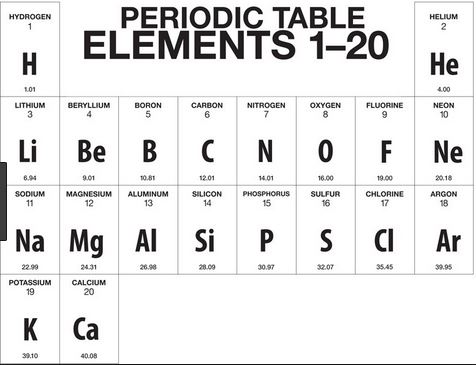
How many valence electrons does Aluminum Have?
1 Valence electron
2 Valence electron
3 Valence electron
4 Valence electron
5 Valence electron
How would you draw a Lewis dot diagram for Magnesium?


Which of these is correct?


This could be the dot diagram of
Mg
Cl
C
O

