wayground logo

Free Printable Worksheets

Font size

S
M
L
XL
Worksheets

Quarter 1 Cumulative Review

Total questions: 102

Worksheet time: 1hrs 29mins

Name
Class
Date
1.
Waldriana would like to investigate the effect of temperature on the amount of food birds eat.  What should she do first to begin her investigation?
a)
develop a question 
b)
conduct background research
c)
design an experiment
d)
come up with a theory
2.
Rigoberto writes down his hypothesis that more salt will dissolve in cold water than in warm water.  He adds salt to different temperatures of water and records his observations including the amount of undissolved salt.  He finds that there is more salt dissolved in warm water than cold water.  What should Rigoberto do next to make sure that his conclusion is valid?
a)
do another investigation with sugar
b)
repeat his investigation using a different liquid than water
c)
repeat his investigation to see if his results are the same
d)
change his results to match his original hypothesis
3.
Which question would be best to answer using a scientific investigation?  
a)
Why are people afraid during thunderstorms?
b)
How easy is it to shovel snow?
c)
Are some clouds prettier than others?
d)
Does temperature affect the amount of rain?
4.
A group of people trained to climb a mountain.  As they practices in high altitudes, a researcher measured changes in their lung strength.  Why is it important that her study has a control group?
a)
to ensure that everyone in the group was strong enough to climb a mountain
b)
to test equipment for measuring lung strength
c)
to share her research with as many people as possible
d)
to compare typical lung strength with the effects of training
5.
Austin is studying states of matter by heating water in a pan.  Which statement from his notebook is an observation?
a)
It is hard to estimate the size of the bubbles.
b)
Tiny bubbles form on the bottom of the pan.
c)
The bottom of the pan must be very hot.
d)
I think there is air in the bubbles.
6.
Amanda makes the following hypothesis:  If the humidity increases, it will help plants grow.  Which of these describes a controlled experiment that would best help Amanda prove or disprove her hypothesis?
a)
recording the number of tall plants and short plants in different fields that have different humidity levels
b)
observing plant growth in a greenhouse with a constant humidity and in a greenhouse with changing humidity
c)
measuring the temperatures and humidity in a greenhouse that has both short and tall plants growing in it
d)
making a model to observe whether water collects on the walls of a greenhouse with increasing humidity
7.
When experimenting with the growth of a plant, a scientist uses three (of the same type of) plants, two different fertilizers, equal light, and equal water. What type of variable is the fertilizer?
a)
Dependent
b)
Independent
c)
Control
d)
Compound
8.
What would the INDEPENDENT variable be in an experiment testing which types of paper airplane goes furthest?
a)
the paper used
b)
the type of paper airplane
c)
the distance of each plane's flight
d)
how hard the plane is thrown
9.
a)
The dependent variable is total cost
b)
The dependent variable is weight
c)
The independent variable is total cost
d)
The independent variable is cost of a package
10.

What is something on a graph that you have control over and isn't changed by any other variable?

a)

Independent variable

b)

Dependent variable

c)

Controlled variable

d)

Extraneous variable

11.

Time such as minutes, days, and months will always be a(n) ________________ variable when graphing.

a)

Controlled

b)

Independent

c)

Dependent

d)

Extraneous

12.

What is the independent variable in this graph?

a)

Tadpoles

b)

Year

c)

Frogs

d)

Number of tadpoles in the pond

13.

What type of graph shows change over time?

a)
b)
c)
d)
14.

What is a dependent variable?

a)

A variable most often found on the x-axis

b)

Dependent variables are only found on pie charts

c)

The variable that changes because another variable changes

d)

The variable the experimenter changes or manipulates
15.
Large bodies of water do not quickly fluctuate in temperature. Why?
a)
Water is a solvent.
b)
Water has a high heat capacity.
c)
Water acts as a buffer.
d)
Water is non-polar.
16.
Water is a universal solvent because it...
a)
It can be found anywhere
b)
It freezes when it gets cold
c)
floats when frozen
d)
Dissolves most substances
17.
The fact that ice floats on liquid water is due to the fact that water's solid is ___________ than it's liquid form
a)
less polar
b)
more polar
c)
less dense
d)
more dense
18.
The tightness across the surface of water that enables paper clips to float is ____________.
a)
adhesion
b)
capillary action
c)
surface tension
d)
polarity
19.
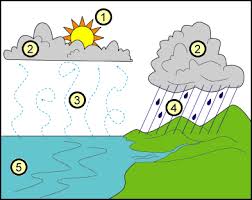
Number 2 in the water cycle diagram is ___________.
a)
The Sun
b)
condensation
c)
precipitation
d)
evaporation
20.
Which statement explains why water molecules stick together?
a)
both sides are negative
b)
one side has a positive charge and the other side has a negative charge
c)
one side has a negative charge adn the other side has a neutral charge
d)
both sides are positive
21.
Large bodies of water help to keep nearby climates from being too hot or too cold  because they...
a)
absorb heat in the spring and slowly release that heat in the fall
b)
absorb heat in the fall and slowly release that heat in the spring
c)
absorb heat in the summer and slowly release that heat in the winter
d)
absorb heat in the winter and slowly release that heat in the summer
22.
Which end of the water molecule has a slightly positive charge?
a)
the oxygen end
b)
the hydrogen end
c)
both ends are slightly positive
d)
neither end is positive
23.
When a molecule has an opposite electrical charge on each end, it is known as what?
a)
cohesion
b)
polar molecule
c)
hydrogen bond
d)
solution
24.
What word describes when water is attracted to other substances?
a)
cohesion
b)
adhesion
c)
capillary action
d)
surface tension
25.
When water molecules stick easily to other water molecules, this is called what?
a)
cohesion
b)
adhesion
c)
solution
d)
polar molecule
26.

Cohesive force between water molecules and adhesive force between water molecules and other molecules enable this phenomenon __________________ occur.

a)

surface tension

b)

capillary action

c)

float on water

d)

photosynthesis

27.
Attractions between the negative Oxygen atom of one water molecule and the positive Hydrogen atom of another water molecule are called
a)
Covalent bonds
b)
Ionic bonds
c)
Polar bonds
d)
Hydrogen bonds
28.
Why does ice float?
a)
As water freezes, it expands and its density decreases.
b)
As water freezes, it takes up more hydrogen from the atmosphere, causing it to have a greater buoyancy.
c)
As water freezes, air becomes trapped between the hydrogen bonds of water molecules.
d)
As water freezes, it takes up more oxygen from the atmosphere, causing it to have a greater buoyancy.
29.
Large bodies of water, such as lakes and oceans, do not quickly fluctuate in temperature. What is the reason for this phenomenon?
a)
Water is an acid.
b)
Water is a versatile solvent.
c)
Water has a high heat capacity.
d)
 Water acts as a buffer.
30.

What is precipitation?

a)

Sweat from our bodies on hot days

b)

Warm rain but not cold snow or sleet

c)

Gas that we use in furnaces or ovens

d)

Any form of water that falls from the sky

31.

What is the energy source that drives the water cycle?

a)

The moon T

b)

The heat from our home in the winter all around the world

c)

The sun

d)

he heat generated solely from the core of the earth

32.

What are formed when water vapor condenses?

a)

Clouds

b)

Mountains

c)

Transpiration

d)

Valleys

33.

The act of turning from a gas into a liquid. ________________________

a)

Condensation

b)

Evaporation

c)

Transpiration

d)

Precipitation

34.

The process where plants absorb water through the roots and then give off water vapor through pores in their leaves. __________________________

a)

Transpiration

b)

Condensation

c)

Evaporation

d)

Precipitation

35.
How much salt water covers the earth?
a)
55%
b)
65%
c)
75%
d)
85%
36.

What percentage of Earth's fresh water that is not frozen

a)

97%

b)

1%

c)

100%

d)

3%

37.

Which of the following are types of freshwater that can be used by people?


Select all that are true.

a)

groundwater

b)

ice caps and glaciers

c)

oceans

d)

rivers

e)

lakes

38.

What happens once groundwater reaches a layer of rock in the ground that it cannot pass through?

a)

it is soaked up by that layer of rock and dirt

b)

it creates an aquifer

c)

it creates a reservoir

d)

it evaporates

39.

People get fresh water from

a)

reservoirs

b)

lakes and rivers

c)

pumping groundwater up from aquifers using wells

d)

all of the above

40.

What are the main components of the water cycle?

a)

runoff

b)

transpiration

c)

evaporation

d)

condensation

e)

precipitation

41.
During which stage do clouds form?
a)
condensation
b)
evaporation
c)
precipitation
42.
Which stage does the #2 show in the diagram?
a)
condensation
b)
evaporation
c)
precipitation
d)
run off
43.

In an endothermic reaction, energy is _________.

a)

absorbed

b)

released

44.

_____ reactions usually feel hot!

a)

endothermic

b)

exothermic

45.

Solid --> liquid --> gas is what type of reaction?

a)

endothermic

b)

exothermic

c)

catalytic

d)

inhibited

46.

Baking pizza in the oven

a)

endothermic

b)

exothermic

47.

A sunflower makes food during photosynthesis.

a)

exothermic

b)

endothermic

48.

What does the following equation represent?


Sunlight +6H20 + 6CO2--> C6H1206 +6O2

a)

Cellular respiration

b)

Human respiration

c)

Photosynthesis

d)

Solar energy

49.

C6H1206 +6O2--> 6H20 + 6CO2 + Energy (ATP)

This equation represents ___________________.

a)

Human Respiration

b)

Cellular Respiration

c)

DNA Replication

d)

Photosynthesis

50.

The products of cellular respiration are:

a)

Carbon Dioxide, Energy (ATP) and Water

b)

Oxygen and Glucose

c)

Water and Glucose

d)

Oxygen and Water

51.

The reactants in photosynthesis are ____________

a)

Sunlight, Water, and Carbon Dioxide

b)

Glucose and Water

c)

Carbon Dioxide and Water

d)

Oxygen and Glucose

52.

The gas given off by plants is ________________.

a)

carbon dioxide

b)

ATP

c)

oxygen

d)

vaporized water

53.

Which of the following statements is true

a)

The products of photosynthesis are the reactants of cellular respiration.

b)

The products of photosynthesis are not necessary for respiration to occur.

c)

The reactants of photosynthesis are also the reactants of cellular respiration.

d)

The products of photosynthesis are also the products of cellular respiration.

54.

A group of ecosystems that share similar climates is called _______________.

a)

cell

b)

biome

c)

organ

d)

community

55.

In the fall, deciduous trees no longer produce ____________.

a)

Chromosomes

b)

Mitocondria

c)

Chlorophyll

d)

Endoplasmic Reticulum

56.

The entire planet is a ______________.

a)

biosphere

b)

community

c)

organ system

d)

ecosystem

57.

Biotic and abiotic factors in an area are referred to as a(n) ___________________.

a)

biome

b)

ecosystem

c)

community

d)

biosphere

58.

Organisms of the same species that can breed is a ____________

a)

community

b)

biome

c)

population

d)

biosphere

59.

How does carbon in a grass plant get into a lion?

a)

The lion eats an antelope that ate the grass

b)

Carbon from grass doesn't end up in a lion.

c)

The lion absorbs the carbon given off by transpiration

d)

The lion breathes in carbon given out by the plant
60.
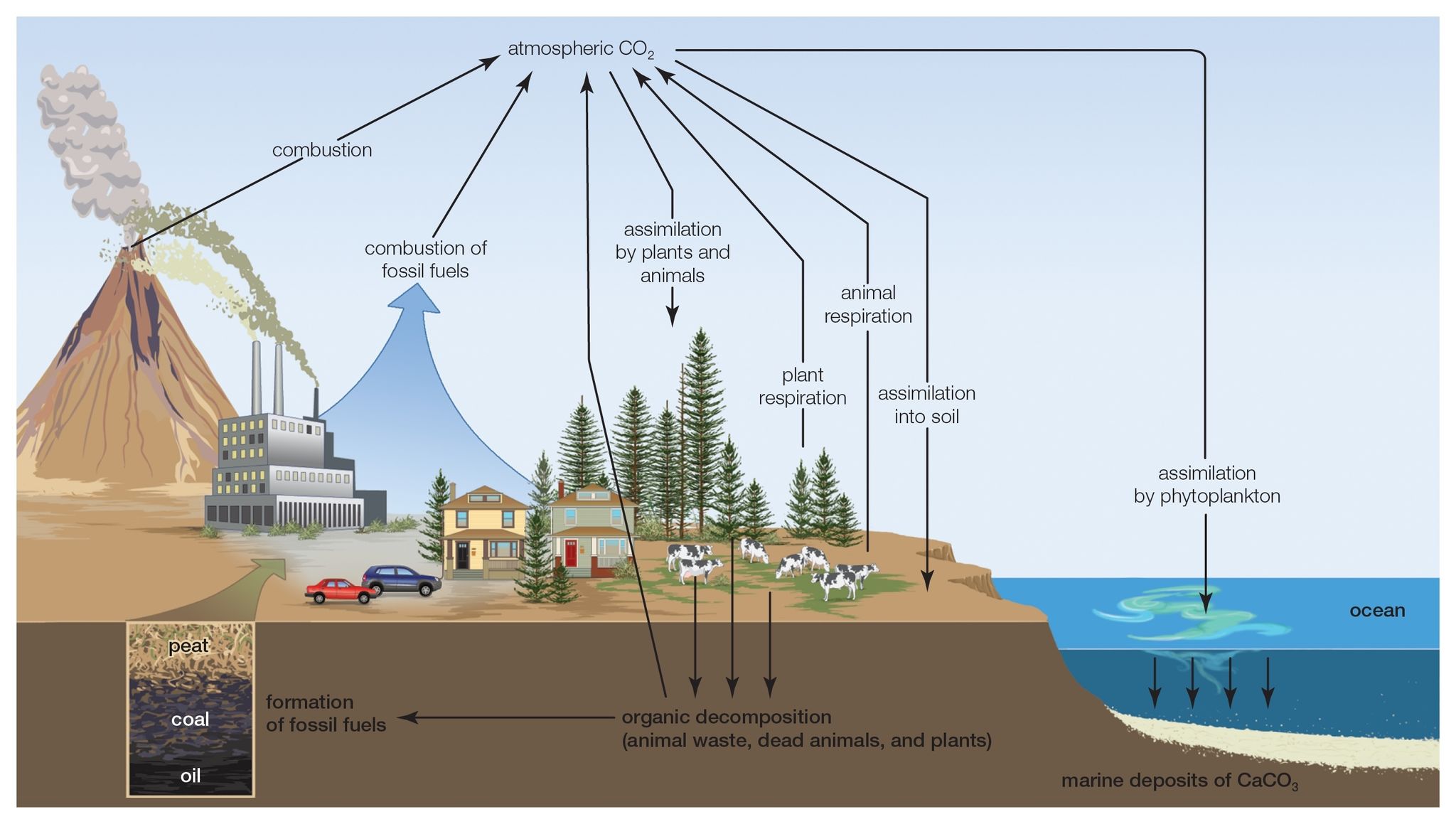
Which of the following add carbon dioxide to the atmosphere?
a)
volcanoes
b)
combustion of fossil fuels
c)
animal and plant respiration
d)
all of these
61.
Plants release water into the atmosphere by 
a)
photosynthesis
b)
transpiration
c)
perspiration
d)
respiration
62.
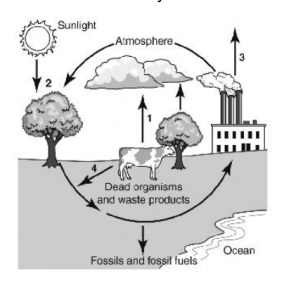
What is happening at 1?
a)
respiration: releasing CO2
b)
decomposing CO2 in the soil
c)
photosynthesis: absorbing CO2
d)
turning CO2 from the atmosphere into organic molecules
63.

features of environment that are alive or were once alive

a)

biotic

b)

abiotic

c)

inbiotic

d)

biography

64.
How much of the atmosphere is composed of nitrogen gas?
a)
87%
b)
38%
c)
78%
d)
21%
65.
How nitrogen is "fixed" into useable form for plants
a)
only through action of bacteria
b)
only through lightning
c)
through action of bacteria & lightning
d)
through photosynthesis
66.
Nitrogen fixing bacteria, lives in nodules on the root of a plant called
a)
Broccoli
b)
Legumes
c)
Beats
d)
Carrots
67.
Organisms that do not decompose can be buried and become what?
a)
water
b)
nutrients
c)
air
d)
fossil fuels
68.
Which one of these does not add CO2 to the atmosphere?
a)
cooking with gas
b)
planting trees
c)
burning wood
d)
riding in a bus
69.

Which describes the relationship between plants and animals in the carbon cycle?

a)

Plants produce and release oxygen that animals need

b)

Plants produce and release carbon dioxide that animals need

c)

Animals produce and release oxygen that plants need

d)

Animals produce oxygen that plants turn into carbon dioxide

70.

Carbon molecules cannot be created or destroyed

a)

True

b)

False

c)

Not enough information to answer

71.
How do  animals get nitrogen?
a)
the atmosphere 
b)
eating other organisms
c)
bacteria
d)
lightning 
72.
Building proteins and DNA is the reason organisms need what substance?
a)
Water
b)
Carbon
c)
Nitrogen
d)
Calcium
73.
How do living organisms return carbon to the atmosphere in the carbon cycle?
a)
respiration and photosynthesis
b)
 decomposition and respiration
74.
In the carbon cycle, producers take in the gas __
a)
carbon dioxide
b)
oxygen
c)
nitrogen
d)
carbon monoxide
75.
In what process is Carbon transformed into chemical energy?
a)
Photosynthesis
b)
Respiration
c)
Primary Production
d)
Secondary Production
76.
How do  animals get nitrogen?
a)
the atmosphere 
b)
eating other organisms
c)
bacteria
d)
lightning 
77.

Biome with plants and grasses, but no trees.

a)

grassland

b)

desert

c)

forest

d)

arctic tundra

78.

Biome with many different species of cacti and reptiles and very little rainfall.

a)

Desert

b)

Temperate Rainforest

c)

Tropical Rainforest

d)

Arctic Tundra

79.
Type of forest biome near the equator; receives a lot of rain; temperatures are warm all year.
a)
desert
b)
tropical rain forest
c)
arctic
d)
temperate rain forest
80.
Identify an a example of an abiotic factor?
a)
Panda
b)
Turtle
c)
Butterfly
d)
sunlight
81.
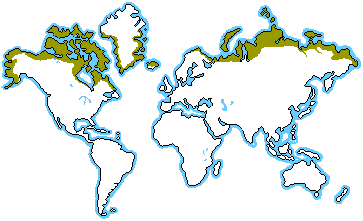
The area of the map shaded in green represents which of the following terrestrial biome
a)
Coniferous Forrest
b)
Deciduous Forrest 
c)
Desert
d)
Tundra
82.
This biome is found around the equator and is home to a large amount of biodiversity.
a)
Deserts
b)
Tropical Rain Forests
c)
Savannas
d)
Chaparral 
83.
Which two biomes have the least precipitation?
a)
tropical rain forest and temperate grasslan
b)
savanna and tropical dry forest
c)
tundra and desert
d)
boreal forest and temperate woodland
84.

What do we call the regions of the marine biome where rivers and streams flow into the oceans?

a)

Coral reefs

b)

Euphotic zones

c)

Trenches

d)

Estuaries

e)

Twilight zones

85.

Through what process do plankton get energy and provide energy to the rest of the ocean?

a)

Carbon cycle

b)

Photosynthesis

c)

Chemosynthesis

d)

Bioerosion

e)

Nitrogen cycle

86.
This is a wetland marsh composed of a mixture of both salt and freshwater (brackish water). 
a)
estuary
b)
fen
c)
bog
d)
river
87.
These are the three main jobs of wetlands.
a)
provide habitats, store flood waters, purify water
b)
provide habitats, store plant life, purify water
c)
purify water, store wildlife, provide habitats
d)
purify the land, store flood waters, provide habitats
88.
Which description below best describes how wetlands purify water?
a)
Wetlands slow down the water flow when the water encounters the vegetation. This allows the sediments and pollutants to drop out of the water before the water moves on.
b)
Wetlands don't really purify the water. They just slow it down and the heat from the Sun makes it hot enough to purify the water before it moves on.
c)
Wetlands slow down the water flow so that sediments and pollutants can drop out of the water before it moves on.
d)
Wetlands can't really purify the water because they release the water in large increments which doesn't allow enough time for it to be cleaned.
89.
What are the 3 types of wetlands?
a)
swamp, ocean, river
b)
pond, river, marsh
c)
marsh, marsh, marsh
d)
swamp, marsh, bog
90.
An ecosystem has :
a)
living things
b)
living and nonliving things
c)
nonliving things
d)
nothing
91.

Latitude is the measurement of distance north or south of the Equator

a)

true

b)

false

92.
What is the local, day-by-day variation in the atmosphere's condition called?
a)
climate
b)
weather
c)
temperature
d)
precipitation
93.

The further away from the equator you travel, the ___________ the latitude.

a)

lower

b)

higher

94.
A large, relatively distinct region with a similar climate, soil, plants, and animals
a)
ecozones
b)
biotopes
c)
biomes
d)
biodomes
95.
Which biome is a treeless biome in the far north with harsh, cold winters and extremely short summers
a)
tundra
b)
desert
c)
temperate deciduous forest
d)
tropical rain forest
96.
The most important abiotic factors when studying biomes are...
a)
Food and Water
b)
Water and Sunlight
c)
Temperature and Oxygen
d)
Precipitation and Temperature 
97.
In which biome would you MOST LIKELY find this organism?
a)
tundra
b)
desert
c)
tropical rainforest
d)
temperate deciduous forest
98.
What is the name for all populations of species within an area
a)
Community
b)
Ecosystem
c)
Biosphere
d)
Biome
99.
What is the name for a community or species and its non-living environment
a)
Community
b)
Ecosystem
c)
Biosphere
d)
Biome
100.
What is the name for a group of individuals of one species.
a)
Community
b)
Ecosystem
c)
Population
d)
Biome
101.
Ecosystems are classified by:-
a)
Climate, Elevation, Vegetation
b)
Elevation, Vegetation, Temperature
c)
Climate, Vegitation, Animals
d)
Vegitation, Animals, Rainfall
102.
Why is moisture important for the different biomes?
a)
Varying moisture can drastically change a biome
b)
Moisture isn't important in determining biomes
c)
The moisture the environment, the colder it is