wayground logo

Free Printable Worksheets

Font size

S
M
L
XL
Worksheets

Honors Science - Fall Interim Review Unit 3

Total questions: 102

Worksheet time: 6hrs 46mins

Name
Class
Date
1.
When a large nucleus splits into a smaller nucleus + energy formed
a)
Fission
b)
Fusion
c)
Alpha Particle
d)
Beta Particle
e)
Gamma Radiation
2.
Two lighter nuclei come together forming larger nucleus
a)
Fission
b)
Fusion
c)
Alpha Particle
d)
Beta Particle
e)
Gamma Radiation
3.
A technique used to determine the actual age of a fossil on the basis of the amount of a radioactive element it contains
a)
Fission
b)
Fusion
c)
Radioactive Dating
d)
Beta Particle
e)
Gamma Radiation
4.
a nuclear weapon that uses the energy from a primary nuclear fission reaction to compress and ignite a secondary nuclear fusion reaction
a)
Fission
b)
Fusion
c)
Thermonuclear Bomb
d)
Alpha Particle
e)
Gamma Radiation
5.
Equivalent of a helium nucleus (2 protons, 2 neutrons)
a)
Fission
b)
Fusion
c)
Alpha Particle
d)
Beta Particle
e)
Gamma Radiation
6.
The least penetrating form of radiation is
a)
Fission
b)
Fusion
c)
Alpha Particle
d)
Beta Particle
e)
Gamma Radiation
7.
equivalent to an electron particle
a)
Fission
b)
Fusion
c)
Alpha Particle
d)
Beta Particle
e)
Gamma Radiation
8.
high energy electromagnetic radiation that usually accompanies alpha or beta radiation and accounts for most of the energy lost during radioactivity decay
a)
Fission
b)
Fusion
c)
Alpha Particle
d)
Beta Particle
e)
Gamma Radiation
9.
Radiation type Often byproduct of nuclear fission
a)
Fission
b)
Fusion
c)
Alpha Particle
d)
Beta Particle
e)
Gamma Radiation
10.
length of time it takes for half of the atoms mass to Decay
a)
Half-Life
b)
Radioactive Decay
c)
Thermonuclear Bomb
d)
Alpha Particle
e)
Beta Particle
11.
Process where radioactive element breaks down to an non reactive element
a)
Half-Life
b)
Radioactive Decay
c)
thermonuclear Bomb
d)
Alpha Particle
e)
Beta Particle
12.
Less green house gases/global warming since no air pollution is produced
a)
Benefit of Nuclear Power
b)
Disadvantage of Nuclear Power
13.
More energy produced with less fossil fuels
a)
Benefit of Nuclear Power
b)
Disadvantage of Nuclear Power
14.
Cost less than coal
a)
Benefit of Nuclear Power
b)
Disadvantage of Nuclear Power
15.
Waste is radioactive and safe disposal is very difficult and expensive.
a)
Benefit of Nuclear Power
b)
Disadvantage of Nuclear Power
16.
Local thermal pollution from wastewater affects marine life.
a)
Benefit of Nuclear Power
b)
Disadvantage of Nuclear Power
17.
Costs of building and safely decommissioning are very high
a)
Benefit of Nuclear Power
b)
Disadvantage of Nuclear Power
18.
Nuclear accidents (Chernobyl and 5 Mile Island)
a)
Benefit of Nuclear Power
b)
Disadvantage of Nuclear Power
19.
Radioactive decay (waste)
a)
Benefit of Nuclear Power
b)
Disadvantage of Nuclear Power
20.
Helps date oldest rocks and age of fossils and understand the age of the earth
a)
Benefit of Nuclear Power
b)
Disadvantage of Nuclear Power
21.

____ releases energy when atoms are split, while ______ releases energy when atoms are joined

(a)  

22.

Which reaction releases more energy?

a)

Fission

b)

chain reaction

c)

Fusion

d)

Photosynthesis

23.

Which reaction produces harmful radioactive waste?

a)

Fission

b)

Photosynthesis

c)

chain reaction

d)

Fusion

24.

_____is the joining of atomic nuclei

a)

Fusion

b)

chain reaction

c)

Photosynthesis

d)

Fission

25.

_______is the splitting of atomic nuclei

a)

Fission

b)

nuclear reaction

c)

Fusion

d)

bayler reaction

26.

_____involve nuclear reactions that release large amounts of energy that can be used to produce electricity

a)

Fission

b)

Fusion

c)

Chain

d)

A and B

27.

Which process occurs naturally in the centre of stars like the Sun

a)

Bi-multiple reaction

b)

Fission

c)

chemical

d)

fusion

28.

Which process uses uranium rather than fossil fuels to generate the heat

a)

Muti faceted reaction

b)

fusion

c)

chemical

d)

fission

29.

Which process is more powerful

a)

fission

b)

fusion

c)

chain

d)

A and B

30.
What subatomic particles would you find in the nucleus of an atom?
a)
Protons only
b)
Protons and Neutrons
c)
Neutrons and Electrons
d)
Protons and Electrons 
31.
Electric charges that are alike _______ each other.
a)
Attract
b)
Repel
32.

What subatomic particles can you find at the center of nucleus?

a)

electron and proton

b)

proton only

c)

neutron and proton

d)

neutron and electron

33.
Which type of charges do these balloons have?
a)
like charges
b)
opposite charges
34.
Nuclei are held together by the strongest of the four fundamental forces of physics, _____
a)
the electromagnetic force
b)
the gravitational force
c)
the strong nuclear force
d)
the weak nuclear force
35.
Neutrons serve as a kind of _____
a)
charge carrier
b)
shock absorber for collisions
c)
shield for radiation
d)
buffer between the protons
36.

Proton

a)

Positively charged subatomic particle found in the electron cloud of an atom.
b)

Positively charged subatomic particle found in the nucleus of an atom.

c)

Negatively charge subatomic particle found in the electron cloud of an atom.

37.
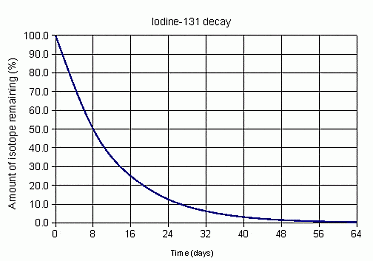
What is the half-life of iodine-131?
a)
32 days
b)
8 days
c)
16 days
d)
24 days
38.

The % of the parent isotope remaining after 1 Half Life.

a)

50%

b)

25%

c)

12.5%

d)

6.25%

39.

The % of the parent isotope remaining after 2 Half Lives.

a)

50%

b)

25%

c)

12.5%

d)

6.25%

40.

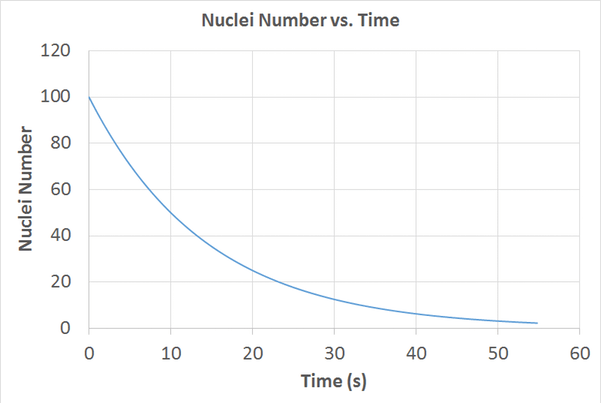
What is the Half life of this isotope?

a)

5 seconds

b)

10 seconds

c)

15 seconds

d)

20 seconds

41.

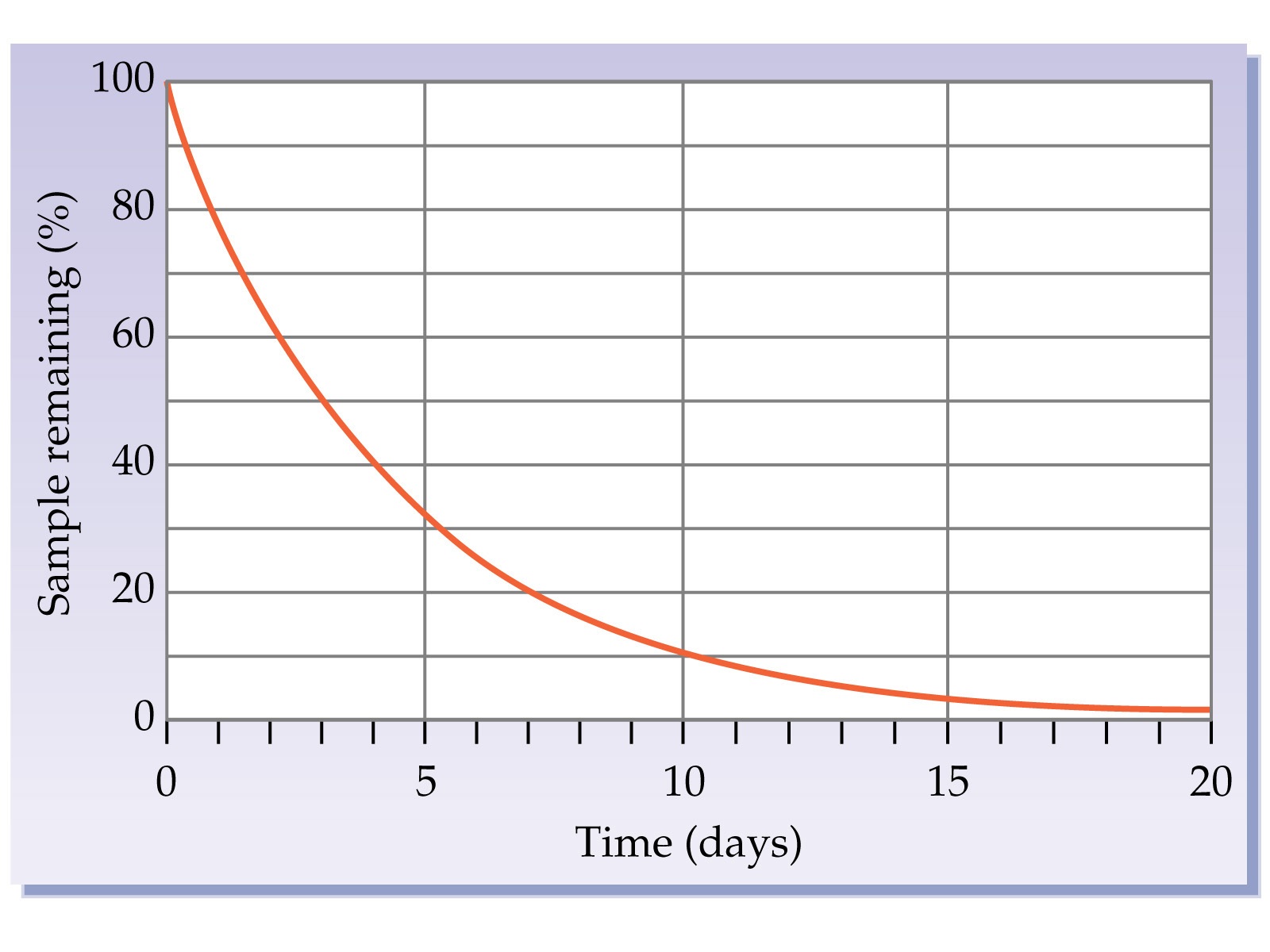
What is the Half Life of this isotope?

a)

3 days

b)

5 days

c)

8 days

d)

10 days

42.
What is Half-life?
a)
The amount of time it takes for some of the nuclei in a sample of the isotope to decay
b)
The amount of time it takes for half the electrons in a sample of the isotope to decay
c)
The amount of time it takes for half the nuclei in a sample of the isotope to decay
d)
the amount of time it takes to double the nuclei in a sample of the isotope to decay
43.
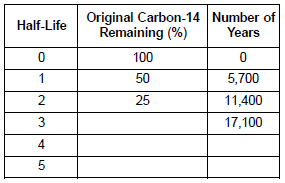
If one-fourth of the carbon-14 is remaining then how many half-lives have passed?
a)
1
b)
2
c)
3
d)
4
44.

Why do some elements have half-lives?

a)

they radioactively decay

b)

half of their atom gets stolen

c)

They are Twizzlers that break in half

45.

What is the only difference between two different isotopes of the same element?

a)

Number of neutrons

b)

Number of protons

c)

Number of electrons

d)

Size of atom

46.

After the third half-life, how much of the sample is left?

a)

1/2

b)

1/3

c)

1/16

d)

1/8

47.

After 22,800 years, approximately what percentage of the original carbon-14 remains?

a)

15%

b)

12.5%

c)

6.25%

d)

3.125%

48.
What is the half-life of iodine-131?
a)
32 days
b)
8 days
c)
16 days
d)
24 days
49.

The % of the parent isotope remaining after 1 Half Life.

a)

50%

b)

25%

c)

12.5%

d)

6.25%

50.

The % of the parent isotope remaining after 2 Half Lives.

a)

50%

b)

25%

c)

12.5%

d)

6.25%

51.

What is the Half life of this isotope?

a)

5 seconds

b)

10 seconds

c)

15 seconds

d)

20 seconds

52.

What is the Half Life of this isotope?

a)

3 days

b)

5 days

c)

8 days

d)

10 days

53.
What is Half-life?
a)
The amount of time it takes for some of the nuclei in a sample of the isotope to decay
b)
The amount of time it takes for half the electrons in a sample of the isotope to decay
c)
The amount of time it takes for half the nuclei in a sample of the isotope to decay
d)
the amount of time it takes to double the nuclei in a sample of the isotope to decay
54.

Why do some elements have half-lives?

a)

they radioactively decay

b)

half of their atom gets stolen

c)

They are Twizzlers that break in half

55.

What is the only difference between two different isotopes of the same element?

a)

Number of neutrons

b)

Number of protons

c)

Number of electrons

d)

Size of atom

56.

The half-life of Element X is 2 years.


How long has passed if Element X has reduced by half 5 times?

a)

2 years

b)

4 years

c)

6 years

d)

8 years

e)

10 years

57.

After the third half-life, how much of the sample is left?

a)

1/2

b)

1/3

c)

1/16

d)

1/8

58.

Half life (in radioactivity) is the amount of time it takes for half of a radioactive sample to

a)

split.

b)

combine.

c)

decay.

d)

become parent material.

59.

You have 100 grams of radioactive C-14. The half life of C-14 is 5730 years.

How many grams are left after 2 half lives?

a)

100 grams

b)

25 grams

c)

50 grams

d)

14 grams

60.

The half-life of Zn-71 is 2.4 minutes. If one had 100.0 g at the beginning, how many grams would be left after 2.4 minutes has elapsed?

a)

100.0g

b)

50.0g

c)

12.5g

d)

8.5g

61.

The half-life of Zn-71 is 2.4 minutes. If one had 100.0 g at the beginning, how many grams would be left after 4.8 minutes has elapsed?

a)

100.0g

b)

25.0g

c)

12.5g

d)

8.5g

62.

The half-life of Zn-71 is 2.4 minutes. If one had 100.0 g at the beginning, how many grams would be left after 7.2 minutes has elapsed?

a)

100.0g

b)

25.0g

c)

12.5g

d)

8.5g

63.
Uranium-238  decays into  Thorium-234  by emitting .........
a)
an alpha particle
b)
a beta particle
c)
gamma rays
d)
visible light
64.
A helium nucleus with two protons and two neutrons is called a(n) ____.  
a)
alpha particle
b)
electroscope
c)
beta particle
d)
gamma ray
65.
Which type of nuclear radiation is being emitted here?
a)
Alpha
b)
beta
c)
gamma 
d)
none
66.
If we start off with element 24X50 after an alpha decay we get another element Y that looks like
a)
22Y50
b)
22Y46
c)
20Y48
d)
26Y54
67.
If we start off with element 24X50 after an beta decay we get another element Y that looks like
a)
23Y50
b)
22Y46
c)
25Y50
d)
24Y50
68.
Solve this equation for alpha decay.
85209At = ___ + 24He
a)
83205Bi
b)
86209Rn
c)
81207Tl
d)
85208At
69.
Balance the following equation:
146C --> 0-1e + ________
a)
145B
b)
146C
c)
147N
d)
42He
70.
Has a mass of 0 and a charge of 0
a)
Alpha
b)
Beta
c)
Gamma
71.

Gamma rays have

a)

no mass

b)

a huge mass

c)

a small mass

d)

an average mass

72.
Electromagnetic radiation made of high-energy photons.
a)
Alpha 
b)
Beta
c)
Gamma
73.
Has the lowest penetrating power.  Can only penetrate 0.05 mm into the body and can be stopped by a piece of paper or clothing.
a)
Alpha
b)
Beta
c)
Gamma
74.
Has the highest penetrating power.  Can penetrate our body.  Even several cm thick of lead or several meters thick of concrete cannot stop all of it.
a)
Alpha
b)
Beta
c)
Gamma
75.
What particle completes this reaction?
a)
alpha particle
b)
beta particle
c)
gamma particle
d)
neutron
76.

Gamma radiation is...

a)

An electromagnetic wave

b)

A helium nucleus

c)

An electron

77.

What form of radiation is emitted by nuclei with too many neutrons?

a)

Alpha

b)

Gamma

c)

Beta

78.

What causes an atom's nucleus to become unstable?

a)

Too many or too few neutrons in the nucleus

b)

More electrons than protons

c)

Fewer electrons than protons

79.

An alpha particle is...

a)

An electron

b)

A helium nucleus

c)

An electromagnetic wave

80.

Which type of radiation can reach the furthest?

a)

Beta

b)

Gamma

c)

Alpha

81.

What is alpha particle?

a)

Fast-moving electron

b)

A helium (He) nucleus which consists of two protons and two neutrons

c)

high-frequency electromagnetic wave

82.

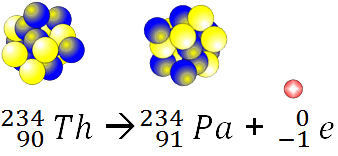
Diagram shows radioactive decay process. Identify the radioactive radiation produced?

a)

Alpha particle

b)

Beta particle

c)

Gamma Ray

83.
Uranium-238  decays into  Thorium-234  by emitting .........
a)
an alpha particle
b)
a beta particle
c)
gamma rays
d)
visible light
84.
A helium nucleus with two protons and two neutrons is called a(n) ____.  
a)
alpha particle
b)
electroscope
c)
beta particle
d)
gamma ray
85.
Which type of nuclear radiation is being emitted here?
a)
Alpha
b)
beta
c)
gamma 
d)
none
86.
If we start off with element 24X50 after an alpha decay we get another element Y that looks like
a)
22Y50
b)
22Y46
c)
20Y48
d)
26Y54
87.
If we start off with element 24X50 after an beta decay we get another element Y that looks like
a)
23Y50
b)
22Y46
c)
25Y50
d)
24Y50
88.
Solve this equation for alpha decay.
85209At = ___ + 24He
a)
83205Bi
b)
86209Rn
c)
81207Tl
d)
85208At
89.
Balance the following equation:
146C --> 0-1e + ________
a)
145B
b)
146C
c)
147N
d)
42He
90.
Has a mass of 0 and a charge of 0
a)
Alpha
b)
Beta
c)
Gamma
91.

Gamma rays have

a)

no mass

b)

a huge mass

c)

a small mass

d)

an average mass

92.
Electromagnetic radiation made of high-energy photons.
a)
Alpha 
b)
Beta
c)
Gamma
93.
Has the lowest penetrating power.  Can only penetrate 0.05 mm into the body and can be stopped by a piece of paper or clothing.
a)
Alpha
b)
Beta
c)
Gamma
94.
Has the highest penetrating power.  Can penetrate our body.  Even several cm thick of lead or several meters thick of concrete cannot stop all of it.
a)
Alpha
b)
Beta
c)
Gamma
95.
What particle completes this reaction?
a)
alpha particle
b)
beta particle
c)
gamma particle
d)
neutron
96.

Gamma radiation is...

a)

An electromagnetic wave

b)

A helium nucleus

c)

An electron

97.

What form of radiation is emitted by nuclei with too many neutrons?

a)

Alpha

b)

Gamma

c)

Beta

98.

What causes an atom's nucleus to become unstable?

a)

Too many or too few neutrons in the nucleus

b)

More electrons than protons

c)

Fewer electrons than protons

99.

An alpha particle is...

a)

An electron

b)

A helium nucleus

c)

An electromagnetic wave

100.

Which type of radiation can reach the furthest?

a)

Beta

b)

Gamma

c)

Alpha

101.

What is alpha particle?

a)

Fast-moving electron

b)

A helium (He) nucleus which consists of two protons and two neutrons

c)

high-frequency electromagnetic wave

102.

Diagram shows radioactive decay process. Identify the radioactive radiation produced?

a)

Alpha particle

b)

Beta particle

c)

Gamma Ray