
 Worksheets
Pre-Calculus Units 1-3 Extra Credit
Total questions: 110
Worksheet time: 9hrs 10mins

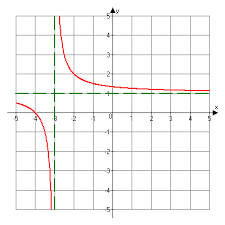
What is the equation of the horizontal asymptote?
y = 0
y = -2
y = 2
There isn't one

What is the equation of the vertical asymptote?
x = 0
x = 4
x = -1, x = 4
x = -1

Find the x-intercept(s), if one exists.
(1, 0)
(-1, 0)
(1, 0), (-1, 0)
(0, 0), (1, 0)

What are the coordinates of the y-intercept, if one exists.
(0, 0)
(0, 1)
(0, -1)
there isn't one

What are the coordinates of the hole, if one exists.
(-1, -2)
(-1, ½)
(-1, -½)
there isn't one

What is the equation of the vertical asymptote?
x = 3
x = -3
x = 0
x = -2

What are the x and y intercepts?
(4, 0) and (0, -4)
(-4, 0) and (0, -4)
(-4, 0) and (0, 4)
(0, 0) and (0, -4)

What is the equation of the graph?


What's the horizontal asymptote of the function?
y = 0
No horizontal asymptote
y = 1
y = 9

What's the vertical asymptote of the function?
x = -9
x = 9
x = 3 , x = -3
x = 3


What are the transformations of this functions compared to the parent function?
Shifted right 5, shifted down 2, and reflected over the x-axis
Reflected over the x-axis, vertical stretch by 2, and shifted right 5
Reflected over the x-axis, vertical stretch by 2, and shifted left 5
Shifted right 5, shifted down 2

Which equation matches the transformation described?


Name the parent function.
cube root
quadratic
cubic
square root
linear

Which of the following is the domain shown in the graph?
[4,∞)
[-4,∞)
(4,8)
[-4,8]

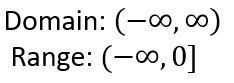
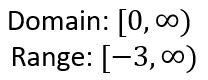
Find the domain and range of the function.
Domain: (-∞, ∞)
Range: [-∞, 4]
Domain: [1, ∞)
Range: (-∞, 4]
Domain: [-1. ∞)
Range: [4, ∞)
Domain: [4, ∞)
Range: [-1,∞)


f(x-2)
2x2 - 13x + 18
2x2 - 5x + 18
2x2 - 8x + 3
2x2 - 13x + 2

Find f[g(5)]
30
242
92
2

24
96
2
-4
4
Find the inverse of f(x) = -3x2+5


Find the inverse.
A
B
C
D

Find the inverse.
A
B
C
D
If f(x)=x1 and g(x)=3x+2 find (g∘f)(x)
3x1+2
3x+2
x3+2
3x+21

Given f and g in the graph,
what is f(g(2)) ?
3
8
1
4

Given f and g in the graph,
what is (f∘g)(−1)?
1
4
-1
6
What is the first step when solving the radical equation 4x−7+ 12 = 28
Divide both sides of the equation by 4
Square both sides of the equation
Subtract 12 from both sides of the equation
Add 7 to both sides of the equation
Check your solution

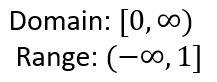
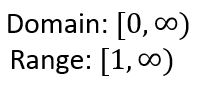

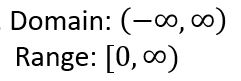
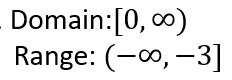

Factor
7w3-14w
7w(w2-2)
7w(w2-2w)
7w(w-2)
7w(w+2)
3a2 + 4a + 1
4x2-16x-9
Solve 6x2-x=2
x= -2/3, 1/2
x= 2/3, -1/2
x= -2/3, -1/2
Solve 3x2-48=0
x= 4, 4
x= -4, -4
x= -4, 4
Solve by factoring: 4x2 - 2 = -11x + 1
x = -3/4 and x = -1
x = 4 and x = 3
x = 1/4 and x = -3
x = -1/4 and x = 3


g(x) = -2(x+3) -6
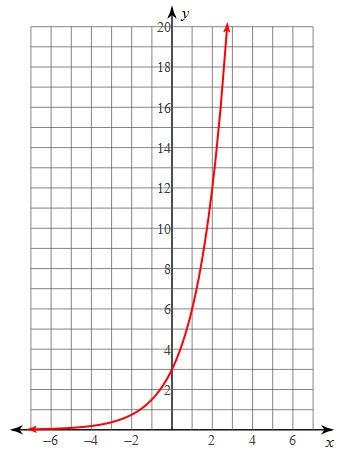
f(x)=3(2)x-4+5
f(x)=3(2)x-4+5
f(x)=3(2)x-4+5
log232 = 5

Which equation is depicted by this graph?
y = 3x + 2
y = -3x - 2
y = -3x + 2
y = 3x - 2
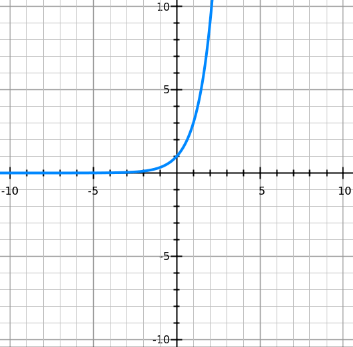
Which graph depicts the function y = 3(2)x+3 - 4


Choose all functions that have a range of (0, ∞)
y = 4x + 2
y = 4x+2
y = 4x-2
y = -4x
y = (1/4)x
4x = 1/16

Find the intervals of concavity for
f(x) = x2 + 2x + 1.
concave up: (-∞,∞)
concave down: (-∞,∞)
concave up: (2, ∞)
concave down: (-∞,2)
concave up: (-∞,2)
concave down: (2, ∞)


What is the increasing interval(s) on the function shown?
(−∞, −15) and (9, −15)
(−2, 9) and (2, ∞)
(−∞, −2) and (0, 2)
(−2, 0) and (2, ∞)

What are the increasing intervals?
(- ∞, 0) & (2, ∞ )
(-1, 0) & (2,4)
(0,2) & (-3, -7)
(-8, -3) & (-7, 8)

This graph is positive on the intervals...
( -∞, -2 ) U ( 2, ∞ )
( 4, ∞ )
( -2, 2 )
( -∞, 4 )

What is the end behavior of the graphed function as x approaches negative infinity?
y approaches negative infinity
y approaches positive infinity
y approaches 2
y approaches -1
Does Not Exist

Identify the intervals where the graph is negative. Check all that apply.
(−∞,−1)
(−1,∞)
(−3,1)
(−∞,−3)
(1, ∞)

Identify the intervals where the graph is positive. Check all that apply.
(−∞,0)
(0,4)
(4,∞)
(−∞,2)
(2,∞)
Which is the correct notation for the "limit of f(x) as x approaches 3 is 7"?
x→7limf(x)=3
limf(3)=7
f(3)=7
x→3limf(x)=7

What is the end behavior on the left side
x→∞limf(x)=∞
x→−∞limf(x)=−∞
x→−∞limf(x)=∞
x→∞limf(x)=∞

x→−∞limf(x)=
−∞
∞
0
DNE

x→∞limf(x) = ?
(a)


Which equation is the inverse of the equation above?


Logarithms are the inverse of ___________.
Natural Log
Quadratics
Radicals
Exponentials
Find the Inverse of y = log4(x−1)
y=x
y=log34x
y=4x+1
y=4x+1
Find the inverse of y=ln(x+3)
y=ex−3
y=ex−3
y=ex+3
y=ex+3
Simplify: eln40
40
-40
e
ln
log228 =

List the domain for the following.
(-∞,∞)
(-1, ∞)
(5,∞)
(1, ∞)
Find the inverse of: y = 7x +6


Over the interval (−1, 2), the graph of the polynomial shown could be described as
decreasing
increasing
positive
negative
You want to make a box to contain dirt and your pet earthworm. Using a 7 in by 10 in rectangle of cardboard, you cut congruent squares from the corners and fold up the sides. Which of the following is the function that will find the maximum volume?
V=(7−2x)(10−2x)
V=x(7−2x)(10−2x)
V=x(7−x)(10−x)
V=x(7+2x)(10+2x)
A farmer wants to construct a rectangular pigpen using 400 ft of fencing. The pen will be built next to an existing stone wall, so only three sides of fencing need to be constructed to enclose the pen. What dimensions should the farmer use to construct the pen with the largest possible area?
100ft x 200ft
102ft x 196 ft
50 ft x 300 ft
50 ft x 175 ft
(10+ 15i) - (48 - 30i)
Find the solutions of the above inequality.
(−∞,−1)∪(1,5)
(−2,2)∪(6,∞)
(−2,2)∪(6,∞)
(−∞,−2)∪(2,6)
What are the solutions for the polynomial inequality?
−2x3+2x2+4x<0
(−1, 0)∪(2, ∞)
(−∞, −1)∪(0, 2)
(2, ∞)
(−1, 2)∪(2, ∞)
Solve the rational inequality and state your solution in interval notation.
x−3−x≥0
(0, +∞)
[0, 3)
(−∞, 0)∪(3, +∞)
(−∞, 0]∪[3, +∞)
Solve the rational inequality and state your solution in interval notation.
x+23x−7>0
(−2, 37)
( 37, +∞)
(−∞,−2)∪(37, +∞)
(−∞,−2)∪[37, +∞)
Solve the rational inequality and state your solution in interval notation.
x2−4x+4x2+4x−12>0
(−∞, −2]∪[6, +∞)
(−∞, −2)∪(6, +∞)
(−∞, −6]∪[2, +∞)
(−∞, −6)∪(2, +∞)
Which statements below describe the domain of the rational function.
f(x)=x2−9x3
Check all that apply.
x=3
x=±3
(−∞, 3)∪(3, +∞)
(−∞, −3)∪(3, +∞)
(−∞, −3)∪(−3,3)∪(3, +∞)
What are the x-intercepts for the rational function?
f(x)=3x−2x2−2x−8
(32, 0)
(−32, 0)
(−4, 0 ) (2, 0)
(4, 0 ) (−2, 0)

Check all the intervals where this graph is increasing.
(-∞, -1)
(-1, 0)
(0, 1)
(1, ∞)

What is the Range of the function being graphed?
(-∞, ∞)
(7, ∞)
(-∞, 7)
(-1, 1)


State the domain:
(-oo, oo)
(-oo, -2) U (-2, 2) U (2, oo)
(-2, 2)
(-oo, -2) U (2, oo)

