Wayground logo

Free Printable Worksheets

Font size

S
M
L
XL
Worksheets

Unit 3 Review

Total questions: 50

Worksheet time: 33mins

Name
Class
Date
1.
This forms a boundary between the inside of the cell and the outside of the cell. 
a)
Cell Membrane
b)
Lipid Cleric Layer
c)
Membrane Gate
d)
Protein Receptors 
2.
All cells have a:
a)
Nucleus
b)
Plasma membrane
c)
Cell wall
d)
Buddy
3.
The function of the plasma membrane is....
a)
to regulate what enters and leaves the cell.
b)
fight bacteria and viruses that enter the cell.
c)
provide rigid support and protection to the cell.
d)
make sure each cell can move
4.
A balance that an organism maintains by regulating what goes into and out of the cell.
a)
Hypertonic
b)
Homeostasis
c)
Plasmolysis
d)
Hypotonic
5.
What are the two other names that you can use for the cell membrane?
a)
plasma membrane, fluid mosaic model
b)
plasma membrane, outer layer
c)
plasma membrane, cell membrane
d)
plasma membrane, cytoplasm
6.
What three substances make up the cell membrane?
a)
lipids, starches, nucleic acids
b)
lipids, fats, sugars
c)
lipids, sugars, proteins
d)
lipids, proteins, carbohydrates
7.
Hydrophobic region of the cell membrane?
a)
E
b)
B
c)
C
d)
A 
8.

Which image correctly shows the way phospholipids arrange themselves in the cell (plasma) membrane?

a)
b)
c)
d)
9.
Which cell membrane structures allow for movement of some substances across the cell membrane?  The substances that move through the membrane are unable to cross the hydrophobic tails in the membrane.
a)
phospholipids
b)
transport proteins
c)
cholesterol
d)
carbohydrate chains
10.
What does "bilayer" mean?
a)
one layer
b)
two layers
c)
laminated
d)
bilateral
11.
What does the term "fluid mosaic" mean in regards to the fluid mosaic model of the cell membrane?
a)
The membrane is always composed of the same parts in the same locations.
b)
The membrane is in constant motion and is made of many different parts.
c)
The membrane allows some substances to pass through while other substances cannot pass through.
d)
The membrane is made of only one type of structure that is always moving.
12.
Which cell membrane structures form a bilayer, are mainly responsible for the selective permeability of the cell membrane, and are composed of hydrophilic heads and hydrophobic tails?
a)
phospholipids
b)
transport proteins
c)
cholesterol
d)
carbohydrate chains
13.
What is structure B?
a)
carbohydrate chain
b)
phospholipid head
c)
phospholipid tail
d)
cholesterol
14.
How does cholesterol affect the cell membrane in low temperatures?
a)
helps it from becoming too rigid
b)
makes it more viscous
c)
denatures it
d)
assures it solidifies
15.
What forms the channels and pumps in the phospholipid bilayer?
a)
carbohydrates
b)
proteins
c)
hydrophilic heads 
d)
lipids
16.
Part of the plasma membrane responsible for cell recognition... 
a)
C
b)
E
c)
B
d)
D
17.
Which of the following is responsible for getting large or charged (polar) molecules across the cell membrane?
a)
E
b)
B
c)
C
d)
D
18.
The _____ in the plasma membrane prevents the fatty acids tails from sticking together. 
a)
carbohydrate chains
b)
cholesterol
c)
proteins
d)
lipids
19.
Passive transport requires no
a)
concentration gradients
b)
osmosis
c)
motion
d)
energy
20.
What is diffusion?
a)
when molecules move 
b)
when molecules move from a high concentration to a low.
c)
no movement 
d)
molecules move everywhere
21.
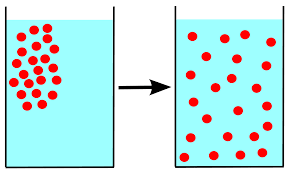
The picture below is an example of _________________.
a)
osmosis
b)
isotonic
c)
diffusion
d)
active transport
22.

Small, nonpolar, hydrophobic molecules such as fatty acids

a)

easily pass through the membrane's bilayer

b)

very slowly diffuse through the bilayer

c)

require transport proteins

d)

enter through endocytosis

23.
Osmosis is the movement of _____ across a membrane.
a)
food
b)
energy
c)
oxygen
d)
water
24.
During osmosis
a)
water moves from high to low concentration
b)
large or oddly shaped molecules move across a cell membrane
c)
water moves when energy is used
d)
proteins are built
25.

Which of the following allows water to move faster across cell membranes?

a)

aquaporins

b)

ATP

c)

peripheral proteins

d)

the sodium-potassium pump

26.

Utilizing ATP energy to move molecules across the membrane is:

a)

simple diffusion

b)

facilitated diffusion

c)

osmosis

d)

active transport

27.
When the concentration of molecules on both sides of a membrane is the SAME, the solution is
a)
isotonic
b)
hypertonic
c)
hypotonic
28.
If a cell is placed in a hypertonic solution, what will happen?
a)
Water will move into the cell causing it to swell.
b)
Water will move out of the cell causing it to shrink.
c)
nothing.
d)
Water will move out of the cell causing it to swell.
29.

Which type of Passive transport uses the help of a transport protein?

a)

Osmosis

b)

Facilitated diffusion

c)

Simple diffusion

30.
The cell below is in a _________ solution.
a)
Hypotonic
b)
Hypertonic
c)
Isotonic
31.
The cell below is in a _____________ solution.
a)
Hypertonic
b)
Hypotonic
c)
Isotonic
32.

A cell is placed in a salt solution. No osmosis is observed over time, so the solution must have been

a)

Hypotonic

b)

Isotonic

c)

Hypertonic

d)

Cryptotonic

33.

A cell in the body has an oxygen concentration of 16% inside the cell. The blood vessels have an oxygen concentration of 12%. Both are permeable to oxygen. In this example, oxygen will diffuse

a)

into the cell

b)

out of the cell

c)

in neither direction

d)

equally in both directions

34.

What are the types of passive transport? Select all that apply.

a)

Simple diffusion

b)

Facilitated diffusion

c)

Endocytosis

d)

Osmosis

e)

Protein pumps / carrier proteins

35.

Which type of solution makes a cell shrink?

a)

Hypotonic

b)

Hypertonic

c)

Isotonic

36.
What type of molecules can easily move through the phospholipid bilayer?
a)
Small, charged particles
b)
Small, non-polar particles
c)
Large, charged particles
d)
Large, polar particles
37.
Which type of solution causes a cell to swell?
a)
Hypotonic
b)
Hypertonic
c)
Isotonic
38.
What is equilibrium?
a)
When concentrations cannot be balanced between two substances 
b)
When concentrations are balanced between two substances 
c)
Making the energy in the top half of your body equal the the energy in the bottom half
d)
Concentrations do not exist 
39.
Which type of transport requires an input of energy?
a)
Passive Transport
b)
Osmosis
c)
Simple Diffusion
d)
Active Transport
40.
Which form of active transport is being shown?
a)
Pinocytosis
b)
Endocytosis
c)
Exocytosis
d)
Osmosis
41.
What is the difference between active and passive transport?
a)
Active does not need energy and passive uses ATP (energy)
b)
Active uses ATP (energy) and passive does not need energy
c)
Active stores transport proteins and passive releases 
d)
Active uses hormones and passive does not 
42.
When cells form a vesicle to release materials, which form of transport is occurring? 
a)
Endocytosis
b)
Exocytosis
c)
Facilitated Diffusion
d)
Osmosis
43.
Human immune cells can engulf bacteria to destroy them. This is an example of 
a)
pinocytosis
b)
phagocytosis
c)
exocytosis
d)
acidosis
44.
Materials that can move across a membrane with passive transport include
a)
water, oxygen, and carbon dioxide
b)
starch and other polysaccharides
c)
DNA and RNA
d)
large proteins
45.

What do the processes of exocytosis and endocytosis have in common?

a)

They are a way to move materials out of a cell.

b)

The are a way to move materials into a cell.

c)

They are both kinds of passive transport.

d)

They both involve a vesicle surrounding material that needs to be moved in or out of a cell.

46.
The sodium potassium pump usually pumps
a)
potassium out of the cell 
b)
sodium out of the cell 
c)
sodium into the cell 
d)
both potassium and sodium into the cell 
47.

In active transport, molecules move from an area of __________ concentration to an area of __________ concentraiton

a)

high, low

b)

low, high

c)

water, salt

d)

active, passive

48.

The diagram shows two chambers with different concentration of molecules separated by a selectively permeable membrane. Predict what will happen to the water molecules ?

a)

move from B to A due to diffusion

b)

move from B to A due to osmosis

c)

move from B to A due to active transport

d)

move from A to B due to osmosis

49.

This plasmolysis condition will happen if we put plant cell in ....solution

a)

hypotonic

b)

isotonic

c)

elektronic

d)

hypertonic

50.

This red blood cell swell and burst in a ....solution

a)

hypotonic

b)

isotonic

c)

elektronic

d)

hypertonic