
 Worksheets
Bonding Review PS
Total questions: 46
Worksheet time: 50mins
Electrons are ____________________ in ionic bonding.
Shared
Transferred
constant
Electrons are ____________________ in covalent bonding.
Shared
Transferred
constant
Group 1 creates what type of bond?
Ionic
Covalent
Metallic
Group 1 ________________ valence electrons and Group 17 ________________ electrons when bonded.
loses; accepts
accepts; loses
loses; loses
accepts; accepts
Which of the following shows the correct arrangement of magnesium and nitrogen coming together?


What ion does group 1 form?
+1
-1
+2
-2
What ion does group 2 form?
+1
-1
+2
-2
What ion does group 17 form?
+1
-1
+2
-2
What ion does group 16 mostly form?
+1
-1
+2
-2
What would need to be REMOVED in order to decrease the mass number of an atom?
protons
neutrons
electrons
nucleus
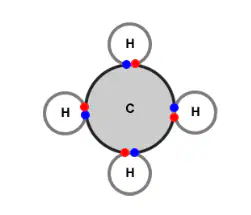
The red and blue electrons are being ____________________.
shared
transferred
Covalent bonds are created by ________________ electrons.
sharing
transferring
Ionic bonds are created by ________________ electrons.
sharing
transferring
Why are noble gases unreactive?
the have a complete shell of valence electrons
they are unstable
they are not found in nature
they do not want their valence electrons
What is the correct formula of magnesium sulfide?
MgSO4
MgS
MgSO3
Mg2S2
How many valence electrons does group 2 have?
1
2
3
4
How many valence electrons does group 17 have?
1
6
7
8
How many electrons will sodium give up in an ionic bond?
1
3
5
7
Gaining an electron forms a ______________ charge.
positive
neutral
negative
Losing an electron forms a ______________ charge.
positive
neutral
negative
What is the name of the compound SO2
Monosulfate oxide
Sulfur Dioxide
Monosulfur dioxide
what is the name of CCl4?
carbon tetrachloride
monocarbon tetrachloride
tetracarbon monochloride
carbon chloride
CS2
monocarbon disulfide
carbon bisulfide
carbon disulfide
carbon disulfer
monocarbon sulfide
Ionic compounds involve _________________________.
metals and metals
metals and nonmetals
nonmetals and nonmetals
Covalent compounds involve _________________________.
metals and metals
metals and nonmetals
nonmetals and nonmetals
Where are nonmetals on the periodic table?
Left of the staircase
Right of the staircase
Around the staircase
At the bottom
Where are metals on the periodic table?
Left of the staircase
Right of the staircase
Around the staircase
At the bottom
Where are metalloids on the periodic table?
Left of the staircase
Right of the staircase
Around the staircase
At the bottom
What kind of bonding involves cations and anions?
Ionic
Covalent
what is the name of CCl4?
carbon tetrachloride
monocarbon tetrachloride
tetracarbon monochloride
carbon chloride
NaBr
Bromide sodide
Sodium bromide
Sodium bromate
Sodium bromite
What is the name for AlBr3?
aluminum bromide
aluminum tribromide
aluminum bromine
monoaluminum tribromide
The correct name for B2H4 is __________.
boron hydride
boron (II) hydride
diboron tetrahydride
dibromine tetrahydride
The chemical bond between a non-metal and another non-metal will be a ________ bond.
metal
ionic
covalent
polar
Beryllium and sulfur will form a ______ bond
ionic
covalent
metalloid
Sodium and Bromine will make a _____ bond.
ionic
covalent
metallic
Carbon and Oxygen will make a ___________ bond.
ionic
covalent
metallic
MgO
ionic
covalent
metallic

