
 Worksheets
UCSP-Evolutution of Man
Total questions: 50
Worksheet time: 25mins
What is Evolution?
When only people change.
When people change from a monkey to a person.
The process by which different kinds of living organisms are thought to have developed and diversified from earlier forms during the history of the earth.
When animals change to a human.
What is natural selection?
Animals that have acquired traits to survive and reproduce.
Animals who pick who they want to mate with.
People pick the mates for the animals.
People change the DNA of animals to make them have desired traits.
What is variation?
Things that vary.
Different in traits.
Animals that are the same.
Species that change.
What are the Five Principles of Natural Selection?
Overproduction, Variation, Competition, Adaption, Extinction
Overproduction, Competition, Extinction, Evolution, Adaption,
Overproduction, Variation, Competition, Adaption, Evolution
What does "Survival Of the Fittest" mean?
The best adapted organisms
The biggest organisms
The fastest organisms
The smartest organisms
The surroundings or conditions in which a person, animal, or plant lives or operates.
Environment
Starbucks
Earth
Mars


Example: "Modern day humans and apes evolved from a common ancestor.


"Survival of the fittest."


What is Biological Evolution?
The proces in which animals drink water.
The process in which plants and animals reproduce.
The process in which living organisms change through the passed of the years.
The process in which explains the cycle of life.
According to the scientists, what is the ancestor of the amphibians?
Fish
Whales
Sharks
Crabs
According to the path of the evolution, which animals were the last that evolved?
Snakes and crocodiles.
Monkeys and apes.
Reptiles
Dinosaurs.
What is a real example of a biological evolution?
A man becomes a spiderman
A man becomes an alien.
Lizard becomes a crocodile.
Dinosaur becomes a horse.
The first man to use fire
Cro- magnon man
Australopithecus
Neanderthal
Homo erectus
According to fossils discovered up to present time origin and evolution of man started from
Africa
Asia
Java
Australia
Darwin's book On The Origin of Species included _____
lots of evidence to show that evolution had taken place
an analysis of the anatomy of analogous structures
an analysis of the DNA sequences of closely related animals
all of the above
The strongest evidence for evolution from a common ancestor is
similar DNA sequences
similar body structures
similar fossils
all of the above
Which are we (humans) more closely related to?
pigs
mice
flies
chimpanzees
If evolution occurs, we would expect different biogeographical regions with similar environments to
all contain the same mix of plants and animals
each have it own specific mixes of plants and animals
have plant and animals with different adaptations.

Modern humans are classified as the species...
Homo habilis
Homo erectus
Homo sapiens
Homo Neanderthalensis
This earliest type of hominid, which scientists believe was the common ancestor for several types of early humans is called...
Australopithecus
Homo sapiens
Homo erectus
Homo habilis
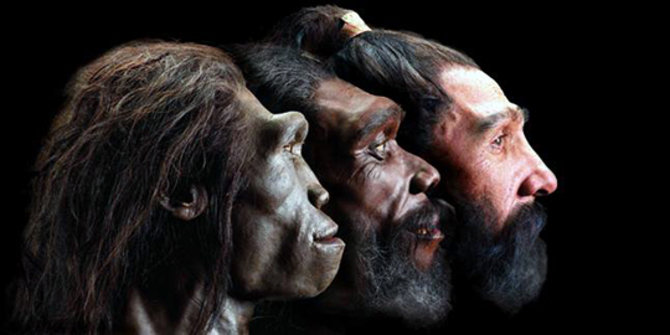
Modern humans and their closest relatives belong to the same family. Members of this family are called:
Hominids
Primates
Homo sapiens
Neanderthals

Which species evolved about 5 million years ago and was bipedal?
Australopithecus
Homo neanderthalensis
Homo habilis
Homo erectus
Which of our hominid ancestors were likely the first to control & start fires?
Homo sapiens
Homo habilis
Homo erectus
Homo neanderthalensis

This early hominid walked upright and had a huge lower jaw and a brain around the size of an ape
Australopithecus
Homo erectus
Homo sapiens
Homo habilus
What is human evolution?
Short process of change by which primates became modern humans.
Long process of change by which modern humans became primates.
Long process of change by which primates became modern humans.
Long process of change by which primates became apes
Name the first physical change:
Decreased jaw and teeth.
Bipedalism (walking on two legs).
Hands became free.
Evolution of opposable thumbs.
Name the Human species:
Australophitecus.
Homo Habilis.
Homo Sapiens.
Homo Neanderthalensis.
Why are Homo Habilis considered to be the first human species?
Because of his speaking skills.
Because he discovered fire.
Because of his artistic skills.
Because of his toolmaking skills.
Explain the consequences of bipedalism:
Hands became free and allowed opposable thumbs to evolve. Thanks to this, hominids made tools.
Hands became free and allowed opposable thumbs to evolve. Because of this, hominids could not make tools.
Hands became free and allowed opposable thumbs to evolve. Thanks to this, hominids began to speak.
The nickname of Homo Habilis is...
"Upright Man"
"Handy Man"
"Wise Man"
"Artist Man"
Which one of the following species is never thought to have ventured out of Africa.
Homo neanderthalensis
Homo habilis
Homo sapiens
Homo erectus
Which of the following arranges the fossils in the correct order, from oldest to youngest?
Lucy, Ardepithecus, handy man, neanderthal man.
Ardepithecus, Lucy, Handy man, Neanderthal man
Handy man, Lucy, Ardepithecus, Neanderthal man
Ardepithecus, Neanderthal man, Lucy, Handy man.
Arrange the following behaviours in the order in which they appear in human development
speech, bipedalism, tool use , fire
bipedalism , tool use, speech, fire
bipedalism, speech, tool use, fire
bipedalism, tool use, fire, speech
The man who proposed the Theory of Natural Selection was-
Thomas Moore
Gregor Mendel
Neil Degrasse Tyson
Charles Darwin

