wayground logo

Free Printable Worksheets

Font size

S
M
L
XL
Worksheets

Studying Materials Scientifically

Total questions: 61

Worksheet time: 1hrs 15mins

Name
Class
Date
1.

What is the amount of space something takes up?

a)

Matter

b)

Mass

c)

Volume

d)

Density

2.
Put these materials in order from most dense to least dense.  Water (1.0 g/mL), Rubbing Alcohol (0.79 g/mL), Baby Oil (0.83 g/mL)
a)
Rubbing Alcohol, Baby Oil, Water
b)
Baby oil, Rubbing Alcohol, Water
c)
Water, Baby Oil, Rubbing Alcohol
d)
Water, Rubbing Alcohol, Baby Oil
3.
An ice cube (0.92 g/mL) is dropped into a cup of maple syrup (1.37 g/mL) and baby oil (0.83 g/mL)   Where will the ice cube be positioned in the cup?
a)
On top of the baby oil
b)
in between the baby oil and the maple syrup
c)
on the bottom of the cup
d)
who would put those three ingredients together??
4.
How do you measure mass?
a)
Triple Beam Balance
b)
A scale
c)
Graduated Cylinder
d)
Water Displacement Method
5.
How do you find the volume of an irregular shaped object, like a rock?
a)
A triple beam balance
b)
a ruler - length x width x height
c)
Water Displacement Method
d)
A graduated cylinder
6.
What is the final step in the water displacement method?
a)
Subtract your initial volume from your final volume
b)
You fill the graduated cylinder with water to a starting volume
c)
You place the object in the graduated cylinder
d)
You measure the new height of the water.
7.
What is the equation for density?
a)
Volume/Mass
b)
Water Displacement Method
c)
Length x width x height
d)
Mass/Volume
8.
Density is 
a)
how much matter is in a substance
b)
how much space a substance takes up
c)
How compact the molecules are in a given volume
d)
made up
9.
Mass is 
a)
how much matter is in a substance
b)
how much space a substance takes up
c)
How compact the molecules are in a given volume
d)
weight
10.
Volume is 
a)
how much matter is in a substance
b)
how much space a substance takes up
c)
How compact the molecules are in a given volume
11.
If an object floats in water, the object is ________________ dense than water.
a)
less
b)
more
c)
equal
d)
bananas
12.
If an object sinks in water, the object is ________________ dense than water.
a)
less
b)
more
c)
equal
d)
bananas
13.
If a substance floats in water, the density is ________________ compared to water.
a)
less
b)
more
c)
equal
d)
bananas
14.

The amount of mass per unit of volume

a)

Density

b)

Reactivity

c)

Conductivity

d)

Mass

15.

A metric unit of volume

a)

Observation

b)

Miscible

c)

Liter

d)

Gram

16.
Where do we read the level of liquid?
a)
The highest point the liquid touches
b)
The bottom of the meniscus
c)
Half way between, we make an educated guess and round it
d)
Somewhere about there
17.
What is the correct value?
a)
5 ml
b)
15 ml
c)
20 ml
d)
25 ml
18.
What is the volume of the liquid in this graduated cylinder?
a)
8.5 mL 
b)
7.5 mL 
c)
8 mL 
d)
.1 mL
19.
What is the volume of the liquid in this graduated cylinder?
a)
1.5 mL 
b)
15 mL 
c)
1.05 mL 
d)
.15 mL
20.
What is the scale on this graduated cylinder?
a)
.1 mL per line
b)
.2 mL per line
c)
.5 mL per line
d)
1 mL per line
21.
Identify the equipment shown here:
a)
beakers
b)
flasks
c)
decanters
d)
graduated cylinders
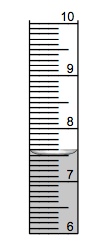
22.
What is the volume of the water in this graduated cylinder?
a)
7.6 mL
b)
7.2 mL
c)
6.6 mL
d)
6.8 mL
23.

Let's practice! Before reads 50 mL. After we drop in the object, the new water level goes up to 60 mL. What is the volume of the blocks? (Hint: new volume- old volume)

a)

8 mL

b)

10 mL

c)

60 mL

d)

5 mL

24.

What is the volume of the two red spheres? (Hint: new volume - old volume)

a)

4 mL

b)

6 mL

c)

2 mL

d)

8 mL

25.
What is the mass on this triple beam?
a)
220g
b)
222g
c)
20g
26.
What is the mass on this triple beam?
a)
270g
b)
202g
c)
273g
27.
What is the mass on this triple beam?
a)
40g
b)
1g
c)
401g
d)
41g
28.
What is the mass on this triple beam?
a)
200g
b)
44g
c)
244g
d)
4g
29.
What is the mass on this triple beam?
a)
142g
b)
42g
c)
102g
d)
444g
30.

Select all of the units that can be used to express the density of an object:

a)

cm/s

b)

g/cm3

c)

g/km

d)

g/mL

e)

mL/kg

31.

If a liquid has a mass of 13.4 grams and a volume of 23 millilitres, then what is the density of the liquid?

a)

0.73 g/mL

b)

0.58 g/mL

c)

1.7 g/mL

d)

11.6 g/mL

32.

A solid has a mass of 356 g and a volume of 40 cm3. What is it?

a)

Brick

b)

Copper

c)

Lead

d)

Paraffin

33.

If the following 4 fluids were mixed to form a density column, what would be the order of the liquids from top to bottom:

  • dichloromethane: 1.33 g/mL
  • gasoline: 0.74 g/mL
  • olive oil: 0.91 g/mL
  • water
a)

dichloromethane, water, olive oil, gasoline

b)

gasoline, olive oil, water, dichloromethane

c)

olive oil water, gasoline, dichloromethane

d)

dichloromethane, water, gasoline, olive oil

e)

gasoline, water, dichloromethane, olive oil

34.
What is this tool to get volume?
a)
triple beam balance
b)
ruler
c)
thermometer
d)
graduate cylinder
35.
What is this tool to get mass?
a)
triple beam balance
b)
ruler
c)
thermometer
d)
graduate cylinder
36.
True or False:  The density of a specific type of material never changes.  
a)
True
b)
False
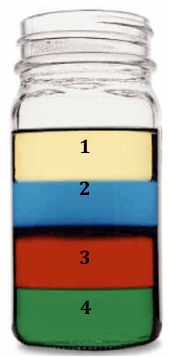
37.
Put the liquids in order from most dense to least dense?
a)
4, 3, 2, 1
b)
1, 2, 3, 4
c)
3, 4, 2, 1, 
d)
4, 3, 1, 2
38.
If an object has a density of .6 g/cm^3 and you put it into water, will it sink or float?  
a)
sink
b)
float
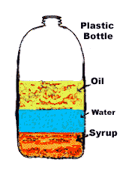
39.
Which liquid is the least dense?
a)
oil
b)
water
c)
syrup 
d)
plastic bottle
40.
What is the formula for density?
a)
density = mass x volume
b)
density = mass / volume
c)
density = mass + volume
d)
density = mass - volume
41.
Jack has a rock. The rock has a mass of 14 g and a volume of 2 cm3. What is the density of the rock?
a)
7 mL
b)
7 g/cm3
c)
28 g/cm3
d)
1/7 g/cm3
42.
Frank has an eraser. It has a mass of 4 g, and a volume of 2 cm3. What is its density?
a)
8 g/cm3
b)
2 g/cm3
c)
1/2 g/cm3
d)
24 g/cm3
43.
Frank has a liquid. It has a mass of 6 g and a volume of 9 mL. What is its density?
a)
3 g/mL
b)
.66 g/mL
c)
1.33 g/mL
d)
54 g/mL
44.
What two types of measurements make up DENSITY
a)
Mass and Volume
b)
Temperature and Mass
c)
Grams and Centimeters
d)
Volume and Weight
45.
What units are used to measure mass?
a)
g
b)
cm3
c)
g/cm3
d)
cm3/g
46.
A possible explanation to a problem that has not yet been tested. 
a)
data
b)
theory
c)
hypothesis
d)
fact
47.
The summary at the end of an experiment that explains the results. 
a)
conclusion
b)
procedures
c)
materials
d)
responding variable
48.

What is an observation?

a)

A scientific statement based on ideas

b)

Using your senses to notice what is going on around you

c)

To be unaware of your surroundings

d)

The question that you want an answer to.

49.
A series of steps used by scientists to solve a problem or answer a question. 
a)
scientific method
b)
recipe
c)
data collection
d)
metric system
50.
Which is NOT a step in the scientific method?
a)
Make observation
b)
Form a theory
c)
Collect data
d)
Form a hypothesis
51.
Should experiments be repeated over and over to see if the results are the same each time?
a)
yes
b)
no
52.
Testing a hypothesis often involves a(n):
a)
answer
b)
experiment
c)
problem
d)
safety check
53.

This variable is the one thing that changed on purpose...

a)

Dependent Variable

b)

Control

c)

Independent Variable

54.

You are testing how the amount you water a plant affects its growth. What would be the INDEPENDENT VARIABLE in this experiment.

a)

They type of pot you put the plants in.

b)

The amount you water each plant.

c)

The amount of sunlight the plants get.

d)

The amount the plant grows.

55.

A scientist is testing which flavor of ice cream melts the fastest. What would his controlled variables be? (choose ALL that apply)

a)

The flavor of ice cream

b)

the kind of cone the ice creams are in

c)

the place in the room where the ice cream is

d)

the size of the scoop

e)

the time it takes to melt

56.

What is the DEPENDENT variable (effect that is measured) in this experiment?

"Do tall people jump further than short people?"

a)

height of the person

b)

weight of the person

c)

how fast the person runs

d)

how far the person jumps

57.

The variable that is being tested, counted, or measured and how it reacts to the independent variable is known as:

a)

Independent Variable

b)

Controlled Variable

c)

Dependent Variable

58.

These are the variables that should stay the same. They do not get any changes in order to make for a fair test.

a)

Dependent Variables

b)

Controlled variables

c)

Independent Variables

59.

Mr. Pransky wants to see how different surfaces affect how high a tennis ball can bounce. What is the independent variable?

a)

the different surfaces

b)

using the same ball

c)

how high they bounce

60.

A student wants to test the hypothesis of "If salt is added to water then the boiling point of water will decrease (go down)." What is the independent variable?

a)

Whether salt is added or not

b)

Boiling Point

c)

Amount of water

61.

How many independent variables are allowed to be changed in an experiment?

a)

1

b)

2

c)

as many as you want

d)

0