
 Worksheets
CPE 110
Total questions: 122
Worksheet time: 2hrs 42mins
The CPU makes sense of the instruction it has just fetched.
Which of the following are main components of the CPU? Click all that apply.
ROM
Arithmetic Logic Unit (ALU)
Control Unit (CU)
Cache and Registers
RAM
In Von Neumann Architecture, the stored-program concept stores what in what?
Program instructions and Data in Secondary Memory
Data in Memory
The memory address in registers
Program instructions and Data in Primary memory
What is a Register?
A small amount of high-speed read only memory contained within the processor
A small amount of high-speed random access memory contained within the processor
Sort the following memory types by speed (Slowest to Fastest):
RAM 2. HDD 3. SSD 4. Registers 5. Cache 6. CPU
1, 3, 5, 6, 2, 4
2, 3, 1, 4, 5, 6
2, 3, 1, 5, 4, 6
3, 2, 1, 4, 5, 6
Which component of the CPU holds the address of the next instruction to be fetched from memory?
Program counter (PC)
Memory address register (MAR)
Accumulator (ACC)
Memory Data Register (MDR)
Arithmetic Logic Unit (ALU)
Which component of the CPU performs calculations and logical expressions?
Program counter (PC)
Memory address register (MAR)
Accumulator (ACC)
Memory Data Register (MDR)
Arithmetic Logic Unit (ALU)
Which component of the CPU holds the result of an instruction before it is transferred to memory?
Program counter (PC)
Memory address register (MAR)
Accumulator (ACC)
Memory Data Register (MDR)
Arithmetic Logic Unit (ALU)
Which component of the CPU holds data to be written to/retrieved from memory?
Program counter (PC)
Memory address register (MAR)
Accumulator (ACC)
Memory Data Register (MDR)
Arithmetic Logic Unit (ALU)
Which component of the CPU holds the address of the next instruction to be retrieved from memory then executed?
Program counter (PC)
Memory address register (MAR)
Accumulator (ACC)
Memory Data Register (MDR)
Arithmetic Logic Unit (ALU)
What does Fetch Decode Execute cycle do?
Fetches instructions/data from main memory, Decodes instructions, Executes instructions.
Fetches RAM, Decode programmes, Executes the CPU
Fetches Instructions, Decodes Instructions, Executes Data.
What 3 factors can affect the speed of the CPU? Select all that apply.
Number of Cores
Amount of RAM
Amount of Cache
Clock Speed
Use of SSD over HDD
What are embedded systems?
A system that is volatile
A system with many processors
A small computer that forms part of a larger system
A computer designed for multiple uses
According to the von Neumann model, _______ are stored in memory.
only data
only programs
data & programs
neither data nor programs
Which of these are REGISTERS in the CPU? (Tick ALL that are correct)
Accumulator
ALU
Program Counter
Memory Address Register
Control Bus Register
Which of these are REGISTERS in the CPU? (Tick ALL that are correct)
Accumulator
ALU
Program Counter
Memory Address Register
Control Bus Register
Tick all options that happen in the FETCH CYCLE?
PC is incremented
The Instruction at the MAR address is read from RAM
The PC value is copied to the MAR
The instruction in the MAR is decoded
The value in the MDR is written to the address in the MAR.
Tick all options that happen in the DECODE CYCLE?
PC is incremented
The Instruction at the MAR address is read from RAM
The PC value is copied to the MAR
The instruction in the MAR is decoded by the CU
The value in the MDR is written to the address in the MAR.
Tick all options that happen in the EXECUTE CYCLE?
PC is incremented
The data at the MAR address is read from RAM
The ALU performs any calculations required on the ACC
The instruction in the MAR is decoded by the CU
The value in the MDR is written to the address in the MAR.


The Program Counter
Stores the address of the next instruction in memory
Stores the address of where the next item will be fetched from
Stores data fetched from memory, or waiting to be stored in memory
Stores the result of arithmetic calculations
Accumulator
Stores the address of the next instruction in memory
Stores the address of where the next item will be fetched from
Stores data fetched from memory, or waiting to be stored in memory
Stores the result of arithmetic calculations
The Control Unit
Controls the flow of data around the CPU and also decodes instructions
Only controls the flow of data around the CPU
Only decodes instructions
Controls how much power is directed to all components within the computer
The Arithmetic Logic Unit (ALU)
Carries out numerical calculations and logical decisions
Calculates the different items of number data stored within the Accumulator and converts them into logical decisions
Calculates graphic data as they are only found within GPU units.
Calculates the flow of execution in a program and decodes instructions into small steps to be carried out by the program counter.


1101 to decimal
15
11
12
13
1111 to decimal
15
11
12
13
11101 to decimal
23
27
29
30
16 to binary
10000
1111
1000
111
28 to binary
11100
11001
10011
00111
64 to binary
1000 0000
0100 0000
0010 0000
0001 0000
128 to binary
1000 0000
0100 0000
0010 0000
0001 0000
Which of these are hexadecimal digits?
F
G
6
0
H
How many different values can be represented using 8 bits?
128
255
256
999
What is the largest integer that can be represented using 7 bits?
127
128
125
999
What is the binary equivalent of the hexadecimal digit E?
1110
1111
0110
0111
Hexadecimal is used because...
It takes up less space
It is easier for computers to process
It is easier for people to read
It is quicker to write data in
What is the decimal equivalent of the binary number 00100111?
39
57
228
7
What is the decimal equivalent of the hexadecimal number 4B?
75
180
31
255
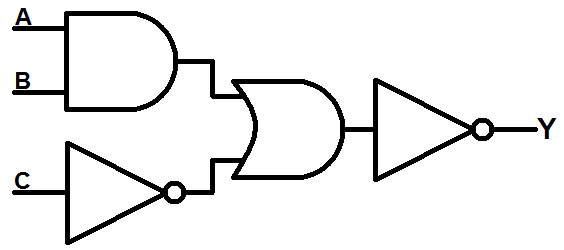
What is the output Y of this logic cricuit if A = 1, B = 1, and C = 1
0
1
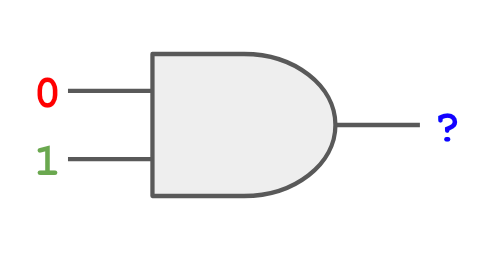
What will the AND gate's output be?
0
1
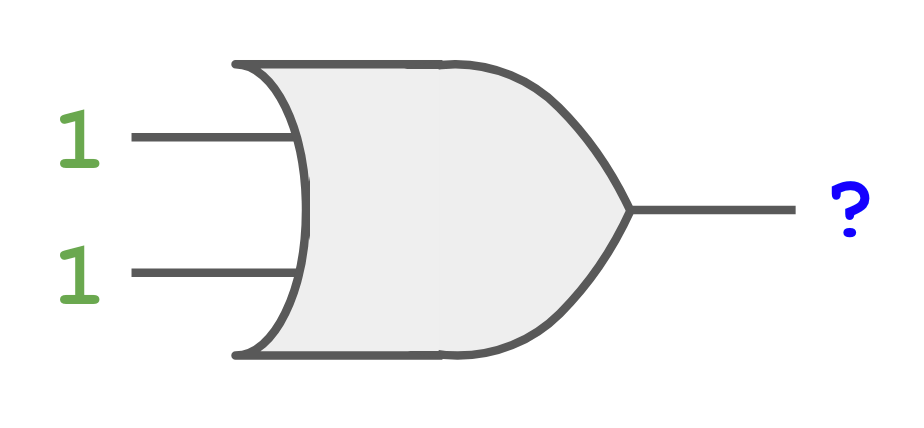
What will the OR gate's output be?
0
1
(a) is a self-taught English mathematician in the 1800s from which Boolean Algebra later got its name.
What are the three boolean operations in Boolean Algebra?
NOT, AND and XOR
NOT, AND and OR
ADDITION, SUBTRACTION AND MULTIPLICATION
X, Y AND Z
In an XOR Gate if the input A is true and the input B is false the output will be _____.
True
False

Which logic gate represented by this symbol?
OR
XNOR
XOR
NAND
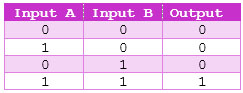
Which logic gate is represented by this truth table?
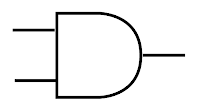
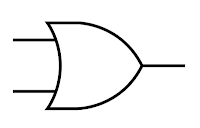
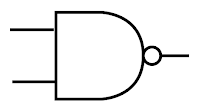
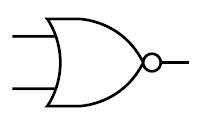

Which logic gate is represented by this truth table?


Which logic gate is represented by this truth table?

To increase the speed of memory access in pipelining, we make use of _______
Special memory locations
Special purpose registers
Cache
Buffers
What does the hardwired control generator consist of?
Decoder/encoder
Condition codes
Control step counter
All of the mentioned
CPU can directly understand this language(PNB Clerk 2011)
C
Assembly language
Machine language
JAVA
Which one of the following is the smallest memory ?
Main Memory
Cache
Registers
External Memory

This Type of access method is known as...
Direct Access
Random Access
Sequential Access
Associative
Which among the following is not of the bus types?
Address Lines
Data Lines
Memory Lines
Control Lines
Multiple interrupts are possible during the program execution.
True
False
Can I/O Modules directly access the memory without involving the processor?
Yes
No
A high priority interrupt will wait for a low priority interrupt to finish.
True
False
Segment Register is a _____register
General Purpose
Address Reg
Data Reg
Program Counter (PC) stores
Address
Data
Instruction
Instruction Reg (IR) stores
Address
Instruction
Data
Register and ALU communicates through
Address Bus
Data Bus
Internal CPU bus
The data read from memory is stored in to
MAR
IR
MDR
After fetch cycle the CPU will execute which cycle?
Interrupt Cycle
Execute Cycle
Execute or Indirect Cycle
After indirect cycle the cpu will perform
Fetch cycle
Interupt Cycle
Execute Cycle
The direction of data flow in fetch cycle is
towards CPU
Towards Memory
Both Direction
The direction of data flow in data bus at interrupt cycle
towards cpu
towards memry
both direction
In fetch cycle MAR gets address from
PC
Control Umit
MDR
In interrupt cycle MAR get address from
PC
IR
Control Unit
In indirect cycle MAR gets address from
PC
Control Unit
MDR
What architecture means for computers
how the computer looks
how computer runs or work
we need to tell the computers what to do with the data and provide instructions
True
False
The fastest memory in the computer system is _____________
ROM
RAM
Cache
None of these
_______________ is a large multilayered printed circuit board inside a computer that contains CPU,BIOS,ROM chip and the CMOS setup information.
Motherboard
RAM
ROM
Cache
1. To achieve high speed, an algorithm must be implemented in hardware.
True
False
2. Magnetic disk is a circular platter constructed of nonmagnetic material, called the substrate, coated with a magnetizable material.
True
False
3. Data are read and written in contiguous blocks called ________________.
logical records
virtual records
physical records
memory records
4. CD-RW provide a permanent record of large volume of user data.
True
False
7. Transfer time in disk performance parameters is time that positioning the head of disk then read and write operation will have performed as the sector moves under the head.
True
False
12. A solid-state drive (SSD) is electromechanical magnetic disks which have a better speed than hard disk drives (HDDs).
True
False
Microprocessor 8085 is the enhanced version of ......... with essentially the same construction set
4800
6800
8080
8088
The stack pointer in the microprocessor is a ______
16 bit register that points to stack memory locations
32 bit accumulator
memory location in the stack
flag regsiter used for the stack
Computer Architecture deals with Hardware and Software
True
False
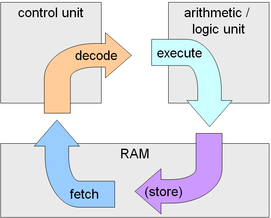
This cycle is called
Execution Cycle
The Fetch-Execute cycle
Fetch Cycle
The first stage in The Fetch-Execute cycle is Fetch Instructions
True
False
The Fetch-Execute cycle mean how the instructions are executed and process data
True
False
The ALU performs arithmetic and logical operations on all required data. It carries out instructions and also performs the operations on various registers. If it is necessary to get more data for a specific instruction, then they are transferred from the main memory to the registers.
Executing of instructions
Decoding of instructions
Storing of results
Fetching of instructions
The results of executing instructions are placed in the main memory.
Executing of instructions
Decoding of instructions
Storing of results
Fetching of instructions
The instructions are transferred from the main memory and stored temporarily in small memories within the CPU called registers.
Executing of instructions
Decoding of instructions
Storing of results
Fetching of instructions
The control unit interprets the instruction stored in the instruction register, turning it into a signal that can be understood by the ALU.
Executing of instructions
Decoding of instructions
Storing of results
Fetching of instructions
The Second stage in The Fetch-Execute cycle is --------------
Fetch Instructions
Restore results
Execution Cycle
Decode Instructions
The Third stage in The Fetch-Execute cycle is --------------
Fetch Instructions
Restore results
Execution Cycle
Decode Instructions
The Last stage in The Fetch-Execute cycle is Restore results
True
False

