
NEW
Font size
 Worksheets
Redox Reactions
Total questions: 45
Worksheet time: 3570secs
Oxidation is the _________ of electrons.
loss
gain
sharing
transfer
What is the oxidation number of chlorine in HClO?
0
-1
+1
+5
Reduction is the ___________ of electrons.
loss
gain
sharing
transfer
What is the oxidation number of iodine in KIO3?
0
-1
+5
+1
Which of the following represents oxidation?
C → CH4
Fe3+ → Fe2+
Cl2 → 2Cl-
Zn → ZnO
In the reaction Zn + 2HCl --> ZnCl2 + H2
which element, if any, is oxidized?
Zinc
Hydrogen
Chlorine
None
2Ca(s) + O2(g) --> 2CaO(s), calcium is __________
Mg → Mg2+ + 2e–
4Fe + 3O2 --> 2Fe2O3
2CaO--> 2Ca + O2
Which of these metals is the least easily oxidized?
Na
Au
Fe
Ca
Ag
Of the following elements, ___________ is the most easily oxidized.
oxygen
fluorine
nitrogen
aluminum
gold
Which of the following reactions is a redox reaction?
K2CrO4 + BaCl2 --> BaCrO4 + 2 KCl
Pb2+ + 2 Br- --> PbBr
Cu + S --> CuS
What is the coefficient of the permanganate ion when the follow equation is balanced?
MnO4- + Br- --> Mn2+ + Br2 (acidic solution)
1
4
3
2
5
What is the coefficient of Fe3+ when the follow equation is balanced?
CN- + Fe3+ --> CNO- + Fe2+ (basic solution)
1
2
3
4
5
Which transormation could take place at the anode of an electrochemical cell?
F2 to F-
O2 to H2O
Cr2O72- to Cr2+
HAsO2 to As
none of the above could take place at the anode
Which one of the following is the best oxidizing agent?
Ca
Na
O2
H2
Li
Which of the following reactions will occur spontaneously as written?
3 Sn4+ (aq) + 2 Cr (s) --> 2 Cr3+ (aq) + 3 Sn2+ (aq)
Sn4+ (aq) + Fe3+ (aq) --> Sn2+ (aq) + Fe2+ (aq)
Sn4+ (aq) + Fe2+ (aq) --> Sn2+ (aq) + Fe (s)
3 Fe (s) + 2 Cr3+ (aq) --> 2 Cr (s) + 3 Fe2+ (aq)
_______ is reduced in the following reaction:
Cr2O72- + 6 S2O32- + 14 H+ --> 2 Cr3+ + 3 S4O62- + 7 H2O
S4O62-
Cr6+
H+
S2+
O2-
_______ is the oxidizing agen in the following reaction:
Cr2O72- + 6 S2O32- + 14 H+ --> 2 Cr3+ + 3 S4O62- + 7 H2O
S2O32-
H+
Cr3+
S4O62-
Cr2O72-
What is the oxidation number of chromium in Cr2O72- ion?
+3
+14
+12
+6
+7
What is the oxidation number of oxygen in H2O2?
+1
+2
-1/2
-2
-1
The balanced half reaction in which the dichromate ion is reduced to chromium metal is a ________.
6 electron
12 electron
four electron
2 electron
3 electron
The standard cell potential for the voltaic cell based on the reaction below is __________ V.
Sn2+ (aq) + 2 Fe3+ (aq) --> 2 Fe2+ (aq) + Sn4+ (aq)
-0.46
+1.39
+0.617
+0.46
+1.21
The standard cell potential for the voltaic cell based on the reaction below is ______ V.
2 Cr (s) + 3 Fe2+ (aq) --> 3 Fe (s) + 2 Cr3+ (aq)
+0.83
+0.30
+2.80
+3.10
-0.16
In the galvanic cell using the redox reaction below, the reduction half-reaction is _______.
Zn(s) + Cu2+ (aq) --> Zn2+ (aq) + Cu (s)
Cu2+ --> Cu + 2 e-
Cu2++ 2 e- --> Cu
Zn --> Zn2+ + 2 e-
Zn + 2 e- --> Zn2+
What is a voltmeter?
The liquid part of the electrochemical cell
The metal part of the electrochemical cell
The part that measures the voltage in an electrochemical cell
The standard redox potentials for a number of substances are shown below:
F2(g) + 2e-→ 2F-(aq); E0 = 2.87 V
O2(g)+ 4H+(aq)+ 4e-→ 2H2O(l); E0 = 1.23 V
Cu2+(aq) + 2e-→ Cu(s); E0 = 0.34 V
Fe2+(aq) + e- → Fe(s); E0 = -0.41V
2H2O(l) + 2e- → H2(g) + 2OH-(aq); E0 = -0.83 V
Mg2+(aq) + 2e- → Mg(s); E0 = -2.38 V
If all of these substances were available, what galvanic cell could be set up using these substances that would steadily deliver approximately 1.6 V?
F2/F- and O2/H2O
O2/H2O and Fe2+/Fe
O2/H2O and Cu2+/Cu
H2O/H2 and Mg2+/Mg
What is the oxidation number of C in SrCO3?
-4
+2
-6
+4
Substance that oxidizes another substance by accepting its electrons.
reducing agent
oxidation number
combustion
oxidizing agent
Substance that reduces another substance by losing electrons.
reducing agent
half-reaction
electronegative atom
oxidizing agent
WRITE THIS OUT ON PAPER, YOU MAY USE THE ANSWER TO THIS PROBLEM AGAIN IN ANOTHER QUESTION:
Consider the following REDOX reaction:
Cl2(g) → ClO−(aq) + Cl−(aq) (basic solution)
How many OH- molecules did you add to the reactant side of this reaction when balancing?
1
2
3
4
WRITE THIS OUT ON PAPER, YOU MAY USE THE ANSWER TO THIS PROBLEM AGAIN IN ANOTHER QUESTION:
Consider the following REDOX reaction:
Cl2(g) → ClO−(aq) + Cl−(aq) (basic solution)
Which species is the result of oxidation?
Cl−
ClO−
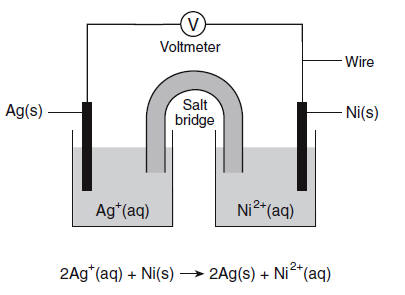
What reaction occurs at the anode?
Ag+ + e- →Ag
Ag → Ag+ + e-
Ni2+ + 2e- → Ni
Ni → Ni2+ + 2e-
___ Al + ___ Fe+2 → ___ Al+3 + ___ Fe
Which energy conversion shown below takes place in a voltaic cell?
Electrical to chemical
Mechanical to chemical
Mechanical to electrical
Chemical to electrical

