
Font size
 Worksheets
Review: Unit B Ecosystems & Population Change
Total questions: 80
Worksheet time: 46mins
Which biome is most likely to have the least amount of precipitation on an annual basis?
tundra
taiga (boreal forest)
grassland
temperate deciduous forest
The biome that covers the greatest amount of area of Canada is:
tundra
taiga (boreal forest)
grassland
temperate deciduous forest
Which Canadian biome has the greatest amount of biodiversity?
tundra
taiga (boreal forest)
grassland
temperate deciduous forest
Which Canadian biome has poor soil quality due to the fact that there is permafrost beneath a very thin soil layer?
tundra
taiga (boreal forest)
grassland
temperate deciduous forest
Which Canadian biome do we live in here in Fort Smith?
tundra
taiga (boreal forest)
grassland
temperate deciduous forest
Which two Canadian biomes do not have many trees?
tundra
taiga (boreal forest)
grassland
temperate deciduous forest
REDEMPTION FROM QUIZ!!!! Since temperature range and length of growing seasons are similar in grassland and deciduous forest biomes, which of the following major factors MOST LIKELY determines the type of plant communities that will grow in a specific area?
soil type
amount of sunlight
amount of available moisture
types of animal species living in the area
The tundra is particularly fragile because
it's cold and dark during the winter
the soil is so thin and poor
there is so much snow
polar bears
The area where two ecosystems overlap is known as an:
(a)
Soil litter can affect which types of vegetation grow in an area. What type of factor is this?
biotic
abiotic
photosynthesis
yucky
The zebra mussel can attach to boats and travel long distances. In this way, zebra mussels have been introduced into Canadian aquatic ecosystems from as far away as Asian and Europe. They compete with native species for food. Zebra mussels are an example of (check all that are correct):
an invasive species
an exotic species
a stripy species
an indicator species
a divergent species
The environment an organism lives in is called its:
habitat
home
biome
community
An organism's role in its environment, including where it lives, how it interacts with other species is known as its:
(a)
Water density is highest at 4 degrees Celsius. The densest water will always go where in a lake?
bottom
surface
the middle
the salty area
Which type of tree has its leaves (needles) all year long?
coniferous
deciduous
poplar
ferns
The primary producers in the tundra biome are generally quite small, such as flowering plants, small shrubs, and lichen. What is the best explanation for this?
Precipitation is lowest in this biome
There is only a thin layer of soil on top of the permafrost
Trees have not adapted to grow in cold, wintery conditions
There is not enough sunlight to support plant growth
Which of the layers of soil would you choose to use for your garden or lawn to promote plant or grass growth?
Litter
Topsoil
Subsoil
Bedrock
Which abiotic factors make life difficult for organisms in the deep ocean? Check all that apply
high pressure
lack of sunlight
cold temperature
difficulty finding mates in the dark
creepy predators with giant teeth
Sunlight is important in ______________ environments because it's required for _____________________. Check whichever apply.
aquatic, photosynthesis
terrestrial, photosynthesis
abiotic, global warming
nearly all, cellular respiration
"The maximum number of offspring that a species could produce with unlimited resources" This is the definition for (a) potential
What is a definition of the length of reproductive life of an organism?
How many years an organism can have offspring for.
How many years an organism lives.
How many years a baby lives for.
How many times an organism reproduces in a year.
If the whooping cranes that live near Fort Smith double in population, are they exceeding their respective environment's carrying capacity?
No, because they're endangered with a low population.
No, because they have no natural predators.
Yes, because doubling population is a big increase
Yes, because their population is already quite large.
Density-dependent factors in an ecosystem affects members of a population _______ population density
Because of
Regardless of
In spite of
None of the above
All of the above
Which of the following are examples of density-dependent factors? You must choose ALL correct answers
Fire
Habitat destruction
Food shortage
Diseases
Which is related to the capacity for survival of an organism?
Elephants reach sexual maturity at 15 years
Elephants usually produce one offspring a year
Elephants generally live to be 90 years
Females elephants care for their young for more than 10 years
Which of following are limiting factors for a producer in a terrestrial environment. You must check all that are correct.
Parasites and diseases
Light availability
Dissolved oxygen
Ease of finding prey species
A very large, tall jack pine tree grows in a forest in Fort Smith, where we have had a particularly rainy year. Which of the following limiting factors will most likely affect the tree's growth this year?
light
temperature
nutrients in the soil
forest fires
water
Which of these is a density-independent factor?
Food shortages
Increased predation
Destruction of habitats
Competition for water and other resources

Where would the zone of intolerance be on this graph of the tolerance level of an organism?
The far left
The middle
The far right
Both the far left and the far right
The law of the minimum states that the factor in the ________ supply is the one that limits population growth.
lowest
highest
Which one of these is an example of the breeding frequency of an organism?
elk mate once a year
sea turtles lay many eggs at once
cranes lay 2 eggs per year
elephants can’t breed until they reach an age of 15 years
Which of these following statements is the definition for the birth potential of an organism?
The maximum number of offspring per year
The maximum number of offspring per birth per month
The maximum number of offspring per birth
The maximum number of offspring per week
You want to bake a cake. You have 4 eggs, huge bags of flour, sugar, lots of baking powder, a big container of vanilla, and 3 sticks of butter. Each cake requires 2 eggs so you can only make 2 cakes, making eggs a limiting factor for your cake making. This cake situation is an analogy for:
The law of tolerance
The law of the minimum
Nutrients
Biotic potential (because birds lay eggs?)
Which type of lake would have the MOST nutrients?
oligotrophic
eutrophic
supertrophic
a big one
Which of the following is NOT a type of water pollution?
thermal (heat)
disease-causing organisms
carbon dioxide
organic solid waste (aka sewage)
fertilizer
Which of the following is not a type of deforestation?
slash-and-burn
clear-cutting
selective cutting
cutting one tree down in your yard
Which type of deforestation has the most significant negative impact on forest regrowth?
slash-and-burn
clear-cutting
selective cutting
all are equally bad
Which type of deforestation involves cutting all trees in an area to use for timber or pulp?
slash-and-burn
clear-cutting
selective cutting
Amazon
Choose the BEST answer. The burning of the Amazon rainforest is a serious problem because this rainforest has a high level of:
biodiversity so this impacts many different species
trees that produce oxygen
rain and contributes greatly to the water cycle
people who care about it because it's super amazing
Trees play an important role in the water cycle. Trees absorb water from the soil and release it from their leaves through the process of _____
transpiration
perspiration
excretion
photosynthesis
Which types of cells do cellular respiration?
plant cells
animal cells
both plant and animal cells
only chemosynthetic bacteria
Trees act as giant sponges for water. This is important because (choose all that are correct)
It prevents soil erosion
It controls water runoff
It releases nutrients into the soil
Water is a polar molecule and is super awesome according to Ms. Matthews
The area of land that drains toward a lake or other body of water is called:
a lake
a watershed
runoff
topsoil
Which of the following are used as indicators of water quality? Choose all that are correct.
checking the levels of disease-causing bacteria
measuring dissolved oxygen
looking to see if the water looks clean or dirty
drinking some to check for a weird taste
examining the type of organisms (ex. type of fish)
What do all organisms want in life? Check all that are correct
to eat
to survive
to reproduce
to contemplate the meaning of life
to do well in bio 20
The scientific name of an organism consists of the (a) and species.
The use of fossils is valuable in explaining natural selection because they
show all of the steps of how organisms changed over time
provide DNA for ecologists to examine and extrapolate
illustrate common ancestry through enzymes and biological components
illustrate the connections between groups of organisms with shared characteristics
Eubacteria and archaebacteria are the most primitive organisms in the six-kingdom system.
True
False
The branch of biology that deals with the classification of organisms is known as:
taxidermy
taxonomy
dichotomous key
classificology
Most mutations are:
harmful or neutral
beneficial
Hemoglobin is a protein in blood that transports oxygen. It has a similar structure in humans, penguins and salmon. This is an example of a ......... feature.
homologous
analagous
vestigial
not needed
The Galapagos Islands that Darwin visited have lots of unique species. This is probably the result of:
lack of competition
geographic isolation
being near the ocean
both isolation and lack of competition
Organisms that reproduce sexually have more variation than organisms that reproduce asexually. Why is this?
mutations are random
variation is impossible in asexually-reproducing organisms
sexual reproduction is faster than asexual reproduction
sexual reproduction combines genetic material from two parents
A barrier that prevents the mixing of genes from two populations can cause those populations to ..... genetically.
diverge
converge
mutate
behave
In which kingdom would you find a mushroom?
(a)
In which kingdom would you find simple eukaryotic organisms like amoeba and slime mould?
eubacteria
protista
archaebacteria
fungi
A prokaryotic cell lacks a:
(a)
Humans and insects both have joints in their legs, but they develop quite differently and do not share a close common ancestor. This type of evolution is called ....
convergent evolution
divergent evolution
speciation
leg evolution
Dogs are bred by humans to look very different, such as size from very tiny to very large. The process of breeding dogs is called:
artificial selection
natural selection
speciation
evolution
Which of the following could not be classified into one of the six kingdoms?
COVID-19 virus (not technically alive!)
a methanogenic bacterium in your intestines (eating our wastes can't be normal?)
a platypus (what even are they?)
humans (we're above all that classification stuff!)
Heritable mutations (passed on from parent to offspring) are important in evolution because they result in:
variability
bad DNA
randomness
extra chromosomes
Evolution is a scientific theory which means it's:
basically just a random idea
well-tested and proven to be true by many different scientists
something Darwin came up with but isn't true
as random as the mutations in our DNA


Genetic variation can result from:
Mutation
Sexual reproduction
Both of these
Neither of these

The formation of a new species is called .....
mutations
Natural selection
genetics
Speciation

homo sapiens
Homo sapiens
Homo Sapiens
HOMO SAPIENS
Carbon dating is used to determine how old fossils are. What is the half life of Carbon-14? (you don't have to memorize this, just use logic!)
15 seconds
5 730 years
4.5 billion years
25 days
Which organisms are most likely to survive?
the best adapted to their environment
the fastest
the strongest
the smartest
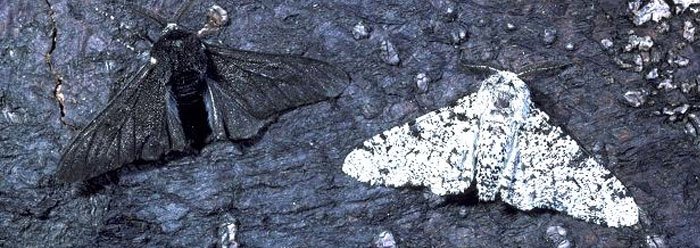
The trees these moths used to live on were white, but the trees have been covered in soot from coal factories. Assuming colouration is genetic, which trait do you think will become more common over time due to the fact that it confers a survival advantage?
Dark moth
Light moth
Both will be equally common
Neither will be common
In recent years "Superbugs" (bacteria that aren't killed by antibiotics) are becoming more and more common. How could natural selection explain this?
The superbugs bacteria that can survive the antibiotics will pass on the genes for resisting antibiotics to the next generation
Antibiotics kill bacteria and also cause them to have more mutations because they damage their DNA
We have always had the same amount of superbug bacteria but now we can find them more easily
Superbug bacteria are able to modify their DNA in response to changes in their environment
Body parts that function like each other, but are totally different in structure and do not show that the organisms evolved from a close common ancestor (ex. wings of a butterfly and wings of a bird)
naturally selected structures
homologous structures
analogous structures
vestigial structures
In biology, the fitness of an organism is related to:
reproductive success
being buff
having strong muscles
being different than others
running fast
Chemosynthetic bacteria in deep sea vents and methanogens that live in human intestines are both examples of "extremophiles" that fit into which kingdom in a 6-kingdom system of classification?
archaebacteria
eubacteria
protista
bizzaro
A scientist studies the following sequences of DNA from related organisms. Which are likely most closely related? Check the two species.
Species 1: AATCGTTAGCAA
Species 2: AATGCTTACCTT
Species 3: AAACGTTAGCAA
Species 4: TTTCGAATGCTT
Evolution involves changes in the ..... of populations of living things over many successive generations.
genetically inherited characteristics
mutations present in the DNA
acquired characteristics
behaviour and physical appearance
How are you feeling about this unit so far?
Like Darwin's finches that were super well-evolved for their environments - AMAZING!
Like a tree that is getting shaded out a bit by its neighbour - enough sun to make it but not ideal! Time to review a bit.
Like a sea turtle that laid 100 eggs but only 2 hatchlings survived in the sea. Could be much better. Time to study!
Like Lamarck ... I'm smart but I'm just not quite getting it for this specific topic. Time to study lots!!

