

wayground logo

Free Printable Worksheets

NEW

Font size

S
M
L
XL
Worksheets

Honors DNA Review

Total questions: 45

Worksheet time: 2hrs 30mins

Name
Class
Date
1.
Which scientists used viruses and radioactive isotopes to definitively prove that DNA, and not protein, was the molecule of heredity?
a)
Griffith and Avery
b)
Chargaff and Franklin
c)
Watson and Crick
d)
Hershey and Chase
2.

antiparallel stands of nucleotides run in:

a)

opposite directions

b)

the same direction

c)

base pairs

d)

chromosomes

3.
Who was responsible for the model shown?
a)
Oswald Avery
b)
Watson and Crick
c)
Erwin Chargaff
d)
Rosalind Franklin
4.

Helicase ____

a)

untwists and separates strands

b)

holds DNA strands apart

c)

synthesizes RNA primer

d)

adds DNA nucleotides to new strand

e)

relieves strain caused by unwinding

5.

Ligase___

a)

joins DNA fragments together

b)

removes RNA primer and replaces with DNA

c)

synthesizes RNA primer

d)

adds DNA nucleotides to new strand

e)

relieves strain caused by unwinding

6.

Okazaki fragments are ___

a)

found on the leading strand and built toward the replication fork

b)

found on the lagging strand and built toward the replication fork

c)

found on the leading strand and built away from the replication fork

d)

found on the lagging strand and built away from the replication fork

7.

If the new DNA strand is being built continuously toward the replication fork, that strand represents the ___

a)

lagging strand

b)

template strand

c)

coding strand

d)

leading strand

8.
Which enzyme is responsible for adding nucleotides?
a)
Topoisomerase
b)
DNA Polymerase
c)
Ligase
d)
Primase
9.

Which of the following is a protein that acts as DNA scissors?

a)

helicase

b)

nuclease

c)

ligase

d)

DNA polymerase

10.
In a molecule of double-stranded DNA, the amount of Adenine present is always equal to the amount of
a)
cytosine
b)
guanine
c)
thymine
d)
uracil
11.
Nitrogenous bases are joined by which type of bond?
a)
polar bonds
b)
ionic bonds
c)
covalent bonds
d)
hydrogen bonds
12.
A five-carbon sugar found in DNA.
a)
ribose
b)
guanine
c)
deoxyribose
d)
helicase
13.
DNA polymerase is a(n)
a)
lipid
b)
enzyme
c)
sugar
d)
starch
14.
Which sequence of DNA bases would pair with this partial strand
ATG TGA CAG
a)
ATG TGA CAG
b)
TAC ACT GTC
c)
GTA AGT GAC
d)
CAT TCA CTG
15.
What is the goal of DNA replication? (choose the most accurate answer)
a)
To destroy the DNA molecule
b)
To make a new copy of DNA from an existing strand of DNA
c)
To make a totally new DNA molecule from nothing
d)
To copy the DNA into RNA
16.
Which 2 molecules form the sides (backbone) of the DNA ladder?
a)
deoxyribose sugar and adenine
b)
deoxyribose sugar and a hydrogen bond
c)
deoxyribose sugar and the nucleus
d)
deoxyribose sugar and phosphate
17.

DNA replication results in two DNA molecules, considered semi-conservative because...

a)

each one with two original strands

b)

each one with two new strands

c)

each one with one new strand and one original strand

d)

one with two new strands and the other with two original strands

18.
Who is responsible for producing this image?
a)
Francis Crick
b)
James Watson
c)
Rosalind Franklin
d)
Watson and Crick
19.
How did Rosalind Franklin's photo 51 affect the work of Watson and Crick?
a)
It was used to determine the physical structure of DNA
b)
It was used to identify the four bases that make up DNA
c)
It was used to determine the theory of independent assortment
d)
It was used to show DNA was the molecule of inheritance
20.
What did Erwin Chargaff conclude from his experiments?
a)
Nitrogen bases are held together by peptide bonds
b)
A and T, C and G always occur in equal amounts
c)
Proteins are the carriers of genetic information
d)
C and G rarely occur in eukaryotic organisms
21.

A sample of DNA is analyzed, the percentage of Adenine is found to be 27%. What percentage of Guanine would be found in the molecule?

a)

27%

b)

54%

c)

23%

d)

46%

22.

Direction that DNA is replicated

a)

3' to 5'

b)

5' to 3'

c)

5' to 1'

d)

1' to 5'

23.

Type of repair where DNA polymerase immediately sees its made an error and fixes it on the spot.

a)

Mismatch

b)

Excision repair

c)

Nucleotidal

d)

Mutinate

24.

Type of repair that uses nuclease to remove mutation and polymerase and ligase to repair damaged section.

a)

Mismatch

b)

Excision repair

c)

Nucleotidal

d)

Mutagen

25.

Testing was performed on a strand of badger DNA and found that 20% was composed of the base Adenine. What would be the percent composition of Thymine?

a)

20%`

b)

30%

c)

80%

d)

60%

26.

Testing was performed on a strand of giraffe DNA and found that 25% was composed of the base Guanine. What would be the percent composition of Adenine?

a)

50%`

b)

30%

c)

25%

d)

60%

27.

Testing was performed on a strand of hippo DNA and found that 40% was composed of the base Cytosine. What would be the percent composition of Adenine?

a)

60%`

b)

40%

c)

20%

d)

10%

28.

How is the instructions for your traits carried on a DNA molecule?

a)

Sequence of the nitrogen bases

b)

In the Deoxyribose Sugar

c)

In the bond between the phosphate and the sugar

d)

In the phosphate group

29.
Which of the following is not a nitrogen base found in DNA?
a)
Thymine
b)
Uracil 
c)
Guanine
d)
Adenine
30.
What is the basis for the difference in how the leading and lagging strands of DNA molecules are synthesized?
a)
DNA polymerase can join new nucleotides to the 3' end of the preexisting strand.
b)
Helicases and single-strand binding proteins work at the 5' end.
c)
The origins of replication occur only at the 5' end.
d)
DNA ligase works only in the 3' to 5' direction
31.
A student isolates, purifies, and combines in a test tube a variety of molecules needed for DNA replication.  After adding some DNA to the mixture, replication occurs, but each DNA molecule consists of a normal strand paired with numerous segments of DNA a few hundred nucleotides long.  What has the student probably left out of the mixture?
a)
DNA polymerase
b)
DNA ligase
c)
Okazaki fragments
d)
primase
32.
Which of the following help(s) to hold the DNA strands apart while they are being replicated?
a)
RNA primase
b)
single–strand binding proteins
c)
DNA polymerase I
d)
DNA ligase
33.
What is meant that DNA replication follows a “semi-conservative” model?
a)
After DNA replication, each strand contains one side that is a parental strand and the other side is a daughter strand.
b)
After DNA replication, one completed strand contains only parental DNA while the other contains only daughter DNA.
c)
None of these identify the “semi-conservative” model.
d)
After DNA replication, one completed strand contains a mixture of both parental DNA and daughter DNA dispersed throughout the strand.
34.
Which is larger guanine or cytosine
a)
guanine because it's a purine
b)
guanine because it's a pyrimidine
c)
cytosine because it's a purine
d)
cytosine because its a pyrimidine
35.
A monomer of DNA is called a(n)
a)
Monosaccharide
b)
Amino Acid
c)
Triglyceride
d)
Nucleotide
36.

What does DNA stand for?

a)

Deoxyribonucleic acid

b)

Denitrogenous acid

c)

Deribonucleonous acid

d)

Dibularnobal acid

37.
Which enzyme proofreads the new DNA strand during replication?
a)
DNA Polymerase
b)
DNA Helicase
c)
DNA Ligase
d)
DNA Primase
38.

Why is it important that when DNA is copied, it makes an exact copy?

a)

If not, then there will be different instructions passed on to the new cell

b)

It's not important

c)

It's not important because the cell will just figure it out

d)

because daughter cells need twice as much DNA
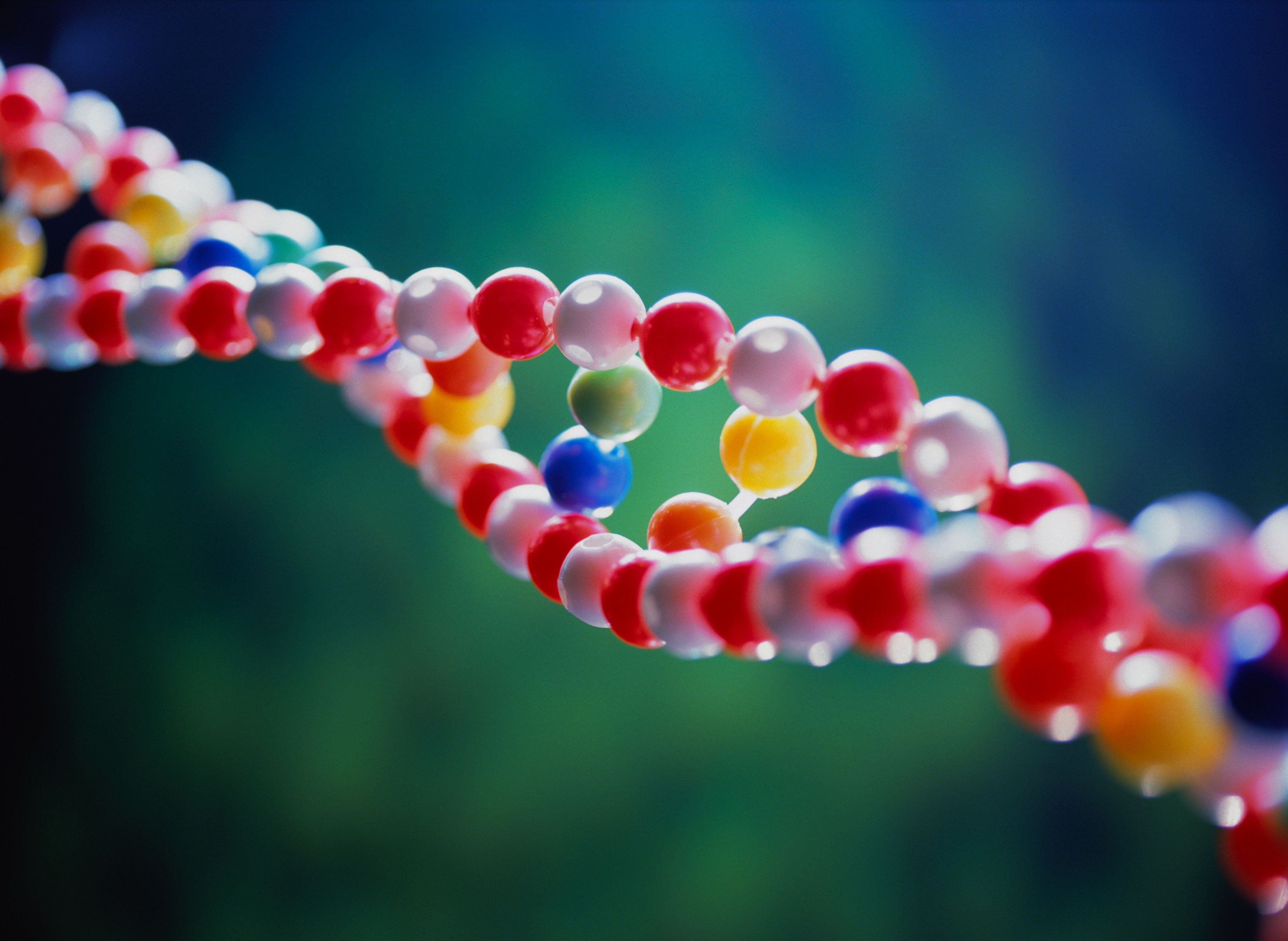
39.
Why is DNA important?
a)
it is very small and very complicated
b)
it's in everything
c)
it serves as the blueprint for traits of all living things
d)
because we eat it every day for energy
40.

What does this image show?

a)

Double helical structure of DNA

b)

Triple Helical Structure of DNA

c)

Singe helical structure of DNA

d)

Double Helical Structure of RNA

41.
What was Watson and Crick's main scientific accomplishment?
a)
Building the first accurate model of DNA
b)
Isolating strains of pneumonia causing bacteria
c)
Determining base pairing rules
d)
Discovering the process of genetic transformation
42.

This picture is illustrating the ____ nature of DNA.

a)

anti-parallel

b)

deoxyribosic

c)

helical

d)

radioactive

43.

Which sequence of RNA bases would pair with this partial strand of DNA?

ATG TGA CAG

a)

AUG UGA CAG

b)

UAC ACU GUC

c)

GTA AGT GAC

d)

TAC ACT GTC

44.

Which bases are purines?

a)

A & T

b)

C & G

c)

A & G

d)

C & T

45.

In DNA, which bases are pyrimidines?

a)

A & T

b)

C & G

c)

A & G

d)

C & T
