
Font size
 Worksheets
Interpolation
Total questions: 32
Worksheet time: 1hrs 27mins

Estimate f(1.5) using Lagrange interpolation.
−0.8673
-0.7214
−0.9773
-0.9113
Find f(2) for the data f(0) = 1, f(1) = 3 and f(3) = 55 using Newton's divided difference formula.
25
21
23
32

Find f(0.25) using Newton's divided difference formula
3.826
3.2567
3.2113
3.912
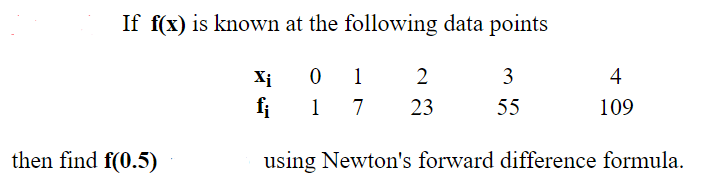
3.125
3.327
3.542
3.837
The methods to find the polynomials approximation are ..
Lagrange interpolation
Newton's Divided Difference
Natural Cubic Spline
Clamped Cubic Spline
f(x)-f(x-h)=
Δf(x)
∇f(x)
E(x)
none
Backward difference operator pronounced as
delta
lamda
nabla
alpha
Δ2y0=
Δy1−Δy0
Δy0−Δy1
Δ2y1−Δ2y0
Δy1+Δy0
∆2x=…………….
2(x+h)-2x
2(x+h)
2(x-h)-2x
2(x-h)


What is the approximate volume of 300 g according to the graph above?
200 mL
250 mL
300 mL
350 mL

A student used the graph below to determine that the maximum heart rate of a person should be 45 beats per minute when a person is 80 years old. Was this point determined by extrapolation or interpolation?
extrapolation
interpolation

1+x+x2+x3+...
ex
sinx
cosx
1−x1
1+x+2!x2+3!x3+...
ex
sinx
cosx
1−x1
Given dxdy=1−y, y(0)=0 using a step size of h=0.1 , the value of y(0.2) using Euler’s method is most nearly
0.1
0.119
0.19
0.01
Which of the following are single step techniques?
Taylor's
Euler's
RK Mehod
Milne's
Modified Euler's method gives more _______results
accurate
moderate
inconclusive
none
The error in Taylors series is given by
n!hnfn(θ)
nhnfn(θ)
n!hnf′(θ)
n!hnf"(θ)
dxdy=x−y and f(3)=1 Use Euler’s method with two steps of equal size to approximate f(6)
dxdy=2x+y and y(1)=k Using Euler’s method, starting at x=1 with a step-size of 0.5, gives the approximation y(1.5)≈4 . Find k.
dxdy=x−2y+2 and f(0)=2 Use Euler’s method with two steps of equal size to approximate f(2.4)
dxdy=2x−2y+3 and y(3)=k Using Euler’s method, starting at x=3 with a step-size of 1, gives the approximation y(4)≈−6 Find k.
dxdy=x+y+1 and f(2)=−1 Use Euler’s method with two steps of equal size to approximate f(2.6)
dxdy=3x−2y and y(0)=k Using Euler’s method, starting at x=0 with a step-size of 1, gives the approximation y(2)≈4.5 Find k.
dxdy=x−y−2 and f(−1)=3 Use Euler’s method with three steps of equal size to approximate f(2) .
dxdy=x+2y−1 and y(−1)=k Using Euler’s method, starting at x=−1 with a step-size of 1, gives the approximation y(1)≈11
dxdy=x+y and f(1)=2 Use Euler’s method with two steps of equal size to approximate f(3)
dxdy=3x+2y+1 and y(0)=k Using Euler’s method, starting at x=0 with a step-size of 2, gives the approximation y(2)≈1

